






Today, we live in the age of zero-click searches. When your content appears in AI Overviews and AI-powered search engine results, people are more likely to trust the information. According to a 2026 study by Search Engine Land, 37% of consumers start online searches with AI instead of Google. One single piece of negative content appearing on AI search results can severely damage an individual’s or a business’s online reputation. But here comes the rescue – AI search engine suppression.
Suppressing negative content on AI search results allows you to control what appears in AI summaries when someone asks queries related to you or your business to AI tools. Gone are the days when traditional SEO techniques like implementing keywords in your content and hoping for the best for your business to rank on search engine results pages.
Dominating the AI search results with positive content requires you to follow a strategic and brilliant approach. Explore our blog to know the 10 best tips and tricks to suppress negative content and claim absolute authority in generative AI results.
What Is Search Suppression in AI Results?
This refers to a strategic practice of creating and optimising high-quality, positive, authoritative content to push down negative content links in the search results of AI-powered search engines such as ChatGPT, Gemini, Perplexity AI, and the like.
What is the aim? The primary goal of AI search engine suppression is to algorithmically outcompete negative links with positive ones so that they move down from the first page of AI search results or are less likely to be cited by AI models.
Why Search Suppression Matters in AI Results: Top 5 Reasons
If you think suppressing negative results from AI search engines is not mandatory, and if traditional search engines are showing positive results when someone searches for your name or your brand name, you are making a big mistake!
Just like traditional negative link suppression, AI search result suppression is also essential. As we mentioned earlier, most modern browsers prefer to perform online searches through AI-powered search engines to get curated and personalised search-result summaries. So what these AI search engines show about you or your business plays a crucial role in building your online reputation.
If there are negative AI results, you must consider implementing effective strategies to push down those and rank positive content about you. Here we have mentioned 5 major reasons why AI search engine suppression is important:
- Brand Trust and Revenue Protection
When AI search engines show negative summaries when someone searches for you or your brand, it can damage your corporate and brand credibility instantly. It can even erode your potential customers’ trust as they may choose your competitors after coming across negative AI search results about you.
Similarly, inaccurate financial projections can directly harm your brand’s stock values. AI summaries often showcase biased product comparisons that can lead to a brand’s immediate revenue drops.
- Personal Reputation Protection
Artificial intelligence can have algorithmic hallucinations that often falsely link individuals to malicious practices. If your prospects come across AI results involving such false reports, it is more likely to leave a negative first impression on them. Additionally, the internet is flooded with AI-generated spam, low-quality content, and harmful misinformation.
Such defamatory AI outputs spread quickly online without source verification and build a negative online perspective. It can significantly impact the hiring opportunities and career growth of individuals. Thus, AI search engine suppression filters out untrustworthy sources and unverified information and prevents them from appearing in AI results.
- Increased Influence of AI-generated Summaries
According to a 2025 study by Menlo Ventures, nearly 1.7-1.8 billion people have used AI tools, and 500-600 million are engaging with them daily. This statistic shows that a majority of users rely on AI answers; thus, suppressing negative AI results can positively influence AI-generated summaries.
As chatbots synthesise multiple sources into one authoritative voice, the first page of AI results reflects public perception entirely. When you remove or push down negative AI results, it will increase the influence of AI-generated summaries on the users browsing it.
- Elimination of Downstream Clicks
AI search engines extract information from valuable web content and showcase their summaries directly on the search page. This prevents users from clicking through the source site link. It creates a ‘zero-click’ environment for the user, as suppressing negative AI results largely eliminates downstream clicks. It eliminates the vital traffic and ad monetisation from such negative content and its sites.
- Algorithm Bias Combating
Search algorithms mostly replicate human biases present in training data. AI search engine suppression serves as a correction tool to push down harmful, biased, and discriminatory content. Negative AI result suppression buries biased viewpoints and offensive stereotypes. Additionally, the process also removes toxic, sexist, and racist training data.
It ensures fair representation of minority viewpoints and delivers neutral, safe, and equitable search results to a diverse user base.
6 Common Reasons Negative Content Appears in AI Results
Do you know why negative content appears in AI results?
If not, let us tell you that you must have a clear idea of the major reasons why negative content may appear in AI search results. Identifying these reasons can help you prevent negative content from appearing in AI results or tailor your search engine suppression strategies to boost your efforts.
But if they still do, you can scroll through our blog to learn the best tips to suppress negative AI search results. Now, let’s talk about the most common reasons why negative content tends to appear on AI search results:
- Outdated News Articles – AI-generated engines are more likely to scan legacy content and present their summaries in their results. These AI search engines often present old controversies and past financial issues as current facts and figures.
- Negative Reviews and Complaints – Your dissatisfied users are more likely to share highly detailed reviews with poor ratings. AI search engines prefer to rank such content over brief posts, as they consider the detailed complaints to be specific, ‘useful’ evidence for the users.
- Weak or Absent Negative Prompting – When the user provides prompts without clear instructions, it is more likely for the AI search engines to show negative results. Weak or absent negative prompting fails to filter out clickbait or toxic language, and AI engines default to summarising all the available sources, including the negative links, rumours, and speculative posts.
- Inaccurate Information Across Websites – Large Language Models rely mainly on multiple indexed websites. If inaccurate information or misconceptions regarding your brand or personal identity are present across the internet, AI models tend to consider it as a widespread consensus and showcase those negative links.
- Low-Quality or Duplicate Content – AI systems often showcase content farms and mass-produced AI text in their results. This is mostly because AI systems pull generalised content to fill topical gaps. For pushing down such duplicate content in AI search results, AI search engine suppression is essential.
- Algorithmic Hallucinations – AI generative engines often summarise factually incorrect claims or misattribute references because of their internal algorithms. When they lack verified data, they tend to showcase these inaccurate claims.
10 Best Negative AI Search Result Suppression Tips You Must Know
Now that you know why AI engine search suppression is crucial for your online reputation and why negative search results can appear in AI search results, it’s time to talk about how you can suppress these unfavourable AI summaries.
Apart from the strategies, some tips and tricks can increase the chances of a successful negative AI search engine suppression. The following are the 10 most helpful tips for individuals and businesses struggling with negative AI search results about them and major reputational damage. Let’s have a look:
Tip 1: Create High-Authority Content Consistently

High-quality, positive, and authoritative content can showcase your online presence as a knowledgeable resource in the niche market. Here’s how you can create consistent high-authority content to rank for those on AI search results.
- Publish Valuable and Relevant Content Regularly
Maintaining content posting consistency is as important as creating good-quality, educational, and engaging content. You must keep updating your owned platforms to signal to AI search algorithms that your or your brand’s presence is active and authoritative.
- Focus on Highlighting Your Expertise and Credibility
While creating content, individuals and brands must prioritise highlighting their professional expertise. They can also share actual results that their customers or audience have achieved through their offerings. Post case studies as AI search algorithms majorly favour such content when extracting summaries. Content that talks about your expertise and brand credibility boosts your AI search engine suppression efforts.
- Build Content around User Intent
Before creating any content to rank on AI, you need to understand the user query intent first. When you have a clear idea of what the users are actually looking for, you can make a list of intent keywords to target for your content. Targeting user intent keywords can help you to engage with the right audience who are actively looking for those answers through AI tools and rank your content on AI summaries.
- 5 Major Types of Content You Must Create
Let’s have a look at the major types of content you must create to rank on AI search summaries:
| Content Name | What to Create? |
| Blog Posts | You need to write educational and SEO-optimized blogs on multiple trending topics. Research relevant keywords and strategically implement them on your blogs to rank them on AI summaries. |
| Industry Reports | You can share definitive and data-backed insights regarding your business or professional experience. |
| Case Studies | The projects you have handled for your clients and the benefits they have received are one of the most important details your prospects may want to know about. You can share case studies with real-time facts and figures to provide trustworthy details about client successes. |
| Expert Articles | We suggest that you write thought leadership pieces for industry journals and expert articles to position yourself and your business as an authoritative source in the market. |
| Whitepapers | Individuals and businesses can also offer deep and research-heavy resources through whitepapers to rank on AI search engine summaries. |
Tip 2: Optimise Your Content for AI Search and Semantic SEO
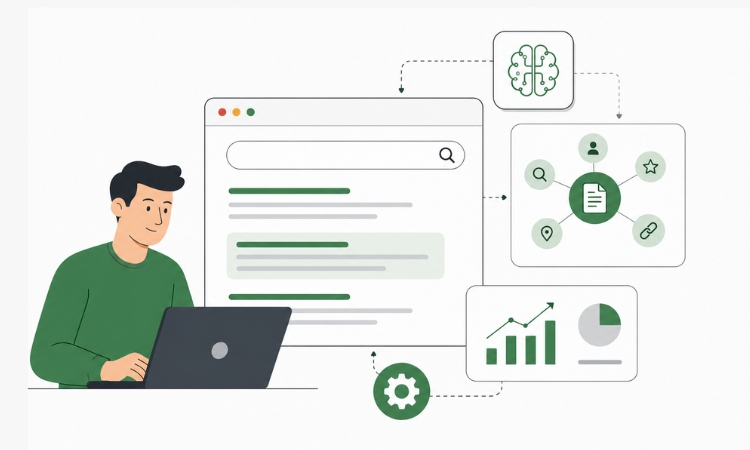
In recent years, the importance of AI-powered chatbots in online reputation management has increased. Thus, optimising your content for ranking on search engine results pages is not enough to build and maintain a robust digital image. This is not at all enough to attract the AI users actively searching for something related to your personal and professional expertise and offerings.
Thus, optimising your content for AI search and implementing it for semantic SEO is crucial for negative AI search engine suppression.
Don’t know what semantic SEO is? Let’s have a look!
Semantic SEO refers to the practice of optimising the web content to rank for a broader topic, context, and user intent rather than implementing exact-match keywords. This practice makes content highly relevant for both human readers and AI-powered search engines.
Let’s see how you can optimise content for AI and semantic SEO:
- Use Topic Clusters instead of Isolated Keywords – Firstly, you need to group content around broader topics. Avoid stuffing your content with isolated keywords to build comprehensive knowledge bases.
- Include Related Terms and Contextual Language – Search for the trending keywords used by your prospects on AI-powered search engines. Implement those in your content to make it rank on AI tools for semantic keywords and related terms to help AI crawlers understand the specific content.
- Structure Content for AI Readability – You can organise your website pages using clear hierarchical headings to make AI search engines easily crawl through your content and rank it in their results. However, structuring content with headings is not enough to make an AI-powered search engine understand and trust a webpage or site, as generative AI scrapers rely mainly on structured data and schema markup.
Tip 3: Strengthen Your Website’s Authority

Your website’s authority strictly determines your position in AI search results. A robust website with smooth user navigation and fast page loading has a higher chance of appearing in AI-based search results for user queries. It helps you ensure the success of your AI search engine suppression efforts.
- Improve Your Site’s Domain Authority – Firstly, you need to earn organic traffic for your website and keep your visitors engaged for a long time on your site. This practice signals your site’s authority to major search engines like Google. AI tools are more likely to prefer to extract summaries from authoritative site content.
- Build Quality Backlinks – Do you know that websites with qualified backlinks earn 3.8X more organic traffic for pages than websites without backlinks? Partner with authoritative businesses, media personnel, and industry leaders to earn brand mentions through their content.
- Maintain Consistent Branding Signals – Always ensure that your brand messaging is identical across all your online platforms. Your personal and professional identity must be consistent across all digital directories, such as Google Business Profile, review profiles, and other industry-specific directories
- Include Trust Signals, Author Pages, and Business Credentials – You must prominently feature author pages and business credentials on your site to build robust credibility. This specifically encourages your prospects to trust your expertise and offerings.
Tip 4: Publish Positive Digital Assets

How you present your digital assets across online platforms plays a major role in determining whether AI-powered search engines will feature summaries from your assets. This is mostly because generative engine models prioritise extracting content from websites based on frequency, source domain authority, and structured data.
Here are some of the most popular positive digital assets to dilute the prominence of negative mentions across popular platforms. Explore the list to know how you can leverage these digital assets to ensure the success of AI search engine suppression.
- Business Websites – Firstly, launch your website, as it serves as the digital storefront of your business. The website should be fully mobile-optimised and user-friendly. Optimise the dedicated domains, specifically those that feature FAQ Schema, to provide the AI models with direct, factual, and relevant information for the users to read and cite.
- Medium Articles – You can use this platform to publish your educational, thought-leadership articles. Don’t forget to use the canonical tags that point back to your main website. It’s the best practice to maximise the search value.
- LinkedIn Content – You can encourage your company executives and important team members to post their personalised and POV (point of view) content on LinkedIn. Brands and professionals can engage in industry conversations to build E-E-A-T signals across their online presence.
- Press Releases – These are the best type of content to reach a broader audience through earning positive media coverage. Create and distribute verified and important announcements to establish credible citations and third-party validation across high-tier news domains.
- Guest Blogs – Effective guest blogging strategies help individuals and businesses contribute expert-level posts to authoritative and reputable industry online sources. This also provides you with the opportunities to build the authoritative backlinks required to push down the negative AI search results.
- Industry Directories – You must claim and optimise your professional and business profiles on industry-specific directories like Trustpilot, Yelp, TripAdvisor, G2, and other niche B2B directories. Update your information across these directories to reinforce your professional footprint across the virtual world.
Tip 5: Monitor AI Search Mentions Regularly

People are regularly mentioning your name or your brand name in their queries to AI-powered search engines. This is one of the best practices of AI search engine suppression.
But do you have a clear idea of the nature of those AI search mentions? Are they mentioning your name for positive queries? Or not?
AI-powered systems scrape real-time and historical web data, which means the narrative of AI users regarding you can shift unpredictably at any time. Regularly tracking your AI search mentions is important to understand your users’ sentiment and perception regarding your personal and professional identity. It will serve as an early reputation defence.
- Track How AI Platforms Display Information
No matter how much high-quality content you are creating and publishing, how AI search engines display the content is crucial. To know this, you need to query AI search engines like ChatGPT and Perplexity to track the summaries they generate about you or your brand when users search for something relevant or the exact keyword.
- Monitor Changes in AI Summaries
Clearly monitor the AI summaries to document whether the summaries of the AI-powered search engines are citing negative reviews, unfavourable forum threads, and competitor claims. This can help you identify any negative or positive changes in the AI summaries.
- Identify Emerging Reputation Risks
When you identify negative changes in AI summaries related to you or your brand, it helps you identify the emerging reputation risks. For this, you need to track whether there are any outdated news sites or negative third-party complaints appearing in the AI search results. If there is any, you can develop specific counter content to outrank the negative AI search results.
- KPIs to Track –
Below are some key performance indicators you must track to strategically monitor AI search mentions and measure your AI search engine suppression success.
- Brand Mentions – The total volume and sentiment of mentions of your personal identity and brand name across major AI search engines
- Individual Names – The visibility for your company’s key executives and professionals, such as their name mentions across the online platforms
- Products and Services – AI summaries involving content regarding your product/service quality, pricing, or comparisons against your competitors
- Executive Profiles – How AI search engines and other AI tools view your leadership team by reviewing the sentiment and presence of your executive profiles on networking platforms like LinkedIn
Tip 6: Manage Customer Reviews like a Pro

You need to encourage positive reviews from your satisfied clients. Because positive reviews are one of the most important and reliable forms of user-generated content that can neutralise the visibility of unfavourable summaries on AI search results.
Strategic customer review management majorly contributes to showcasing positive results across AI search engines. Let’s have a look at how individuals and businesses can implement effective review management strategies.
- Encourage Positive Reviews
Firstly, request your satisfied customers to share their experience with your company, its products and services. Prompt them to share their valuable reviews through email, SMS, and QR codes just after a successful delivery of services/products. When you receive high ratings and glowing reviews consistently, it signals your expertise’s trustworthiness to AI search engine algorithms.
- Respond to Negative Feedback Professionally
To ensure AI search engine suppression of negative customer feedback, you need to address all the complaints immediately after receiving them. This will influence the dissatisfied customers to take down or update their negative reviews with positive comments after receiving the resolutions.
- Build Authentic Customer Engagement
Respond to every review you receive, no matter whether they are positive, negative, or neutral. Address all of them swiftly and offer them suitable solutions. Inform the reviewers regarding the steps you’re taking to provide them with a resolution at the earliest. Communicating through review responses encourages genuine customer engagement.
Tip 7: Use Strategic Press and Media Coverage

Earning positive media coverage helps individuals and businesses establish entity authority across the digital world. When AI systems or search engines evaluate your brand or your personal identity, they are more likely to rely on showcasing data from reputable and third-party publications.
Below are some ways you can leverage press and media coverage for AI search engine suppression:
- Build Positive Media Visibility – You can partner with prominent media personalities and journalists to pitch your original insights, quotes, and case studies. When high-authority media domains share this content, they are more likely to dominate the negative AI search results.
- Work with Reputable Publishers – Always choose collaborating with reputable media publishers to secure positive features in their publications. This will help you earn brand mentions and qualified backlinks on authoritative industry sites. This will significantly push down the negative links and content in AI search results.
- Share Expert Opinions and Insights – Always highlight the opinions shared by your company leaders and executives in your guest blogs. You can also participate in expert roundups to showcase your authority.
- Organise Interviews and Industry Publications – You can schedule interviews and podcasts with industry leaders to share with prominent media professionals and reporters so that the content can get valuable media coverage. You can also transcribe them to implement relevant keywords and bury the negative AI search results.
Tip 8: Remove or Correct Incorrect Information

Found any incorrect information about you while tracking the AI search results?
If yes, you must prioritise AI search engine suppression. But do you know that you can remove those negative AI results as well?
It’s possible to remove or update those details to prevent them from spreading further and causing more reputational damage. Inaccurate content may spread like wildfire if not addressed at the correct time.
- 4 Key Steps to Remove or Update Inaccurate Information across AI Search Results
Here is a list of steps you need to remove or correct inaccurate AI search results:
Step 1: You need to find the contact details of the owners of the site that has posted inaccurate content regarding your personal or professional identity. Navigate to the site and extract the information from their ‘Contact Us’ or ‘About Us’ page. Reach out to the administrator to request the content removal or the addition of a no-index tag.
Step 2: You can send a formal email to the publisher to request the removal or update of the outdated or inaccurate information. You can also share the correct details, facts, and figures via email.
Step 3: If the content includes inaccurate business listings, you must correct them with accurate details. You need to ensure that all the local directories contain correct business listings. You can update your online profiles on popular networks like Google Business Profile
Step 4: You can use helpful tools like Google’s Outdated Content Removal tool page to flag or report this inaccurate content or contact info for deindexing.
Step 5: You can also prioritise seeking professional online content removal services to permanently remove negative content from AI search results. Such personalised services will help you take down the specific negative search results from AI-powered tools.
Tip 9: Build Strong Social Media Authority

How your online authority is appearing across social media profiles is important for AI search engine suppression and a strong digital authority building. Here’s how you can do it:
- Maintain Active Profiles across Multiple Platforms
As AI search engines largely prioritize high-authority and active social media profiles, maintaining a consistent presence with regular posts and engaging communication on social media is important. To ensure the success of the AI engine search suppression, you need to claim your professional or business profiles on major platforms like Facebook, Instagram, X, and YouTube.
- Post Useful Content Consistently
Maintain consistency in publishing value-driven and engaging content across all your social media profiles. From short-form videos and professional documentation to industry insights and thought leadership pieces, individuals and businesses must highlight expertise and build customer trust.
- Increase Engagement Signals
Encourage interactions with your followers through your social media comments, posts, DMs, and reviews. You can encourage your followers and customers to like, share, comment, and view, as all these interactions boost the likelihood of ranking your social media profiles in AI search results.
Tip 10: Use AI-Powered Reputation Management Tools
The process of AI search engine suppression may seem tricky to you. Employing helpful AI-powered tools can help you simplify the process and actively suppress negative links from AI search results.
Explore the list of the 5 best AI-powered reputation management tools and choose what suits your needs for AI search result suppression:
| Tools Name | Features to Use |
| Birdeye | Ideal for enterprise multi-location businesses Offers AI-driven search monitoring that tracks how frequently and where AI search engines mention your name or your business name |
| Spriinklr | Ideal for large enterprises with high-volume social needsProvides early warnings on negative sentiment surgesRanks positive brand signals across more than 30 digital channels |
| Reputation.com | Offers an AI reputation manager that lets users ask AI-specific questions about their own brand to see how exactly the AI search engines assess their businesses Allows the users to directly control the AI-driven recommendations |
| Podium | Best for local and service-oriented SMBs Automates SMS-based review requests to quickly push down positive feedback |
| Yext | Excels in local SEO and directory listings Keeps your business information, operational hours, and data consistent across hundreds of maps and websites Ideal for making your content visible on AI search results |
5 Common Mistakes to Avoid in AI Search Suppression
This is not about suppressing negative links from search results using SEO techniques like positive content creation and strategic distribution. Pushing down negative AI search results is a critical task and requires you to follow a strategic approach.
It is a gradual process, and it takes time to showcase your desired results.
Making certain mistakes can ruin your AI search engine suppression and even slow down the time to showcase your desired results.
Mistake 1: Using Spam Techniques
Many individuals and businesses rely solely on automated AI content generation. On the other hand, many prioritise black-hat tactics when they fail to suppress negative links in AI search results. Using such spam techniques can trigger penalties from the AI generative search engine’s helpful content system and even from AI search results.
What to do? You need to maintain a strict editorial process for all your content. You can combine the efficiency of artificial intelligence with human expertise, unique and factual data, and personal experiences.
Mistake 2: Publishing Thin Content
Do you post short, generic, and copied content online? If yes, you’re hugely failing to provide in-depth value and to completely answer a user’s AI prompt. As this thin content cannot add any value to the users’ queries, it may not help you as well to outrank or suppress the negative links in AI search results.
What to do? While creating high-quality content, you need to focus on providing as much information as you can. Ensure you provide proprietary data, detailed case studies, and specific examples through your content so that AI models are eager to cite your website or content as a credible and knowledgeable resource.
Mistake 3: Ignoring AI Search Trends
What most users are searching for relevant to your name or your brand using AI generative search engines is crucial to AI search engine suppression success. Many brands or individuals ignore AI search trends and assume users are still searching with short, generic keyword strings. This is a huge mistake that can ruin your AI search result suppression efforts.
What to do? You must optimise content to make it appear to answer conversational and multi-part online questions. Additionally, you can use a clear Q&A and FAQ format and check if your content suits Large Language Models to see if it generates AI citations.
Mistake 4: Stuffing Keywords in Content
If you push exact-match phrases into your copy forcefully, you are making a huge mistake. Many individuals and businesses stuff keywords in their content to make them appear in AI searches. This way, you cannot manipulate search engine results and rank that content higher to push down the negative AI results. Forcefully stuffing keywords can ruin your AI search engine suppression efforts.
What to do? You need to naturally implement relevant keywords in your content to rank it higher on AI search engine results. Always use headings throughout the content to naturally answer common questions. While creating content, you need to focus on the logical flow of keywords instead of measuring the keyword density of your content.
Mistake 5: Focusing Only on Traditional Search Suppression
Yes, we know that search suppression techniques using SEO are an age-old, effective technique to rank content on SERPs. But you cannot solely rely on traditional techniques to push down negative AI search results. If you’re doing so, let us tell you that it’s a big mistake! Relying on traditional keyword rankings and ignoring structural optimisation, verifiable brand authority (E-E-A-T), and schema markup can prevent you from getting the opportunities to bury negative AI search results.
What to do? We suggest that you implement clear page structuring, proper schema markup, and verifiable author credentials. So that AI generative engines can easily trust your site and extract information from your content to showcase it in their results.
FAQs
The following are frequently asked questions and answers related to AI search engine suppression:
Ans. No, you cannot directly ask Google to delete negative citations or links from AI Overviews. Because search engines like Google don’t act as editors for AI results, the AI generates responses or summaries by scanning the internet and showcases relevant results to the user’s queries. You can implement effective suppression techniques to push down the negative AI citation links on search results.
Ans. When you add explicit FAQ sections with structured data, it helps search engines clearly understand your business and its parameters. For example, a specific website provides clear, machine-readable answers to common questions of the general public. AI models use these details to confidently recommend your business or you as a professional and cite your pages over unverified third-party criticism.
Ans. While traditional suppression typically focuses on burying a specific web page in search results and moving it to the second or third page of search results using SEO techniques, AI search suppression specifically focuses on training the artificial intelligence’s ‘Entity Model’. The latter requires authoritative and third-party validation and machine-readable transparency rather than just targeting relevant keywords and organic clicks.
Ans. While traditional suppression typically focuses on burying a specific web page in search results and moving it to the second or third page of search results using SEO techniques, AI search suppression specifically focuses on training the artificial intelligence’s ‘Entity Model’. The latter requires authoritative and third-party validation and machine-readable transparency rather than just targeting relevant keywords and organic clicks.
Ans. No, absolutely not! Directly removing negative links from AI Overviews is usually impossible unless the content completely violates the platform’s terms of service or you qualify for legal de-indexing. Apart from these, answer engine optimization (AEO) and AI search engine suppression are the two most effective approaches to push down negative links from AI Overviews.
Conclusion
Putting all your efforts into offering the best possible services to your customers, but prospects are still coming across negative search results while searching for your name on AI tools? We know that it’s quite embarrassing! Negative AI search results can significantly impact your personal and professional reputation.
From leaving a negative first impression to hindering your professional opportunities, negative search results on AI can cause severe reputational risks. But a strategic approach and effective AI search engine suppression strategies can help you prevent those unwanted negative results in AI searches and optimise your owned digital assets.
We hope that our tips and tricks will help you successfully remove or push down negative results on AI-powered search engines and protect your reputation. Does the negative AI result removal process feel complex? Consider hiring a reliable online reputation management agency.

