






In recent years, generative engine optimisation has completely transformed how search engine algorithms work. It has emerged as the frontline of a business’s digital perception. As more people are turning to AI platforms or generative search engines to research brands, it has become more crucial to build a stellar reputation across these generative search engine results. However, implementing only the generative engine optimisation strategy for reputation building is not enough. You need to prioritise measuring the success of your GEO reputation management strategies.
According to a 2026 study by the Pew Research Centre, about half of US adults (49%) now use AI chatbots or generative search engines, while 45% of US adults have asked an AI tool for a local business recommendation.
But how do you actually know whether your GEO reputation management efforts are working? Don’t worry! We’ve come to your rescue! Explore our blog to learn the 9 most effective ways to strategically measure GEO reputation management success.
What Is GEO Reputation Management?
It refers to the practice of shaping how generative search engines describe and recommend your business. You can manage your brand’s GEO reputation by optimising structured and trustworthy content and sharing it across the web.
Unlike traditional SEO, GEO reputation management strategies are designed to ensure generative search engines like ChatGPT, Gemini, Perplexity, and Claude accurately recommend your brand in their direct answers.
Why Does Measuring GEO Reputation Management Matter?
Now you must be wondering why it’s important to measure your GEO reputation management efforts when you’re already implementing the strategies. The role of AI in reputation is crucial, as a majority of users are more likely to use generative search engines to learn more about your brand rather than using traditional search engines like Google.
But measuring your GEO performance is important! It provides you with an extensive list of benefits. Here’s why it matters.
1. Shifting from Clicks to Synthesised Answers
Traditional SEO metrics like your webpage rankings and keyword clicks don’t show how large language models (LLMs) display your brand within GEO search summaries and chat responses. You can assess whether the generative search engines are positively recommending your business and providing accurate answers after you implement your GEO reputation management strategies.
2. Controlling the Narrative
Implementing a robust generative engine optimisation strategy is not enough! Tracking changes in sentiment is important, which can only be possible by effectively measuring your GEO reputation management performance. By measuring your GEO success, you can control the AI narrative about your brand – preventing generative search engines from repeating outdated facts, incorrect business details, and negative customer reviews.
3. Managing High-Stakes Due Diligence
In today’s modern landscape, journalists, institutional investors, and high-intent customers prefer to use generative search engines to quickly examine a brand’s credibility. Measuring your GEO reputation management efforts allows you to track these AI outputs. It helps you validate your expertise and protect your customer trust.
4. Allows Proactive Crisis Control
Monitoring your GEO reputation management lets you identify negative feedback or localised public relations concerns in real-time. When you measure these key performance indicators, it allows you to take necessary precautions before the crisis escalates. If you detect any GEO reputation crisis, you can address it mindfully and resolve the complaints before they damage your brand image.
5. Dominating the Zero-Click Reality
Your customers often get information about your brand using generative search engines even without visiting your website. Traditional traffic dashboards are not capable of showing you whether a generative search engine is praising your business or misrepresenting your expertise in their search result summaries. Measuring the performance of your GEO reputation management strategies helps you dominate the zero-click landscape.
9 Best Ways to Measure GEO Reputation Management Success
Now that you know why you should prioritise measuring your GEO reputation management strategies, it’s time to learn the process.
This is not anything related to a rocket-science! Implementing strategic approaches can help you successfully measure GEO reputation management performance. Measuring your GEO success is one of the most pivotal DIY GEO reputation management strategies. Below, we have talked about the 9 best ways that you can consider to measure your GEO reputation management success.
1. Track Brand Mentions in GEO Search Results

The first way is to track the online mentions of your brand in generative search engine results. This will help you understand how your brand is getting mentioned or recommended by AI platforms as a response to user queries. For this, you need to track the following metrics –
Key Metrics to Track –
- AI Brand Mention Frequency – You need to count how many times a generative search engine references your brand name in its search result summaries.
- Relevant Query Coverage – This requires you to measure the percentage of industry-specific or buyer-intent prompts that can trigger a brand mention.
- Brand Visibility Percentage – You need to calculate the ratio of generative engine responses mentioning your brand versus total category answers.
- Improvement in Mentions after Implementing GEO Strategies – For this, we suggest that you compare the volume and visibility of your brand mentions across GEO search results before and after implementing the GEO optimisation strategies.
2. Measure AI Search Visibility

Now you can track how visible your brand is across GEO or AI search results for specific user queries. The following are key performance indicators you must track while measuring your brand visibility across AI platforms.
Key Metrics to Track –
- Brand Visibility Rate across GEO Results – For this, you need to run a fixed set of 50-200 industry prompts across major generative engine platforms, such as ChatGPT, Perplexity, Gemini, and Claude. If the visibility rate falls below 5% specifically on core brand terms, you need to initiate immediate content tuning to improve the rate.
- Commercial and Information Query Coverage – You can categorise your prompts into different phases to see where and how your AI brand visibility drops.
- Share of AI-generated Mentions – You need to categorise your brand appearances in generative engine outputs related to your top industry competitors. You can monitor the share of those AI-generated mentions based on month-over-month shifts.
- Competitor Visibility across GEO Results – Now you can audit competitor citation frequencies and the featured platforms by using specialised tools. It helps you identify your competitors’ citation gaps.
3. Monitor the Sentiment of AI-Generated Brand Mentions

You have examined the mentions, but are those mentions positive, negative, or neutral?
You must monitor generative engine sentiment regarding your brand by tracking those AI-generated mentions. This is crucial to measure GEO reputation management strategies.
Key Metrics to Track –
- Positive Sentiment Rate – Brands need to measure the shape of generative engine responses involving praise, endorsement, and recommendations.
- Neutral Sentiment Rate – For this, you need to track objective, factual, and cautious descriptions of your brand. Such sentiment often involves no praise or criticism.
- Negative Sentiment Rate – You need to track the GEO sentiment that involves product flaws, security risks, high costs, and negative comparisons of your brand and your market competitors.
- Sentiment Changes over Time – We suggest that brands must follow weekly and monthly shifts in GEO answers. This helps you identify the narrative changes early before they start impacting your brand reputation.
4. Measure the Authority of Online Brand Mention Sources

When optimising your content with GEO reputation management strategies, the quality and authority of where your brand is mentioned is more important than mere volume. Generative search engine models heavily rely on trusted and high-authority sources to extract their answers and recommend your brand.
The following KPIs are important to measure the quality of your online brand mention sources.
Key Metrics to Track –
- Number of Authoritative Mentions – You can track the total number of times niche, established, and highly reliable websites reference your brand.
- Referring Domain Quality – Brands can monitor the Domain Authority (DA) or Domain Rating (DR) of the websites linking to or mentioning your brand. This is important to ensure those websites carry strong search engine trust.
- Industry Publication, Review Platform, and News Outlet Mentions – Now you can track the references that are coming from recognised sector-specific journals, mainstream news outlets, and popular review sites.
- Third-Party Brand References – You can instruct your staff to evaluate the unlinked brand mentions across the internet, as generative search engines use these co-citations to establish entity relationships and establish your brand’s credibility.
5. Track Online Reviews and Reputation Signals

In this part, we will talk about how you can track online reviews and reputation signals across your generative search engine results. This is essential for measuring GEO reputation management strategies and AEO reputation management techniques.
Key Metrics to Track –
- Average Rating – You can measure your overall customer satisfaction. However, you should always aim for a rating between 4.2-4.9 stars. Because a flawless 5.0 rating can sometimes appear manipulated and unreliable to users as well as generative engine algorithms.
- Review volume – You can track the total number of reviews your brand has received across the top review platforms. High volume of reviews reflects your brand credibility, authority, and prominent brand visibility.
- Review Growth Rate – You can monitor how fast you can collect new feedback from your customers. If you can gain 2-3 reviews per week, consider this a natural stream for your business.
- Positive vs. Negative Reviews – We suggest that you need to compare the proportion of n negative and positive reviews. Identifying this can help you detect areas for improvement and customer service bottlenecks.
- Review Sentiment – Try to identify the sentiment or intent of those reviews. Assessing the emotional tone behind the review text can help you identify the underlying customer feelings. Review sentiment analysis is crucial to boost your GEO reputation management strategies.
6. Monitor Brand Sentiment Across the Web
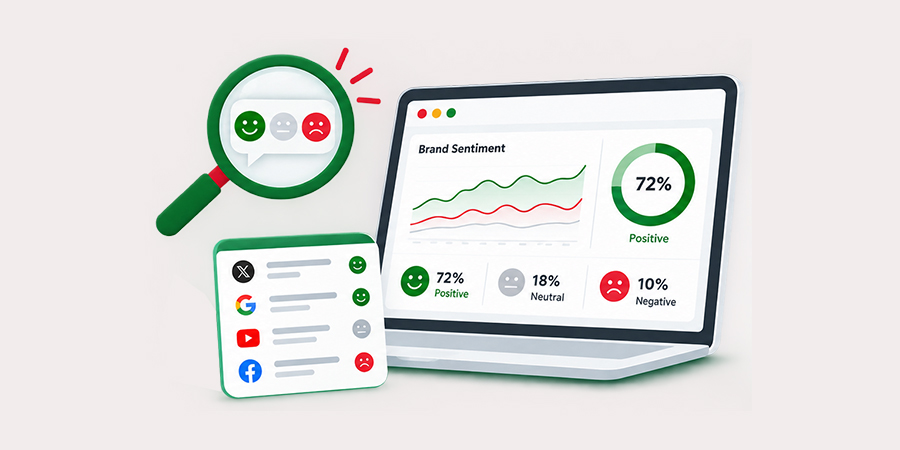
After examining your brand sentiment across the generative engine landscape, it’s time to monitor the same across the entire internet. It’s crucial to know how AI search engines and online platforms perceive and present your brand. The following are some key performance indicators that you can track to monitor your brand sentiment:
Key Metrics to Track –
- Overall Sentiment Score – You need to track the single aggregated rating that reflects the net emotional tone of all the online mentions, reviews, and AI citations.
- Positive Mentions – Now you can track the total volume of positive reviews, favourable media coverage, and supportive social media commentary that highlight your brand strength.
- Negative Mentions – Now it’s time to count the critical feedback, complaints, and damaging press coverage that can ruin AI summaries if you leave them unaddressed.
- Sentiment Ratio – Now you can track the proportional balance between positive and negative conversations. Tracking this ratio can help you normalise raw mention volume against the overall quality.
- Sentiment Trends – Measuring the week-over-week or monthly shifts in your brand perception can help you reveal whether your GEO reputation management strategies are working or a PR crisis is developing.
7. Measure Changes in Branded Search Demand

Your branded search trends are not something consistent. It keeps changing over time – measuring these changes in branded search demand gauges generative engine optimisation strategy. To measure this, you need to track how public awareness and trust translate into direct searches for your brand name.
Key Metrics to Track –
- Branded Search Volume – You can count how many people type your exact brand name into generative search engines every month. While an upward trend means AI mentions and PR efforts successfully drive direct interest, a downward trend can be a sign of a PR crisis.
- Branded Keyword Impressions – This is about monitoring how often your brand name appears on search engine results pages (SERPs). If you detect higher search impressions, it shows increasing brand visibility.
- Branded Organic Traffic – You can measure the exact number of visitors who’re landing on your site through searches that contain your brand name.
- Search Interest Trends – This is regarding evaluating macro-level interest over time, and you can examine it using tools like Google Trends.
8. Track Referral Traffic and Engagement
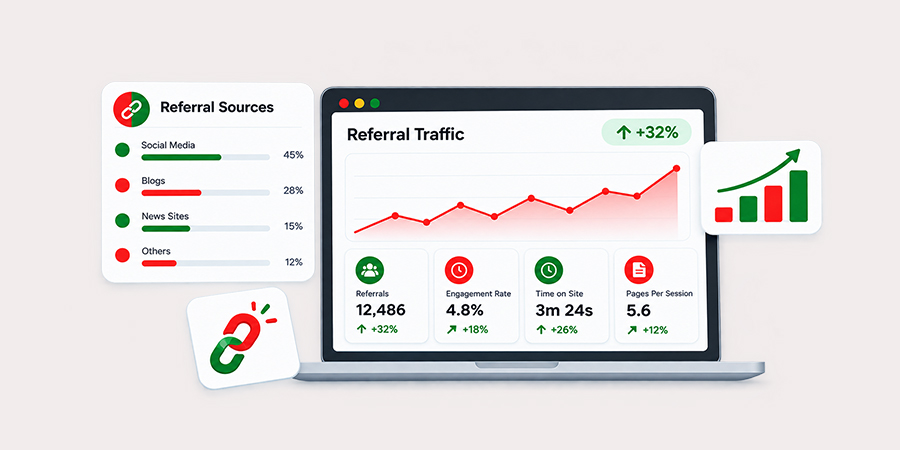
As a crucial part of GEO reputation management strategies, you must measure the referral traffic and engagement from your GEO optimisation strategies. This shows how effectively AI platform mentions turn into website visitors and business outcomes.
Key Metrics to Track –
- Referral Traffic – You need to count the specific sessions that are arriving from generative search engines and LLM citation links by using Google Analytics.
- Engagement Rate – We suggest that you measure the percentage of GEO-referred sessions that have lasted more than 10 seconds or viewed 2 or more pages.
- Time Spent on Site – You need to track the average duration generative search engine users spend reading your content. By measuring the time, you can see whether the time matches the complexity of the users’ query.
- Pages Per Session – You need to monitor how many internal pages a generative search engine-referred visitor explores to evaluate if your website encourages further discovery or not.
- Conversion Rate – Brands must calculate the percentage of AI-referred visitors who complete a high-value action, such as a demo request, form fill, or newsletter sign-up.
9. Measure Leads and Conversions Influenced by GEO
The ultimate analysis of GEO reputation management strategies is their impact on your bottom line – the number of leads you have successfully driven from your GEO reputation management strategy plan. While ranking in generative search engine generated answers is truly valuable, whether your brand visibility drives concrete business actions or not defines your real success.
Below, we have mentioned some key performance indicators you must track to measure your GEO leads and overall GEO reputation management success.
Key Metrics to Track –
- Leads Generated – You need to track the total number of sign-ups, form fills, and inquiries driven from users who have found your brand through generative search engine responses.
- Conversion Rate – Additionally, you need to track the percentage of generative search engine-driven visitors who have now converted into a paying customer.
- Qualified Leads – A brand must track the total volume of leads you have driven from generative engines that meet your specific sales criteria.
- Bookings or Sales – This is about the number of direct purchases, scheduled appointments, and booked demos – you must track all these to identify how many of them are driven from AI users.
A Pro Tip: If you’re still confused about which technique is suitable for your GEO reputation management goals and needs, you can hire professional AI reputation management services from a reputed ORM agency.
How to Create a Measurement Framework for GEO Reputation Management: An Easy 3-Step Guide
Generative engine optimisation has changed how users used to find information online. Thus, it’s crucial to measure GEO reputation management strategies. Till now, we have talked about how you can measure your GEO reputation management success.
Here we have provided you with a three-step guide based on which you can create a solid framework for GEO reputation management. This framework will help you plan a robust strategy to measure, analyse, and optimise your business’s reputation across generative or AI-powered search engines.
Step 1: Define Your Baseline
Firstly, you need to measure your business growth – this requires you to identify where your current brand reputation stands across generative search engines such as ChatGPT, Google Gemini, Perplexity, and the like.
- Perform a thorough audit of your current brand reputation by searching for your brand name, products, services, and other core industry keywords across major generative engines.
- Now you need to note whether the generative search engines or AI platforms recommend your brand, the sentiment they use, or the sources they cite to pull their information.
- This process allows you to spot misinformation, lack of citations, and instances where generative engines are recommending your competitors over your brand.
Step 2: Select the Right KPIs
Now it’s time to select the right key performance indicators (KPIs) to track. If you are choosing the wrong KPIs, your generative engine optimisation efforts will be of no use.
Separate KPIs Divided into Three Categories –
To help you effectively track the performance of your GEO reputation management strategies, we have divided the major KPIs into three different categories. Let’s have a look!
a. Visibility
This category is about effectively measuring how often and how prominently your brand appears in generative search engine results.
- AI mentions – The frequency with which generative search engines showcase your brand name in their search result summaries related to your industry.
- AI search visibility – The percentage of time your brand appears in the top generative engine recommendations for targeted industry keywords
- Branded searches – Whether users are actively searching for your brand name without generative search engines
b. Reputation
This category assesses the quality, sentiment, and authority related to your brand’s AI presence.
- Sentiment – How do generative search engine summaries describe your brand in a positive, negative, or neutral tone?
- Reviews – The aggregate rating and volume of third-party reviews that generative search engines crawl and pull into their answers
- Authoritative mentions – Citations from high-authority industry publications, journals, and news sites that generative search engines use to validate your brand’s credibility
c. Business Impact
To measure GEO reputation management strategies, you need to track the impact of your GEO efforts on your business.
- Website traffic – The volume of referral traffic coming directly from the links and citations within generative search engines
- Leads – The number of prospective customers signing up or inquiring after discovering your brand through generative search engines
- Conversions – The specific actions taken by AI-referred traffic, including the number of downloads, sign-ups, and trial activations
- Revenue – The total dollar value generated from your customers driven from GEO optimisation strategies
Step 3: Monitor Results Consistently
Now, lastly, you need to monitor the results of your GEO reputation management strategies in a consistent manner. Always remember that generative engine optimisation is not a one-time setup, as generative search algorithms constantly evolve.
Regular monitoring helps you refine your generative engine optimisation strategy and ensure driving the highest return on investment.
Top 5 Tools for Measuring GEO Reputation Management Success
Now we hope that you have a clear idea of how you can measure your GEO reputation management strategy plan. You must be wondering if this is a critical process to follow – mostly because you have to track too many key performance indicators (KPIs) when you measure GEO reputation management strategies.
Yes, the process is critical, but not without a strategic approach and the right utilisation of GEO tracking tools. In this section, we have mentioned the top 5 tools that you can employ to successfully track the performance of your generative engine optimisation strategy.
| Tools for Measuring GEO Reputation Management Success | Features You Should Prioritise |
| 1. Profound | ● Ideal for Fortune 500 enterprises and risk governance ● Can track your reputation across ChatGPT, Gemini, Claude, and Google AI Overviews ● Offers prompt-level corporate audit trails and citation analytics |
| 2. GEOReputation | ● Ideal for agencies and multi-location businesses ● Can track your brand reputation across ChatGPT, Perplexity, Gemini, Copilot, Google AIO ● Offers unified portfolio dashboards and allows white-label client reporting |
| 3. Rader Kit AI | ● Ideal for competitor interception and local tracking ● Can track your GEO reputation across Google AIO, ChatGPT, Copilot, Gemini, and Perplexity ● Allows using real localised browser UIs with autonomous outreach |
| 4. Otterly.AI | ● Best for SMBs, agencies, and marketing teams ● Can track your GEO reputation across ChatGPT, Perplexity, Gemini, Copilot, Claude, and Google AIO ● Offers you approachable daily dashboards and technical GEO health audits |
| 5. Semrush AI Toolkit | ● Best for SEO-led teams ● Can track your GEO reputation across Google AIO, Perplexity, and Merges ● Establishes clickstream data with AI visibility scores |
5 Common Mistakes When You Measure GEO Reputation Management Success
Now we will talk about 5 common mistakes you must avoid while measuring the success of your GEO reputation management strategies. Making these mistakes can ruin your GEO reputation management efforts.
Identifying these mistakes can help prevent you from making them.
Mistake 1: Focusing Only on AI Mentions
Do you track only the AI mentions? If yes, you’re making a big mistake. You shouldn’t track how often your brand is cited by large language models like ChatGPT or Gemini, especially without looking at the context. If generative search engines cite your business as a ‘negative resource’, being mentioned across generative search engines is pointless.
Mistake 2: Ignoring Poor AI Sentiment
If you’re happy after seeing only one positive AI recommendation, this is the biggest mistake you’re making right now. You shouldn’t ignore negative AI sentiment, such as ‘Company ABC offers this service, but customers frequently complain about their customer support. This underlying tone or warning that generative search engines attach to your brand shouldn’t be ignored.
Mistake 3: Measuring Only Traffic
If you’re solely relying on traditional click-through traffic to your site to measure GEO reputation management success, it’s a big mistake. To successfully measure the performance of your GEO reputation management strategies, you need to shift your focus to brand lift, direct traffic, and conversions.
Mistake 4: Not Benchmarking Against Competitors
If you’re monitoring your own GEO visibility without benchmarking against competitors in your market, you shouldn’t do it. You must track who else the generative search engines are recommending – are they your direct competitors in your niche market? If a competitor effectively optimises their generative engine optimisation strategy, they’re more likely to displace you from the top three AI recommendations overnight.
Mistake 5: Expecting Immediate Results
Many business owners treat GEO reputation management strategies like paid advertising and expect traffic from their website. They need to understand that GEO optimisation cannot provide them immediate or overnight results. For example, you cannot expect a major spike in your online mentions just a week after implementing a generative engine optimisation strategy.
Conclusion
Nowadays, everyone implements effective reputation management strategies to build a stellar reputation across generative search engines or AI platforms. But most of them often don’t prioritise measuring the performance or success of their GEO reputation management strategies.
To measure GEO reputation management success, you need to follow a strategic approach. We hope that our guide will help you successfully track your generative engine optimisation strategy plan performance.
Still confused? You can consider partnering with a renowned online reputation management agency to seek their expert guidance.
FAQs
The following are some frequently asked questions and answers related to the process of measuring the success of GEO reputation management strategies.
- How is GEO reputation measurement different from AEO reputation measurement?
Ans. The difference between generative reputation management and AEO reputation management is about the scope and tracking environments. While answer engine optimisation allows measuring the accuracy and visibility of isolated and direct factual answers, GEO optimisation strategies measure your brand’s authority, credibility, and overall representation within multi-source AI-synthesized responses.
- Why is AI sentiment tracking crucial in GEO reputation management?
Ans. AI sentiment tracking is a crucial generative engine optimisation strategy, as AI platforms or generative search engines synthesise fragmented internet chatter into a single and definitive summary. This largely shapes your customer trust even before a user visits a brand’s website.
- Can we track zero-click impact from AI visibility?
Ans. Yes, you can track zero-click impact from AI visibility by shifting your focus from traditional traffic metrics to monitoring brand mentions. You need to track citation shares and a CRM-focused customer journey as well.
- How often should a GEO reputation management performance audit be run?
Ans. We suggest that you run a full GEO reputation and visibility audit every six months. However, you can also consider quarterly checks and monthly tracking apart from half-yearly audits.
- How can we measure business revenue from GEO?
Ans. Measuring the success of your GEO reputation management strategies is crucial. You can measure the revenue from GEO optimisation strategies by optimising your brand to be cited and recommended by AI search tools, including ChatGPT, Perplexity, and Gemini.

