





In today’s digital world, your e-commerce business’s online review profile is your biggest marketing asset. No matter whether it’s a 5-star review for a hot-selling product or a one-star criticism about the delivery delay, this user-generated content is the ultimate deciding factor for building your e-commerce reputation. Thus, effective e-commerce review management can help you to generate more glowing reviews and leverage them to turn your satisfied customers into loyal brand advocates.
A 2026 BrightLocal study has claimed that 97% of consumers heavily rely on online reviews to guide their purchase decisions. From driving search engine rankings to attract new prospects, a strategic approach to customer review management transforms an e-commerce business in many ways.
Wondering how you can ace the e-commerce customer review game? No worries! In this blog, we will provide you with a complete guide to online review management for e-commerce brands, along with its benefits, mistakes you should avoid, and beyond. Let’s get started!
What Is E-commerce Review Management?
It refers to a strategic process of generating, responding to, managing, and monitoring customer feedback for an e-commerce brand. Through this proactive approach, an e-commerce business can transform user-generated feedback into strategic marketing assets to boost potential buyers’ trust, improve online search visibility, and drive sales for the e-commerce business.
This strategy revolves around four main pillars:
- Collecting reviews from customers through email, SMS, or WhatsApp after the successful product delivery.
- Addressing feedback by professionally and timely responding to these positive, negative, and neutral reviews.
- Monitoring the online ratings and comments across the ecommerce storefront and third-party platforms like Google, Trustpilot, and Amazon.
- Examining the customer sentiment and feedback trends to identify product issues and improve the user experience.
8 Key Reasons Why E-commerce Businesses Must Prioritize Review Management
Now we will talk about how proactive online review management can completely transform an e-commerce brand’s online presence as well as its digital reputation.
Let’s have a look at the list of benefits that online customer review management can bring to ecommerce businesses:
- Builds Instant Customer Trust
Many consumers often visit ecommerce sites just to browse products; most of them have no prior relationship with the brand. Review management allows ecommerce businesses to generate positive and authentic reviews that serve as social proof. These reviews assure the shoppers that your ecommerce brand is legitimate and responsive, delivering what they promise.
- Strengthens Customer Relationships
When you engage with both positive and negative reviews, it builds an interpersonal relationship between your ecommerce brand and the customers. It showcases that your brand truly values your customers’ opinions. So the level of interaction through the review responses can turn casual buyers into loyal advocates for your brand.
- Improves Conversion Rates
Your potential shoppers are more interested in knowing about real customer experiences with your ecommerce brand and its products. Effective review management requires you to generate high-quality customer feedback that can convert these prospects into loyal paying customers, improving the overall conversion rates.
- Enhances Brand Credibility
Proactive online review management ensures that your ecommerce business gets a consistent stream of genuine reviews, including constructive criticism. It paints a transparent and honest online image of your ecommerce brand. When your buyers see your genuine online review profile with a mix of positive, negative, and neutral reviews, they are more likely to trust your business.
- Provides Unfiltered Customer Insights
Through online review management, ecommerce business owners can get to know about the real voice of the customers. They get to know what the customers are actually thinking about a product – what they have liked and what they have not. So, you can get the unfiltered customer insights related to customer support, shipping times, product quality, website functionality, and more.
- Improves Search Engine Optimization
Search engines like Google mostly prefer ecommerce brands with a noticeable online review volume to rank higher in their search results. Review management strategies require you to regularly update your customer feedback with trending keywords relevant to your ecommerce business. It can boost your organic search visibility and drive organic traffic to your website.
- Influences Purchase Decisions
As we already said, today’s consumers heavily rely on reviews when it comes to making a purchase decision. Review management requires you to generate detailed reviews from satisfied customers, related to its product fits, functionalities, quality, and durability. These details majorly influence your potential customers’ purchase decisions. Ecommerce brands can seek professional online review management services from a renowned online reputation management agency to positively influence their potential customers’ purchase decisions.
- Increases Sales
E-commerce review management helps brands strategically generate, manage, and monitor their customer reviews. From building customer trust to earning higher online visibility and better conversion rates, it helps in driving the overall sales for an e-commerce brand. The shoppers will feel more confident about clicking on the checkout button when they feel satisfied by the other customers’ experiences.
5 Types of E-commerce Reviews You May Receive
Online reviews are crucial to e-commerce success as they serve as social proof and reduce hesitation in your potential customers’ minds regarding their purchase decisions. There are multiple types of reviews your existing and previous customers can share about your e-commerce business—categorising these reviews allows you to effectively manage your interpersonal relationships with the customers.
Here in this section, we will talk about the 5 major types of online reviews that e-commerce companies can receive from their customers. Let’s have a look at the list:
| E-commerce Review Types | What Is It? |
| 1. Product reviews | ● Focused on the product’s quality, size, functionality, and durability. ● Verifies product claims and answers specific questions for potential buyers. |
| 2. Photo and Video Reviews | ● Visual user-generated content where buyers have attached photos and videos of the unboxing of the product with their text reviews. ● Provides undeniable authenticity and helps potential buyers visualise the product. |
| 3. Verified Buyer Reviews | ● Explicitly marked by a store or a platform with a ‘verified’ badge. ● Proves that the reviewer has actually purchased the item. ● Reduces potential buyers’ hesitation related to the product and fake feedback and boosts conversion rates. |
| 4. Seller Reviews | ● Related to the merchant’s business operations. ● Involves details about packaging quality, shipping speed, and customer service. ● Shapes the reputation of your brand and determines the eligibility for seller ratings across marketplaces like Google Customer Reviews. |
| 5. Social Media Reviews and Online Mentions | ● Unsolicited feedback, comments, and unboxing videos are shared across platforms like X, Twitter, and Instagram. ● Exposes your brand to entirely new audiences and drives highly influential viral traffic. |
A Complete Guide for Effective E-Commerce Review Management: Top 9 Strategies to Follow
Now that you have a clear idea of the various types of reviews for e-commerce businesses, it’s time to unfold the secrets of effective e-commerce review management.
Asking for reviews from your customers is not enough! It is all about when you are asking for the reviews, how you are convincing the customers to share their experience, how you are responding to their feedback, and beyond. Here, we have provided you with a complete step-by-step guide to effectively manage your customer reviews to ensure the success of online review management for e-commerce businesses:
Strategy 1: Ask Your Customers to Leave Reviews Timely

Time plays a pivotal role in the success of your review generation. If you ask for reviews three months after the product delivery, the customer is more likely to forget about the purchase experience.
Thus, it’s important when you’re asking for the reviews at the right time. Here we have shared some of the best times to ask your clients to share their reviews:
- Best Times to Request Reviews
These are the 2 best times to ask for reviews from your customers when their satisfaction level is at its peak.
- 7-14 Days Post-Delivery: Within this time, the customers get enough time to unbox the product, use it, and form a genuine opinion about it. However, their purchase experience is still fresh!
- 14-21 Days Post-Delivery: If the product is an electronic or skincare item, the customer may need a slightly longer time to use the product and form an opinion. For such products, you can ask the customers to see the real results and then share their feedback after 14-21 days.
A Tip for You! You should never request a review before the product is delivered to the customer. It can even frustrate the customer regarding the shipping delays.
- Send Post-Delivery and Post-Purchase Follow-Ups
Now that you have sent your review request, it’s time to follow up with your customers. Imagine the customer has still not shared their reviews; then you need to follow up and remind them about sharing a quick review.
- Don’t overwhelm them: Asking for follow-ups doesn’t mean that you need to overwhelm them with too many emails. If you don’t receive any feedback even after sending one or two follow-up emails, you should stop sending them and move on to the next customer.
- Don’t ask for a favour: You can send an email to check if the product has arrived safely and within the promised time. You can include a how-to guide, tutorials, and FAQs to add a touch of personalization to their purchase experience.
Strategy 2: Simplify the Review Submission Process
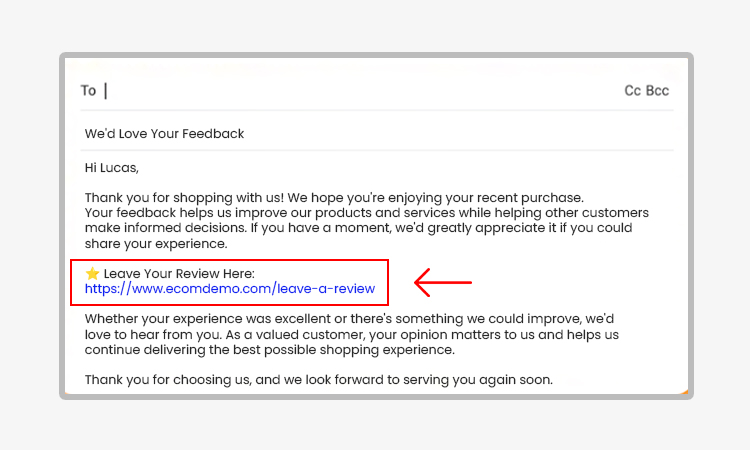
Effective customer review management strategies require e-commerce businesses to simplify the review submission process. If your customers feel that submitting a review for your e-commerce business is too tricky, they may not share feedback.
- Send One-click Review Links
We suggest that you send one-click review page links with your review request emails. So that your customers don’t need to click on multiple links to share one review. You can send a direct and one-click link with your email that will guide them to the exact page where they can share the review.
- Share Mobile-friendly Review Forms
Most of your customers will open your follow-up emails on their mobile phones. Thus, you must optimise your review forms for working perfectly on mobile devices. The review form must feature large-tap targets, have intuitive drop-downs, and include easy image-upload options.
Strategy 3: Make the Process of Sending Review Requests Automated

If you own a large e-commerce business and have a large number of customers, you need to send separate review requests to each customer. If you lack a proper team, it will be quite difficult for you to individually send review requests to your customers.
Automating the entire process can help you to make it simpler. Here are some major ways you can automate the process:
- SMS Reminders
According to a 2025 G2 study, 58% of consumers are open to hearing from brands several times a week via SMS. SMS has high open rates; you can send a quick and friendly text reminder 3-5 days after you have sent your initial email request. Don’t forget to send a direct link to your review page with your SMS.
- CRM Integration
You sync your review software with your customer relationship management system or your entire e-commerce platform. This integration can help you to automate your review generation process.
- Email Automation
You must build a seamless post-purchase email flow for your e-commerce review management. You can set up a sequence for the email to automatically send the review requests and follow-ups within time, 1-2 days after the purchase and 7-10 days after you send the review request, respectively.
Strategy 4: Encourage Authentic Reviews from Clients

You should never buy fake reviews just to increase your online review volume for your e-commerce business. It’s an illegal practice; search engines like Google have algorithms that can easily detect these fraudulent reviews and suspend your Google Business Profile.
Instead, you need to ask your satisfied customers to share their genuine purchase experience from your e-commerce business. You can send emails or SMS shortly after the successful delivery of the product. Make the process spontaneous rather than forcing your customers to leave a higher online rating for your ecommerce company.
Strategy 5: Offer an Excellent Customer Experience to Encourage Positive Reviews

The success of your e-commerce reputation management efforts hugely depends on the quality of your customer service. The more premium service you provide to your customers, the more chances you have to encourage your customers to share positive reviews.
The best way to earn a 5-star online rating is to serve your customers with an exceptional experience beyond their expectations. To ensure offering an excellent customer experience, you need to focus on three factors:
- Fast Shipping: You need to provide the facilities for transparent tracking of product shipping and ensure the fastest delivery possible.
- Responsive Customer Support: Always resolve issues faced by your customers in a timely manner by discussing them through live chat or helpdesk software.
- Quality Products: Always ensure that your e-commerce company provides the best quality products. The product pages of your website accurately reflect the reality of the items to maintain the ultimate level of transparency. It will also help you to prevent product returns and poor ratings.
Strategy 6: Encourage Visual Testimonials

Reviews with visual proofs often have more impact on your potential customers than text-only feedback. Visual content, like photos and videos, accompanied by detailed reviews, builds more trust. You can encourage your customers to share photos of the products or attach a video of their product unboxing with their reviews.
Apart from this, we suggest that you run a photo contest and offer attractive prizes like gift cards, wallet credits, loyalty points, or VIP early access to sales for the customers who share reviews with photos and videos. These visual testimonials will add more value to your e-commerce online review profile.
Strategy 7: Personalize Review Requests
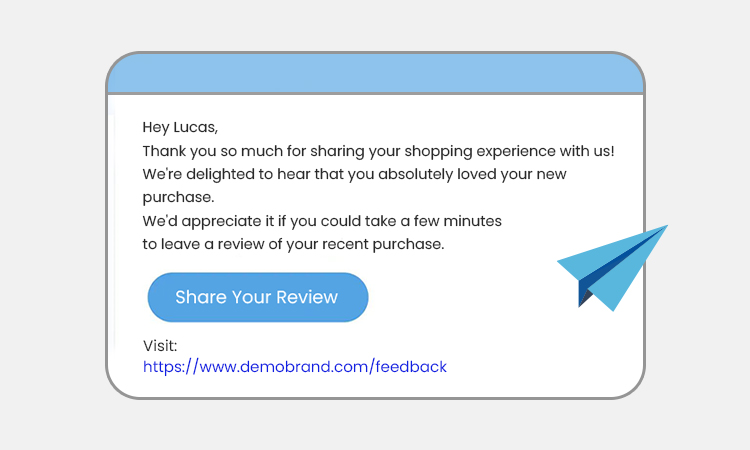
Your review requests with generic messages are more likely to get ignored by your customers. It’s important to make your customers feel valued by personalizing your review and follow-up requests. Refrain from sending the same request to every other customer.
Personalizing your review requests requires you to address the customers by their name in your emails and use a dynamic placeholder in your email software to include their details. Here you can add the customer’s first name, the product they have bought, and, of course, a picture of the product.
- Sample Example of Personalized Review Requests to E-commerce Clients
Below, we have added a sample of a personalized review request for your e-commerce client:
“Hey (customer’s name), thank you so much for sharing your experience of shopping with us! It’s great to know that you absolutely loved your new (product name). It will be great if you can take a few minutes to share your feedback regarding your latest purchase. Share your experience at (your review page link)!”
Strategy 8: Respond to Customer Reviews
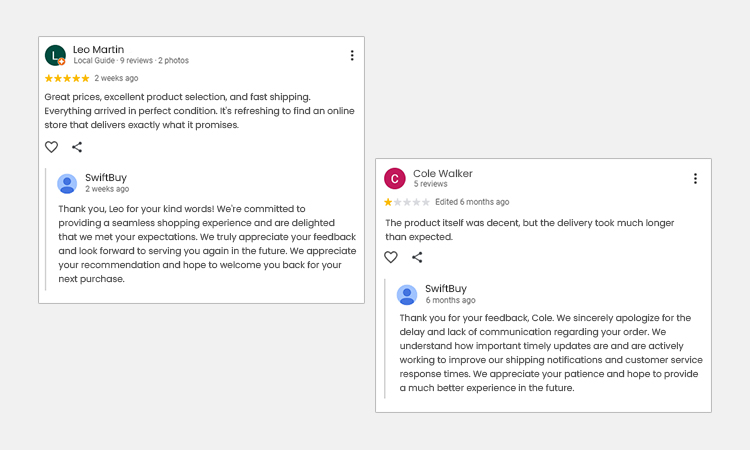
Now we will know how you can effectively and professionally respond to your customer reviews. How you reply to customer reviews showcases that you truly value your customers and are committed to continuously improving your products and services.
Here’s how you can professionally respond to positive and negative reviews:
- How to Respond to Positive Reviews?
Reviewers who have shared positive feedback expect you to value their time and opinions. If you ignore responding to these positive reviews, those customers are more likely not to share reviews in the future.
Do you know that 42% of consumers are more likely to expect businesses to respond to their reviews within 24 hours?
Thus, it’s crucial to respond to positive reviews to showcase your gratitude.
- Address the customer by their name and reference specific details from their purchase.
- First, always showcase your gratitude to the customers for taking their valuable time to share their feedback.
- You can reinforce why the customer has made a great choice by purchasing from your ecommerce brand.
- You offer a gentle reminder to return or suggest a complementary product.
- Sample Example of Positive Reviews
“Hi (Reviewer’s name), thank you for sharing your kind words. We are thrilled to know that you have received your product before the estimated delivery date. Shop with us soon!’
- How to Respond to Negative Reviews?
Now we will know how you can respond to negative reviews for your ecommerce business:
- A strategic negative review management strategy plan requires you to act quickly when you receive a negative review.
- You should never respond defensively or emotionally to a negative review. At least wait for 12-24 hours to let the situation cool down if needed.
- If the fault is at your end, you must sincerely apologize and take ownership of the situation.
- You should never argue publicly with the reviewer, as it can escalate the situation and showcase your ecommerce business in a negative light. Instead, you must provide a direct phone number or email ID to privately resolve the issue at the earliest.
- Never consider deleting the negative reviews from your online review profile, no matter how harsh the criticism is. It’s not about your brand reputation damage, but it’s about the opportunity you can get to regain your customers’ trust and resolve the issue.
- Sample Example of Negative Reviews
“Hi (reviewer’s name), we’re so sorry to hear about your poor experience with (product name) you have recently purchased. This is not the standard we strive for, and we completely understand your concern. We have sent you an email with refund details. Please reach out at (your email ID) if you need further assistance.”
Step 9: Monitor the Success of E-commerce Review Management

Now that you know how you can effectively manage your ecommerce customer reviews, it’s time to know how you can measure the success of review management efforts for your e-commerce business.
E-commerce businesses can compare review monitoring tools to choose the most suitable one to monitor the success of their review management strategy plan.
- KPIs to Track:
Tracking certain key performance indicators (KPIs) can help you measure the effectiveness of your ecommerce reputation management strategy plan, helping you to identify the areas for improvement and which strategy is working well for your ecommerce business.
- Average Star Ratings – The overall online ratings your product has earned.
- Review Volume – The number of online reviews your e-commerce business has achieved within a specific period.
- Response Rate – The percentage of reviews your team generally replies to.
- Review Request Conversion Rate – The percentage of reviews your customers have shared after being prompted.
- Review-to-Sale Conversion—How browsing customers are interacting with your reviews.
- Negative-to-Positive Resolution Rate – The percentage of customers who have shared positive reviews after your team has resolved their issues.
- Customer Lifetime Value – The total revenue your ecommerce business can expect from a single customer account.
5 Helpful Review Management Tools for E-commerce Businesses
Review management for e-commerce businesses is a time-consuming process. If you have a team of skilled review management experts, you can seamlessly manage a large number of customer reviews. Otherwise, it may feel like a daunting task to you!
The following 5 most helpful tools ecommerce businesses must consider using to make the process of review management simpler. Let’s have a look:
| Tools Name | Features to Use |
| 1. Trustpilot | ● Widely recognized open review platform. ● Helps ecommerce businesses to build consumer confidence through verified reviews. ● Allows you to use customizable widgets and offers seamless social media sharing. |
| 2. Birdeye | ●All-in-one reputation and customer experience platform. ● Centralizes customer reviews across the web. ● Offers automated review requests, ticketing, and survey tools. |
| 3. Right Response | ● An AI-focused tool specialized in automating personalized and brand-appropriate responses to customer reviews. ● Helps ecommerce brands save time and improve customer satisfaction. |
| 4. Reviews.io | ● A highly flexible review platform designed for e-commerce brands. ● Provides features to manage video reviews, offers easy integration, and incentives to boost user-generated content. |
| 5. Yotpo | ● A comprehensive e-commerce marketing platform known for its robust review and visual user-generated content tools. ● Integrates deeply with platforms like Shopify and BigCommerce to drive sales. |
5 Mistakes E-commerce Businesses Must Avoid While Managing Online Reviews
No matter how well you have managed your online reviews for your e-commerce business, if you make certain mistakes, all your efforts will be of no use.
Here in this section, we will explore the five most common e-commerce review management mistakes that ecommerce businesses often make:
Mistake 1: Ignoring Negative Reviews
If you ignore responding to negative reviews, it can signal to your existing and potential buyers that you don’t care about your customers’ opinions and their satisfaction. Many ecommerce businesses often choose not to reply to a criticism to avoid online conflicts. But in reality, this practice may showcase your company in a negative light.
Mistake 2: Encouraging Fake and Incentivized Reviews
Are you thinking about incentivizing your customers to share glowing reviews related to their purchase experience? If yes, you are making a mistake. Rewarding a customer for positive reviews violates FTC guidelines and can destroy your brand trust if the review platform or the consumers detect the inauthentic customer review.
Mistake 3: Buying Positive Reviews
There are so many sites available in the market from which you can purchase fake reviews. Buying fake reviews to boost your online review volume is illegal and violates most major review platform policies, including those of Google and Amazon. In the worst scenarios, it can lead to your e-commerce store being banned permanently.
Mistake 4: Not Prioritizing Personalization
If you are sending generic templates for requesting reviews from your customers or following up with your requests, it may show your customers that they are not valued enough. Just a ‘Thank you for your feedback!’ may feel robotic and fail to ensure customer loyalty.
Mistake 5: Delaying Customer Support
Imagine that one of your customers has raised a concern online regarding a product issue. But you have completely ignored it, they may feel unheard and not valued. Your customers always expect an instant resolution from your end, so a delayed response can escalate the situation and turn a little customer concern into a public relations nightmare for your ecommerce business.
Conclusion
Just like any other businesses, ecommerce brands must prioritise building a great online review profile to establish a strong digital reputation. This can only be possible by following a strategic approach to e-commerce review management.
The process is quite tricky, but not with a proper strategy plan. We hope that our comprehensive step-by-step guide to proactively managing online reviews for ecommerce brands can help you navigate the complex and effective process.
Still have a doubt regarding prioritising customer review management for your ecommerce business? Consider consulting with a reliable online reputation management agency to seek their expert advice.
FAQs
Ans. Yes, certainly. Fake reviews can showcase your ecommerce brand in a negative light online. If you avoid responding to those fake reviews, they can build a negative online narrative around your business as well as the products. It can lead to scattered customer trust, making future buyers abandon their purchases from your ecommerce brand. Fake reviews can severely impact your ecommerce site’s overall reputation and sales.
Ans. We suggest that you ask your customers to share reviews at regular intervals. If you send review requests daily, immediately after the purchase or the product delivery, it may overwhelm or irritate the customers. Effective e-commerce review management requires you to send the review requests 1-2 days after the successful product delivery and the follow-up email 7 days after you send the review request.
Ans. No, you cannot abruptly delete or hide negative reviews that are genuine and policy-compliant. Major review platforms like Google, Amazon, and other social media channels don’t allow you to delete or hide real customer reviews. However, these platforms offer you the facility to report reviews that have violated the platform guidelines, or you can also respond to the fake reviews stating that your ecommerce brand has no relevant data of the reviewer as a customer and his/her purchase history.
Ans. You need to reach out to your existing customer network and offer them incentives compliant with the review platform policies. Additionally, you can also leverage automated email campaigns to focus on building initial social proof for the brand-new product. So that the potential buyers feel confident about purchasing the product.
Ans. You can display your customer reviews on your ecommerce site’s product and category pages, on the homepage, near the ‘Add to Cart’ button, and on a separate ‘customer review’ page for each product.

