





Are you struggling to manage your online reputation as a plastic surgeon? When searching for a plastic surgery resource online, an individual is more likely to find numerous surgeons. If you fail to distinguish your plastic surgery expertise from your peers, you may lose a significant number of potential clients. One effective strategy to earn a positive online reputation and stand out in today’s competitive market is to invest in online reputation management for plastic surgeons.
Do you know that nearly 77% of people are more likely to search for healthcare services and providers through search engines like Google?
Seeing the statistics, you can now understand why plastic surgeons must build and maintain a positive reputation across the digital world. Providing exceptional plastic surgery services is not enough; making people aware of your expertise, authority, and market positioning is extremely important for acquiring new plastic surgery clients.
This blog will provide a step-by-step guide to navigate effective reputation management for plastic surgery specialists. We will also discuss the benefits a plastic surgeon can achieve by prioritizing online reputation management, as well as the challenges they may face in building and maintaining a positive professional online reputation.
What Is Online Reputation Management for Plastic Surgeons?
It refers to a process of actively building, monitoring, influencing, and managing a plastic surgeon’s reputation across the web – how the specialist’s expertise is appearing online when someone searches for a reliable plastic surgery resource through search engines like Google, Yahoo, or Bing.
From achieving your potential and existing clients’ trust and securing positive client reviews to positioning your expertise as a reliable and authoritative resource, online reputation management (ORM) covers every specific reputational requirement of a plastic surgeon. ORM professionals often even utilize SEO techniques to ensure a high-quality and strong online presence for plastic surgeons.
Collaborating with a reputed ORM agency to seek their tailored online reputation protection services can be a game-changing strategy for you to kickstart your plastic surgery clinic’s ORM journey.
Some Key Aspects of ORM for Plastic Surgeons
The following are some key elements of plastic surgeon reputation management.
- Active monitoring of online brand mentions, client reviews, and social media comments
- Review generation from satisfied patients and review management
- Client trust and brand credibility building through patient testimonials, before-and-after photos, and high-quality content
- Search engine optimization of digital content
- Crisis management to mitigate the impact of reputational crises
7 Key Reasons Why Plastic Surgeons Must Prioritize Reputation Management
Want your plastic surgery expertise to stand out? Without a positive reputation and authoritative positioning in the virtual world, you cannot reach a wider potential client base. Those looking for a reliable plastic surgeon for their cosmetic enhancement needs will choose your expertise only if you have a strong online reputation.
The importance of online reputation for plastic surgeons lies in these 7 key benefits that you can leverage through effective online reputation management for plastic surgery experts:
- Positive Impact on Client Decision-Making
Before booking a consultation, potential plastic surgery clients always research surgeons online. Effective ORM enables plastic surgeons to generate more positive reviews from satisfied clients, which can later serve as social proof of their plastic surgery expertise and positively influence potential clients’ decision-making.
- High-Trust factors regarding Patient Reviews
According to a 2025 Medical Economics study, more than 51% of patients read at least six online reviews before choosing a healthcare provider. Most of them prioritize online reviews just as they prioritize personal recommendations from their family and friends.
Platforms like Google, Yelp, and RealSelf allow individuals to access the real experiences of people with various plastic surgery experts – they provide the critical, unscripted, and unbiased sources of information (online reviews) to potential plastic surgery clients. This works as a social proof, building higher trustworthiness related to a specific plastic surgery service provider.
- Mitigates Competitive Market Pressure
The plastic surgery market is highly competitive! A Metatech Insights study has revealed that the Global Cosmetic Surgery is projected to grow at a CAGR of 9.7% between 2025 and 2035.
The ‘word-of-mouth’ now lives online in the form of online reviews. If you don’t prioritize reputation management for plastic surgeons, you may lose potential patients to your market competitors who have earned higher star ratings for their online plastic surgery profiles.
- Risk of Reputation Damage Prevention
It’s not always about patient satisfaction and positive reviews, as your unhappy clients are more likely to share negative feedback online. And it can result in mild to severe damage to their online reputation. Apart from this, competitor sabotage and disgruntled staff can also severely impact your online reputation.
Effective online reputation management allows you to prevent these negative client experiences from ruining your online reputation. It also prevents the negative reviews from being misinterpreted as poor client service from your end.
- Beneficial for Patient Acquisition and Revenue
It’s natural for someone who wants to undergo plastic surgery to be skeptical while choosing a service provider. Glowing reviews can help you showcase how your previous clients have benefited from your plastic surgery expertise and offered services.
Effective ORM helps you build and maintain a positive online reputation, which is an extremely crucial factor in acquiring new clients and generating more revenue for your plastic surgery practice. Because more people will get interested in your expertise, witnessing your positive digital reputation.
- Guaranteed Regulatory Compliance
Online reputation management for plastic surgery practices requires the experts to effectively handle sensitive, private client feedback. When you follow a proactive approach to managing your plastic surgery practice’s online reputation, it ensures that you respond to the online client reviews in a HIPAA complaint way.
A HIPAA-compliant ORM approach prevents legal fines, legal actions, and potential blacklisting by search engines.
- Improved Local Search Visibility
No matter how exceptional your plastic surgery services are, if your potential local clients are not aware of their existence and the benefits they can leverage by choosing them, it’s of no use.
Having a great local search visibility is crucial for plastic surgeons to attract local clients. When you build a positive online reputation, it ranks your plastic surgery practice higher in search engine results pages – whenever any local prospects search for a local plastic surgeon, your practice will appear on the first page of online search results.
4 Key Platforms for Plastic Surgeon’s Online Reputation
Do you know that there are some digital platforms through which you can build a positive online reputation for your plastic surgery practice?
Yes, you heard that right! Some tools can help you engage with existing and potential clients through their online reviews and feedback. Here are 4 major digital platforms you must leverage to build an online reputation:
- Google Search Results
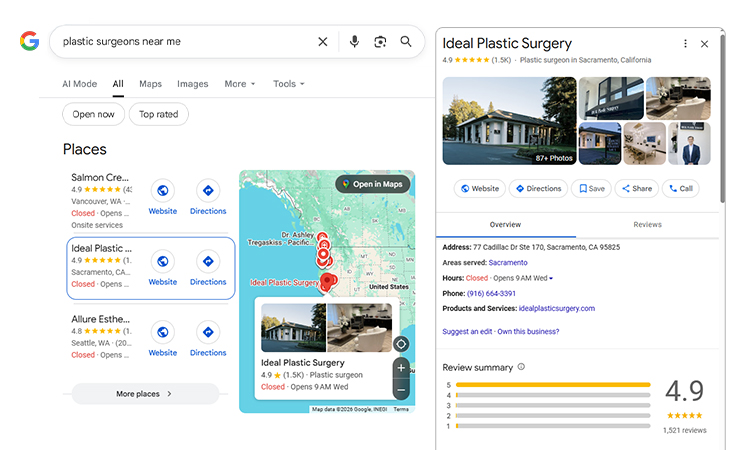
Google is the primary platform that people use while searching for local medical services. So, most of your potential plastic surgery clients will search for a local surgeon on Google. If your practice appears with a positive reputation on Google, those prospects will be more likely to visit your website from your GBP page.
- Google Business Profile (GBP)
Do you know that 60% of patients click on a website with a local Google Business Profile listing? You must create and optimize a GBP profile for your plastic surgery clinic to make it appear in local Google searches and Google Maps. This is the best strategy to drive foot traffic to your clinic.
- Featured Snippets
Always add FAQs and ‘MedicalProcedure’ schema markup to your website, so that your plastic surgery practice will appear in prominent text boxes at the top of Google search results. This allows you to grab the immediate attention of those who are actively searching for plastic surgery resources online.
- Search Rankings
As a plastic surgeon, you must implement organic SEO techniques to make your plastic surgery clinic rank higher on the first page of Google search results. When you use the relevant and most-used keywords like ‘best plastic surgeon near me’ or ‘reliable plastic surgery in my city’, it will make your practice rank for online searches involving these keywords.
- Social Media Platforms
There are some social media platforms that plastic surgeons can leverage to build and maintain a great online image. Social media platforms like YouTube, Instagram, and Facebook can be the best channels for reputation management for plastic surgeons.
If your target audience or potential clients are mostly active on some social media platforms, you can target those platforms for stellar reputation building.
Visual results and community engagement on Facebook can help you drive a noticeable number of client bookings. You can post engaging content and visuals on Facebook to build client communities. Facebook also allows you to run targeted ads and manage the business review section.
By 2025, Business of Apps Analysis has claimed that Instagram has reached 3 billion monthly active users. This is the best platform for visual storytelling, where you can showcase how you provide the best possible plastic surgery services to your clients, your clinic’s infrastructure, and everything that can visually impress your potential patients.
Especially, the photos of your existing clients ‘before-and-after transformations or ‘a day in your life as a plastic surgeon’ reel can help you make your plastic surgery expertise reach a wider audience.
Types of Visual Content You Must Post on Instagram
Here are some engaging visual content that you must share on Instagram:-
- High-Quality Before-and-After Photos (Visual Portfolio)
- Educational videos and reels
- FAQ sessions
- Plastic surgery myth-busting videos
- Positive patient testimonials and Surgery Success Stories
- Behind-the-scene videos
- Patient testimonial videos
- YouTube
This platform is ideal for educational long-form videos of your plastic surgery procedures. Through these YouTube videos, your potential clients can get a clear idea of complex surgical procedures and may not be skeptical anymore about undergoing plastic surgery. It can also help you set realistic recovery expectations for your clients.
You can use LinkedIn to connect with other authoritative plastic surgery professionals in your locality. LinkedIn is the best platform to establish the brand credibility of your plastic surgery practice and build interpersonal networks with your market peers. It will also allow you to share your research or innovations with your LinkedIn connections and followers.
- News & Blogs

Through freshly produced news and blogs, plastic surgeons can showcase the authority and credibility of their practice. Here are some types of channels you can leverage for plastic surgery reputation management:
- Articles and Interviews
Through informative articles on plastic surgery procedures, you can earn featured coverage in popular health journals and local news publications. It can make you appear as a leading expert in your plastic surgery niche. You can arrange interviews with local media publications to publish those interviews and earn an authoritative position in the market.
- Third-party Mentions
These are third-party mentions that can showcase your plastic surgery practice as a knowledgeable and authoritative resource in today’s competitive digital age. It will showcase that other clients have a great experience seeking plastic surgery services from your clinic. It will add a ‘third-party validation’ to your expertise and practice, including an ‘authority’ and ‘trust’.
So, more potential clients will trust your expertise and rely on your capability to transform their facial or body aesthetics.
- Blogs
Have a website?
If yes, don’t forget to develop a separate page for blogs. When you consistently publish fresh, educational, and informative blogs on your own plastic surgery site, it will organically provide all the answers to your potential and existing clients’ questions. It will also make your plastic surgery practice rank higher online for relevant search engine queries.
- Guest Blogs
Plastic surgeons can also earn guest posting opportunities by publishing informative blogs on other authoritative medical or plastic surgery sites. It will allow you to generate quality backlinks that will boost your own plastic surgery website’s ranking on search engines. Guest blogs also allow
- Review and Medical Listing Sites
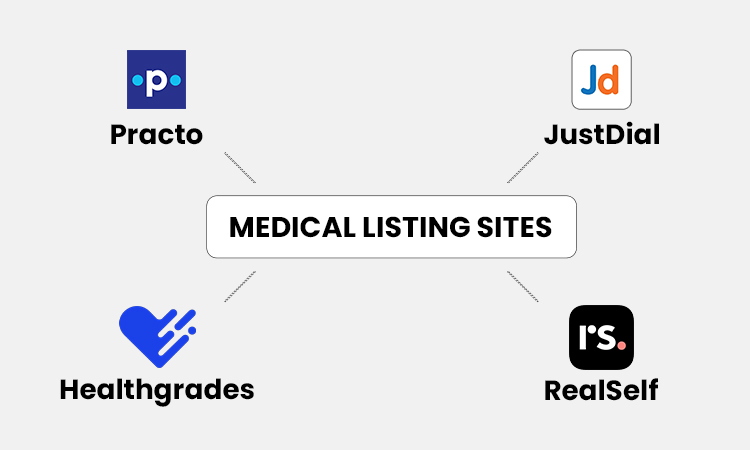
There are some major online reviews and medical listing sites where you can engage with your client reviews. From responding to the reviews to monitoring any unusual patterns, these platforms can help you effectively manage your client reviews. You can use these reviews as social proof and improve your niche visibility:
| Review and Medical Listing Sites | |
| ● Practo | This is a high-traffic reputation management platform for plastic surgeons who can drive direct appointment bookings through it. |
| ● JustDial | This is another high-traffic listing popular in specific regions. You can manage your client reviews and attract new client appointments. |
| ● Healthgrades | This is another high-authority medical database for plastic surgery procedures. Through this platform, you can display your plastic surgery certifications, patient ratings, and your clinic details. |
| ● RealSelf | It’s a niche platform dedicated to plastic surgical procedures. The platform allows plastic surgeons to directly answer the client’s queries. |
How to Manage Online Reputation for Plastic Surgeons: A Step-by-Step Guide
Now it’s time to know the strategies that can help you excel in online reputation management for plastic surgeons. Knowing about the platforms where you can leverage online reputation management for your plastic surgery clinic is not enough. Without having a detailed knowledge of the strategies that you want to implement, you cannot effectively build and maintain a stellar reputation for your plastic surgery practice and acquire new patients.
Let’s have a detailed guide to reputation management and explore the steps you need to follow to position your practice as an authoritative plastic surgery resource:
Step 1: Effective Client Review Management
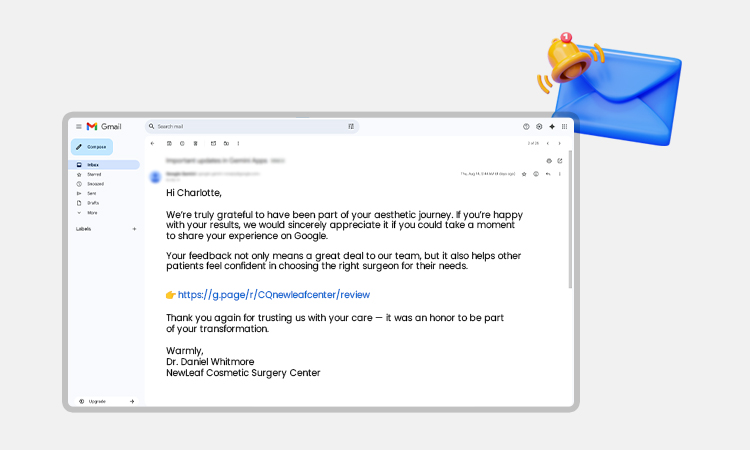
The first and foremost thing you need to ensure is generating positive and genuine reviews from your clients. Apart from review generation, you must professionally and empathically respond to those online reviews and manage the entire set of reviews you receive for your plastic surgery practice.
Now we will talk about how you can be a PRO at effective customer review management.
- Encourage Patients to Share Genuine Reviews
Will your plastic surgery clients share online reviews spontaneously?
The answer is – maybe NO!
Even your happy patients may not leave a review if you don’t encourage them to do so. Always remember, every client needs that little ‘push’ to share their experience. Here’s how you can encourage your clients to leave reviews:
- Utilize the moments of satisfaction: You need to request the satisfied clients to share genuine reviews, target the time period when your patients are the happiest. You can send review requests during post-operation appointments, 8-week checkups, and 12-month follow-ups.
- Leverage diverse platforms: You must encourage your clients to share online reviews on Google Business Profile. It’s an essential factor for ranking your plastic surgery practice higher on the search engine results page. Don’t forget to ask them to share their feedback on platforms like RealSelf, Healthgrades, and Facebook.
- Provide direct links/QR codes: Your clients may struggle to find where to share their reviews. You can make the process easy for them by providing direct links to your review pages through SMS or review request emails. You can also place QR codes in the waiting area or the reception of your plastic surgery clinics, and even print the QR codes on patient handouts.
- Appoint staff: You can train your front desk staff and patient coordinators on how to effectively ask for reviews. Directly asking for reviews is the most powerful and effective method of client review generation.
- Request Online Reviews Timely and Professionally
Timing plays a huge role in determining whether you can successfully generate a positive review from your clients or not. For example, if you ask for reviews after one week of a client’s surgery, it may reduce the chances of them sharing a review.
What to do: You need to request your clients to share their reviews when the surgery experience is still fresh in their minds. You can send a review request email within 1-3 days after a successful surgery, and a follow-up email after one week if you don’t receive a review from their end.
Never opt for AI-generated or generic templates, rather try to personalize your review request emails by including all the important details of their plastic surgery. You can also suggest they include details about the procedure, how well they have recovered, and the care they have received from your plastic surgery clinic.
Example of a Personalized Review Request Email
“Hey (Client’s Name), we’re thrilled to be a part of your transformation journey. If you’re happy with the results, we would appreciate it if you could take a moment to share your experience on (the platform name).”
- Don’t Overwhelm Your Clients with Too Many Requests
Requesting reviews doesn’t mean that you need to send the review requests now and then. You mustn’t overwhelm your clients with too many requests, as it can make them annoyed. So, you should always ask for a review after completing a milestone, such as the initial consultation and successful surgery with a desired result.
Tools like Podium and Birdeye can help you automate the follow-up process. We will talk about the other helpful tools later in this blog.
A Pro Tip: Always respect your clients’ time! If you don’t receive a reply to your first request, send the second one in a polite manner one week later. If you still don’t receive, stop following up anymore.
- Maintain Your Client Review Consistency
Effective review generation and management is not a one-time process. Plastic surgeons need to maintain consistency in requesting and managing their client reviews. Make it a standard part of the client’s plastic surgery journey, so that whenever the surgery is completed, you or your team doesn’t forget to request the review.
Step 2: Respond to Reviews (Positive, Negative, and Neutral)
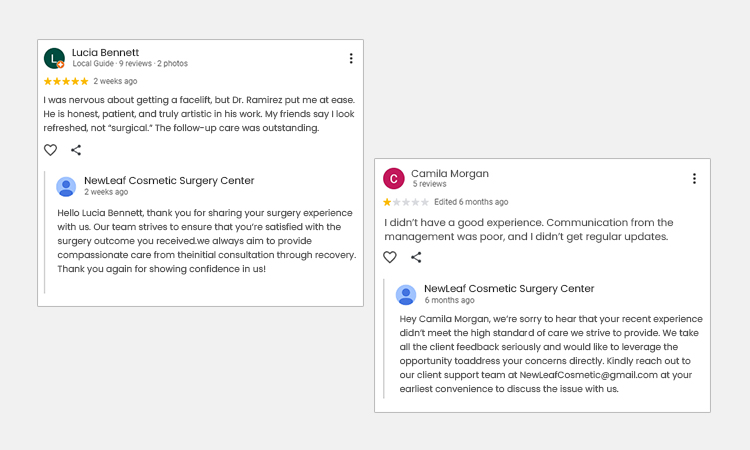
Now that you have a clear idea of how to generate client reviews, it’s time to professionally respond to the reviews. How and when you respond to reviews is extremely crucial to showcase that you care about your clients’ opinions, and your patients feel heard. Effective review management services often help you navigate the complexities of managing plastic surgeon online reviews.
Let’s have a clear idea about how effectively you can respond to the positive, negative, and neutral reviews.
- How to Respond to Positive Reviews?
As a significant part of online reputation management for plastic surgeons, you should always acknowledge the positive reviews and show your gratitude for the reviewers who take the time to provide genuine feedback. Within 24-48 hours of receiving reviews, you should professionally respond and thank them for sharing their positive feedback.
Example of Response to Positive Reviews
“Hello (patient’s name), thank you for sharing your surgery experience with us. Our team strives to ensure that you’re satisfied with the surgery outcome you received. At (your plastic surgery clinic name), we always aim to provide compassionate care from the initial consultation through recovery. Thank you again for showing confidence in us!”
- How to Respond to Negative Reviews?
It’s all about handling negative reviews correctly. Plastic surgeons should never get defensive while responding to a negative review. You need to express your empathy and take the conversation offline immediately if things escalate. You should never rely on generic templates, rather try to personalize your response.
Don’t ever get involved in any arguments with the reviewers. If the negative review contains abusive and violent comments, you can report them on the review platform by using the platform’s internet review reporting tool. Always maintain your professionalism and show your empathy while responding to a negative plastic surgery review.
Example of Response to Negative Reviews
“Hey (patient’s name), we’re sorry to hear that your recent experience in our plastic surgery clinic didn’t meet the high standard of care we strive to provide our clients. We take all the client feedback seriously and would like to leverage the opportunity to address your concerns directly. Kindly reach out to our client support team at (your clinic’s official email ID) at your earliest convenience to discuss the issue with us.”
- How to Respond to Neutral Reviews?
Always start your response by thanking the reviewer by name and showcasing your gratitude for taking their valuable time to share their thoughts. You can highlight the positive elements they have mentioned in their review, as well as address the neutral aspects.
If the review contains detailed complaints, you can take the conversation offline and avoid arguing in public. We suggest you ask specific questions to understand how you can improve your plastic surgery practices and offer better resolutions.
Example of Response to Neutral Reviews
“Hey (the reviewer’s name), thank you for taking your valuable time to share your genuine feedback. We are glad to hear that you’re pleased with your transformation. However, we also apologize for the client support process that didn’t match your expectations. We will discuss with our team to improve our process. We would like to welcome you to have a one-to-one discussion with us. Please reach out to our team to share your concerns further at (your clinic’s official phone number).”
Here are some tips for plastic surgeon reputation management:
- Offer HIPAA-Compliant and Patient-Privacy-Friendly Responses
The golden rule here is to confirm that the reviewer is a patient and has talked about some details about his/her plastic surgery experience.
The Golden Rule: While responding, you should never disclose any treatment details, surgery date, appointment schedules, or other Protected Health Information (PHI) without obtaining consent from the clients. No matter whether the review is negative, positive, or neutral, you must protect your clients’ reputation.
- Implement De-escalation Strategies
If you ever receive an angry review from a plastic surgery client, you must not be defensive while responding to it.
- Maintain a professional tone and respond with empathy.
- Acknowledge your patients’ concerns without agreeing to any kind of liability.
- Read the entire review carefully and try to understand the core issues, like long wait times or client communication problems.
- Offer a clear resolution for the reviewer rather than confusing them with too many processes.
- Always assure them that you’re reviewing the issue and will provide a solution as soon as possible.
- Turn Criticism into a New Business Opportunity
Negative reviews are a part of a business, especially if you’re associated with a medical service provider like a plastic surgery clinic. Never be defensive against the negative reviews; rather, try to turn the criticism into new business opportunities.
Negative reviews act as ‘hidden gems’ that reveal operational gaps in your plastic surgery services.
- Always identify the review trends, such as if multiple reviewers are mentioning long wait times, you must consider it as a sign to re-evaluate your appointment scheduling process.
- Leverage specific complaints to fix your broken workflows, such as long hold times and bad behavior from client support executives.
- Provide a thoughtful and polite response to a negative review to show that you care about your potential patients’ opinions regarding your plastic surgery service. \
- Share your feedback with your surgeon team to improve their training, professionalism, and patient-centered care.
Step 3: Create Engaging, High-Quality Content to Build Your Authority
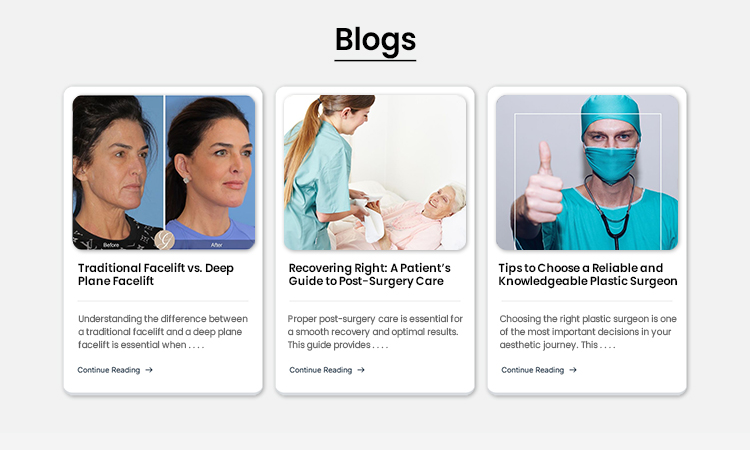
Content creation and content marketing are two major parts of effective online reputation management for plastic surgeons. It helps plastic surgeons build authority in the competitive market and establish themselves as a knowledgeable, reliable, and client-centric plastic surgery resource.
Here’s a guide to creating and promoting engaging content to build a strong authority.
- Publish Informative and Educational Blogs on Complex Plastic Surgery Procedures
Never opt for generic posts; rather, you can publish informative blogs on complex plastic surgery procedures. As most of the plastic surgery clients feel skeptical before choosing a reliable surgeon, reading your educational blogs can answer their queries related to various surgical procedures and also showcase your technical expertise as a plastic surgeon.
Target topic like –
- Traditional Facelift vs. Deep Plane Facelift
- Complex Anatomy of Rhinoplasty
- Secondary Breast Augmentation
- A Guide to Post-Surgery Care
- Tips to Choose a Reliable and Knowledgeable Plastic Surgeon
While writing the blogs, you must highlight advanced techniques used in a surgery, expected results, potential risks, and recovery time. In the blog, explain why an individual should choose a specific procedure to resolve their aesthetic concern.
Tip: Try to conclude such educational blogs within 1000-1500 words, including essential subheadings, bullet points, and relevant before-and-after photos.
- Create FAQs to Address Patient Concerns
Prospective patients often have deep anxieties related to surgery safety and outcomes. Plastic surgeons must add a dedicated FAQ section to address these concerns – this allows you to establish trust and improve your plastic surgery practice’s local search rankings.
Types of questions you can address –
- What are the risks of anesthesia?
- How do you minimize scarring after the surgery?
- What are the signs of infection during a deep plane facelift recovery?
- How to manage post-surgery pain?
- When can a patient return to normal activities after a breast augmentation surgery?
- What happens if a patient is not satisfied with the outcome of a surgery?
A Quick Tip! You can utilize tools like Google’s ‘People also ask’ or ‘AnswerThePublic’ to identify the most common questions your potential clients are actively searching for.
- Share Thought Leadership Articles
You should always prioritize thought leadership articles to establish your position as an expert in the competitive market. It can help you make your plastic surgery clinic stand out by building long-term credibility.
You can choose topics for the thought leadership articles, such as –
- Advancements in Minimally Invasive Body Contouring
- The Rise of Non-Surgical Facial Rejuvenation
- How Plastic Surgery Procedures Boost Self-Esteem
- The Importance of Natural-Looking Plastic Surgery Results
- Debunking the Top 5 Myths About Breast Implants
Step 4: Prioritize Search Engine Reputation Management (SERM)

How is your plastic surgery clinic appearing in search engine results?
This plays a major role in building and managing a positive online reputation for your plastic surgery practice. When your plastic surgery clinic appears positively in the search engine results pages, it increases the chances of your potential clients choosing your expertise over your market competitors.
- Suppress Negative Search Results with Positive Content
The first and foremost thing you can do to suppress the negative search results is to create and promote positive online content. You can proactively publish positive content, such as blog posts, articles, patient testimonials, and the like, to outrank negative links.
You can actively maintain your plastic surgery clinic’s social profiles, especially those with high domain authority like Facebook, YouTube, and LinkedIn. This will help you leverage and optimize third-party platforms like RealSelf and Healthgrades that often rank in online search results.
- Optimize Branded Keywords in Your Content
While creating versatile content, you need to target branded keywords to make your content appear when a potential plastic surgery client searches for services provided by your plastic surgery clinic.
Try to naturally incorporate these keywords into your website content, such as into your H1 headers, meta descriptions, and image alt texts. Target the long-tail keywords, like the specific search queries, to capture high-intent online searches.
Keyword Examples for Your Content:
- (your name as a surgeon) + plastic surgeon
- (your clinic’s name) + online reviews
- Dr. (your surname) rhinoplasty (clinic’s location)
- (clinic’s name) breast augmentation
- (clinic’s name) tummy tuck consultation
- Dr. (clinic’s name) filter treatment
- Create Plastic Surgery Focused Authority Pages
If you have a website, you must develop in-depth, high-authority pages for every procedure and every service you provide. For example, you can develop specific pages for breast augmentation in (your clinic’s location) and the specific service detailing benefits, risks, and recovery.
You can extensively implement curated, high-resolution before-and-after galleries on your website to showcase the actual results of your previous successful surgeries. This often serves as a visual authority for your plastic surgery clinic.
For Surgeon Bios:
You must create dedicated, detailed pages for highlighting your plastic surgeon certifications, education, awards, and affiliations. Such pages will help you showcase the authority of your plastic surgery clinic. When your potential clients know from whom they’re receiving the service, they will feel more confident about it.
- Implement Impactful SEO Techniques to Rank Your Clinic Higher Online
You must claim your plastic surgery clinic’s Google Business Profile and regularly update it with photos, newly launched services, and 5-star reviews. This will help you strengthen your efforts for online reputation management for plastic surgeons.
- Add Your NAP Details: You can ensure adding your name, address, and phone number (NAP details) to your plastic surgery clinic’s GBP. It will help you enhance your clinic’s local search visibility.
- Optimize Your Website Speed: Tools like PageSpeed Insights can help you improve website speed, implement HTTPS for website security, and ensure mobile-friendliness of your plastic surgery website.
- Prioritize Schema Markup: For the schema markup implementation, you must use schema markup, specifically the MedicalBusiness and FAQ schema, to help search engines understand your content better and display it on their rich snippets.
- Secure Backlinks: Plastic surgeons must secure backlinks from reputable and authoritative medical sites, local media publications, and their business partners to build domain authority.
Step 5: Consider Social Media Reputation Management
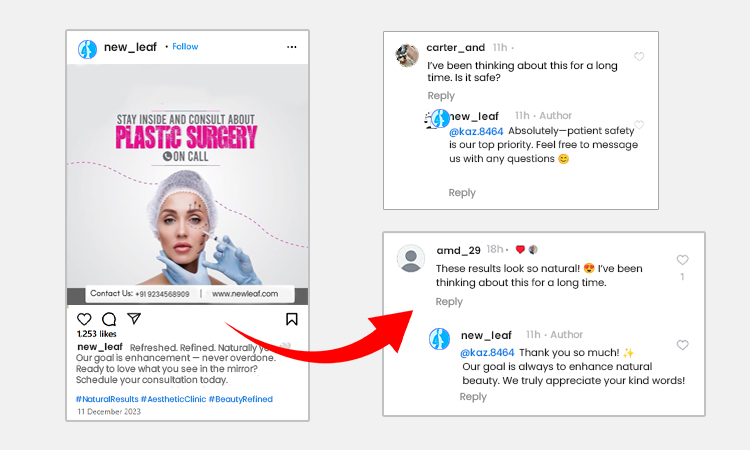
Yes, social media platforms also play a huge role in online reputation management. How your plastic surgery clinic appears on social media plays a huge role in your new client acquisition. Let’s have a look at how you can strengthen your plastic surgery clinic’s social media presence with effective social media reputation management strategies.
- Post Engaging Content on Your Social Media Business Page
Always maintain your plastic surgery clinic’s presence across social media channels. Maintain consistency, post regularly to keep your social media business page active, and prevent it from going irrelevant.
An extra tip for you! You must post 5 pieces of curated content, 3 original branded posts, and 2 humanizing posts for every 10 posts. Share engaging news, special offers, videos, and infographics to make your plastic surgery expertise resonate with your target audience.
Don’t forget to share positive client testimonials and patient success stories to build a strong brand narrative in today’s competitive digital world.
- Manage Your Social Media Comments and Direct Messages
You should respond to all the direct messages, social media mentions, and comments. Within 24 hours, you should respond to all the comments you receive under your social media posts. Avoid being defensive while responding to negative comments, and never argue with your clients. To track your social media mentions and messages, you need to use social listening tools like Brand24, Mention, and Hootsuite.
- Manage Your Reputational Crises on Social Media Platforms
We will talk about crisis management later in this blog. But before this, you need to know how you can manage your social media reputation.
- Set up your systems, like Google Alerts, to detect the negative sentiment before it escalates.
- You must immediately pause all your scheduled posts if you detect any social media crisis.
- Always provide fast, consistent, and transparent responses to the social media direct messages and comments. It will help you maintain your public trust.
- You must sincerely apologize and offer actionable solutions during a crisis, especially if the fault is on your end.
Step 6: Leverage Proactive Reputation Building Techniques

Rather than being reactive, you should focus on proactively building an online reputation for your plastic surgery clinic. Here are some proactive reputation building and management techniques plastic surgeons must prioritize.
- Showcase Patient Testimonials and Surgery Success Stories
Do you know that your positive client testimonials serve as social proof for your plastic surgery expertise?
Yes, you heard that right!
After generating reviews from your satisfied clients, you should always promote these positive client reviews on online review platforms. Provide your potential clients with clear access to the surgery success stories, so that they gain trust in your plastic surgery expertise.
- Add Before-and-After Photo Galleries to Showcase Surgery Outcomes
People will only believe your expertise when they see the real pictures of your surgery outcomes. Thus, you must add photo galleries to feature high-quality, standardized images to accurately represent your surgical outcomes.
Always accompany those photos with brief descriptions of a specific client’s concerns and the surgical approach you have used for the client. Before any visual content you share of a client, you must obtain their written consent. You must respect the client’s right to privacy and specify exactly how and where you will use the images.
- Share Video Testimonials and Surgeon Interviews
If possible, request your satisfied clients to share their video reviews of their experience at your plastic surgery clinic. Video content allows plastic surgeons to approach and explain complex surgical procedures in an easy-to-understand manner.
Apart from this, you can also provide educational content on various plastic surgery procedures and outcomes through interviews with your surgeons working at your clinic. It will allow your plastic surgery practice to position itself as a reliable source.
- Publish Press Releases and Expert Opinions
Press releases are another form of authoritative content that plastic surgeons can leverage to inform the general public and the healthcare community about new technologies they use in their surgery, innovative treatment methods they’re prioritizing, and research milestones they have achieved so far.
This type of content is considered a major part of online reputation management for plastic surgeons as they allow the surgeons to directly communicate with the public and the media.
We also suggest that you publish expert opinions and educational articles on new plastic surgery trends to educate the community and establish your practice’s leadership in your niche.
Step 7: Handle Reputation Crises: How Plastic Surgeons Protect Their Online Image

A reputational crisis can occur at any time. Thus, you need to take preventive measures to handle the crisis at the right time, before it escalates. Here is a short guide on effective reputational crisis management strategies for plastic surgeons.
- Identify Early Warning Signs
The following are some early warning signs that you should detect to prevent a crisis:
- Sudden Spike in Negative Reviews – If you identify a sudden, rapid increase in your negative reviews, especially 1-2 star reviews, it may be a sign of an upcoming reputational crisis.
- Sudden Increase in Negative Online Mentions – If you notice a sudden increase in the number of negative online mentions on your social media platforms and across the web, it may be a sign of a reputational crisis.
- Unusual Patterns in Patient Feedback – If you notice recurring complaints about specific issues in your plastic surgery services, such as billing, long wait times, and bad staff behavior, you must consider them as an early sign of a reputational crisis.
- Abusive Reviews – If some of your client reviews contain aggressive, unprofessional, and highly emotional language, it can be a coordinated attack on your plastic surgery clinic’s reputation.
- Reviews from Fake Accounts – If you observe a wave of reviews from suspicious or newly created accounts with no review history and profile picture, those reviews are more likely to be fraudulent, aiming to damage your online reputation.
- Develop a Crisis Management Plan
Now that you have an idea of the early signs of a reputational crisis, it’s time to develop a crisis management plan. A well-developed plan can help you effectively implement the strategies.
- Create an Immediate Response Checklist
How will you respond to a reputational crisis as a plastic surgeon?
To decide this, you need to create an immediate crisis response checklist where you will mention how you will respond to a specific reputational crisis.
- During the initial period, you need to define the first hour actions to ensure immediate safety.
- Contact the appropriate local authorities for specific incidents that involve injury, immediate threat, and the like.
- Activate your crisis management team and designate a physical or virtual space for your team to meet.
- Designate a spokesperson who will ensure all the messages come from one consistent source.
- Draft a holding statement and prepare templates to share the initial statement to explain what has happened, what is being done, how you’re managing the situation, and when you will share the next update.
- Develop an Internal Crisis Communication Strategy
Your internal stakeholders, such as the surgeons and other staff you have in your plastic surgery clinic, must hear the news first that a crisis has occurred. It will help you prevent the rumors, and you can also ensure that your stakeholders don’t accidentally leak information.
How to develop an internal crisis communication strategy?
- Plastic surgeons must direct employees to an internal channel for any kind of updates.
- Now you need to send an initial email or message to inform the staff and instruct them on immediate safety. You can also direct them not to comment on social media.
- Always clearly state what your staff needs to do during a crisis, so that they are well aware of their plan of action.
- You need to offer frequent updates just after a crisis occurs, as your target audience will be eager to know about what you’re planning to resolve the issue.
- Prioritize Legal and Ethical Considerations
When a crisis occurs, a plastic surgery specialist must prioritize the safety and ethical obligations above their business interest. It will help you minimize long-term legal liability as a plastic surgeon.
It will also allow an open and honest communication, helping to manage your clients’ expectations. Through this, you can also strictly adhere to patient confidentiality.
- When to Seek Legal Support?
Now the question comes – when should you seek legal support during a reputational crisis?
Here are some major instances when you must prioritize seeking legal assistance to handle a reputational crisis.
- When a client threatens to take legal action against you or your plastic surgery clinic
- When an adverse event has caused severe injury or death to one of your clients
- If you or one of your plastic surgeons has made a surgical error or an anesthesia mistake.
- If you’re attacked by negative online reviews that have turned into defamatory attacks
- If one of your clients’ mental states is in question
- If a board complaint or license investigation is initiated against you or your plastic surgery clinic
- How to Avoid Defamation and Privacy Violations?
These are some tips and tricks that you must follow to avoid defamation and privacy violations.
- You must not disclose the client data related to their health condition and surgery details.
- Even in a response to a negative review, you shouldn’t disclose any patient data, as this may violate HIPAA guidelines and lead to higher penalties.
- Do not respond to the review immediately – take your time and don’t respond to a review in anger.
- Keep every communication professional, empathetic, and factual.
- Educate your staff on client communication to ensure all your surgeons and staff are trained to handle dissatisfied patients.
Step 8: Employ Helpful ORM Tools
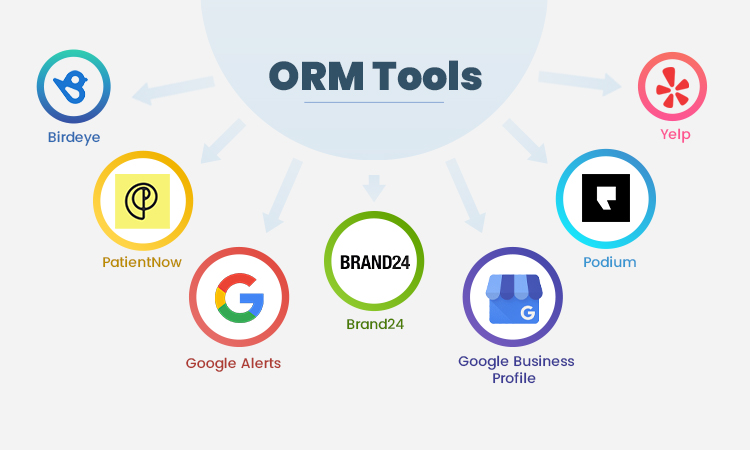
Now that you’re well aware of the strategies of reputation management for plastic surgeons, it’s time to explain to you some benefits of helpful reputation management tools.
Effective utilization of these tools can simplify the reputational management process for plastic surgery experts. Let’s explore the benefits of the top 7 helpful ORM tools that you can use to make your ORM seamless.
| Tools | Features to Use |
| 1. Birdeye | ● Automates review solicitation through SMS and email ● Centralizes reviews from more than 300 sites like Google, Facebook, and Healthgrades ● Identifies operational gaps through effective sentiment analysis |
| 2. Podium | ● Uses SMS to send review requests ● Centralizes customer feedback and communication in one dashboard ● Allows quick, convenient, and text-based follow-up |
| 3. Google Alerts | ● Helps in setting alerts for your plastic surgery clinic’s brand name ● Allows proactive crisis management and provides alerts for negative online mentions |
| 4. Brand24 | ● Helps in tracking online mentions on social media platforms ● Provides sentiment analysis to distinguish positive, negative, and neutral online mentions ● Identifies social media influencers who mention your name or your plastic surgery clinic name ● Tracks the reach of your social media campaigns |
| 5. Google Business Profile | ● Ensures your plastic surgery clinic’s NAP details are consistent across the web ● Allows you to share high-quality before-and-after photos ● Allows you to add special attributes like ‘temperature check upon entry in the clinic’ or ‘mask required.’ |
| 6. Yelp | ● Helps you to claim your GBP profile ● Helps your plastic surgery clinic rank in the top three search results for local search queries ● Centralizes your client reviews and allows effective response |
| 7. PatientNow | ● Integrates patient engagement and marketing ● Makes it easier to manage the entire client journey, from initial consultation to post-operative review generation |
Step 9: Measure the Success of Your ORM Strategy for Plastic Surgeons

Measuring the success of your plastic surgery ORM strategy plan is essential to understanding what is working and what is not. Through the right measurement, you can track specific and actionable metrics that indicate the performance of your ORM strategies.
Here are some key performance metrics (KPIs) that you must track:
- Search Visibility – How your plastic surgery expertise is appearing online for local, national, and global search queries, including relevant keywords.
- Review Ratings and Sentiment Analysis – The online star ratings your expertise is receiving across the digital review sites, the volume of the online reviews, the tone of the majority of online reviews, and the percentage of negative reviews.
- Consultation Bookings – The number of direct conversions, recent appointment bookings, and successful surgeries.
- Patient Trust Indicators – How often the patients share before-and-after photos with reviews, and how many clients have not shared even a single online review after their surgery.
5 Common Reputation Management Challenges Plastic Surgeons May Face
Just like the benefits, it’s quite natural for plastic surgeons to face certain challenges while managing their practice’s online reputation. The process is quite complex as the success largely depends on the client’s care and their trust.
Identifying these challenges can help you take the necessary precautions to prevent major reputational damage. Here is a list of the 5 most common ORM challenges that a plastic surgeon may struggle with:
- Negative Reviews on Medical Platforms
Your unhappy patients are more likely to leave negative online reviews on platforms like Google, Healthgrades, Realself, or Yelp regarding their negative experience with your surgery services. The problem is that even a single negative review can severely impact your potential clients’ decision-making, especially if you don’t respond to those negative reviews.
The challenge: Plastic surgeons, like other healthcare professionals, cannot respond to negative reviews by disclosing the patient’s details, as it can violate HIPAA privacy laws. They need to respond to those reviews in a professional manner without revealing the reviewers’ surgery history.
- Fake or Malicious Reviews
Unfortunately, as a plastic surgery expert, you may have to deal with malicious fake reviews that can adversely impact your online reputation. Those fake reviews can come from competitors, peers, and disgruntled former employees.
The challenge: Most online reviews are designed to look authentic and genuine. You can face difficulties in removing those fake reviews as they appear to be the real ones.
- Unfavorable Media Coverage
If a plastic surgery case is related to a high-profile individual, it may attract negative media attention. If such a surgery case is negatively covered by a prestigious media publication, it can damage your practice’s online reputation and erode your potential clients’ trust.
The Challenge: Misrepresented, sensationalized, and negative news stories often go viral across the web. This can cause immense distress to you and can have a severe impact on your business credibility and reliability.
- Sensational Headlines or Misrepresented Outcomes
Due to the rise of social media platforms like Instagram, people often bring in filtered, unrealistic, and exaggerated images, especially of mostly impossible surgical outcomes. The portrayal of sensational headlines or misinterpreted advertisements about surgical outcomes often leads to major reputational damage.
The Challenge: Misleading advertisements of such exaggerated surgical outcomes can set unrealistic client expectations. When they don’t receive such plastic surgery results that don’t match the curated and edited social media images, it results in immense patient dissatisfaction.
- Social Media Backlash
Nowadays, more clients share their surgery details along with before-and-after images on social media platforms. It has made the plastic surgery specialists susceptible to immediate public backlash on social media.
The Challenge: for example, one of your clients has posted his/her post surgery images mentioning your clinic. The client is more likely to receive criticism and public shaming through negative comments. Even educational content on various plastic surgery practices can escalate quickly if misinterpreted.
FAQs
The following are some frequently asked questions and answers related to online reputation management for plastic surgery experts:
Ans. It’s quite common for plastic surgery experts to receive fake reviews online. They can identify a fake review by analyzing language patterns, excessive and generic praise, and suspiciously similar wording. If they find any review shared by a profile with irrelevant or no pictures and no review history, and if a large number of reviews are posted on the same date, the feedback is more likely to be fake.
Ans. Yes, plastic surgeons can legally initiate online reputation management to build and maintain a positive reputation for their expertise. In today’s digital age, it has become an essential strategy to build and maintain a positive online reputation for your plastic surgery practice. The entire online reputation management process must be conducted within strict ethical and legal boundaries, especially related to patient privacy (HIPAA), truthfulness, and advertising standards.
Ans. Yes, seeking professional services from an online reputation management agency can prove to be a game-changing idea for your plastic surgery practice. We highly recommend that plastic surgeons seek professional ORM service to obtain expert advice and assistance. Effective ORM allows you to leverage your positive digital image as a critical driver of patient acquisition.
Ans. Building or improving a positive online reputation is a gradual process, and the timeline depends on various factors. However, improving a plastic surgery clinic’s online reputation takes from 3-6 months. After this time period, you may witness significant and measurable results. Sometimes, effective ORM techniques help to show major improvements in online visibility within weeks through paid ads.
Ans. Every agency has its own tailored price range for its ORM services. It requires a monthly investment of $1,500 to $5,000 or more per month for a comprehensive, proactive management of your plastic surgery practices’ online reputation. If you hire urgent online reputation repair services, such as suppressing negative online reviews, it can cost you from $5,000 to $10,000 or more per month for 6-12 months.
Ans. Yes, negative reviews can be removed. As a plastic surgeon, you can either directly contact the reviewer to delete the feedback or use the platform’s internal content removal features to delete a review that contains offensive and abusive language. However, you need to provide enough evidence to claim that a review is fake, defamatory, or violates platform guidelines.
Ans. Plastic surgeons can improve their Google search reputation by optimizing their Google Business Profile. They need to generate consistent patient reviews and build high-quality backlinks from authoritative plastic surgery or medical websites. They can also feature extensive before-and-after photo galleries on their website. Optimize your NAP details in the GBP and create educational content regarding your plastic surgery procedures and other offerings to rank your website for local searches.
Ans. It mostly includes monitoring client reviews across many platforms, generating positive client feedback, and responding to those reviews. It also involves improving a plastic surgeon’s presence across search engine results. Through social media, SEO, and paid advertising, a plastic surgeon’s brand management service provider helps strengthen the digital presence of a plastic surgeon’s digital presence and build client trust.
Ans. No, it’s not a guaranteed service. Even the provider of the best reputation management for plastic surgeons cannot guarantee favorable results. The plastic surgery industry is too dynamic to promise precise outcomes. However, ORM agencies use established and ethical strategies to improve a plastic surgeon’s brand image. Some ORM agencies guarantee results for plastic surgeons using unethical, ‘black-hat’ tactics that can actually damage a plastic surgeon’s reputation.
Ans. Plastic surgeons should monitor their online reputation on a weekly basis. While daily monitoring is not essential, they must address the feedback promptly. In today’s highly competitive scenario, they must actively track online platforms like Google, Yelp, RealSelf, and the like to identify potential reputational risks and manage the same in real-time.
Conclusion
Today’s modern individuals are more interested in the aesthetic enhancements of their face and body. This has led to the ongoing and increasing demand for reliable plastic surgery experts. If your plastic surgery clinic fails to make a unique and noticeable position in today’s competitive market, you may lose too many opportunities to acquire new clients.
The only thing that can help you maintain a constant flow of new client acquisition to your plastic surgery clinic is a positive online reputation. We hope that our comprehensive guide to online reputation management for plastic surgeons can help you establish and maintain a stellar digital image for your practice.
If you’re still confused, hire a reliable online reputation management agency to seek their expert guidance and professional assistance.

