





Own a law firm, but don’t know how to manage its online reputation? In today’s digital landscape, effective online reputation management for law firms is crucial, as its image appearing across the web is its most valuable asset. This is mostly because the outcome of the cases no longer defines your law firm’s online reputation. Your online image will determine the first impression your law firm will have on your potential clients, especially when they search for your law firm on search engines.
Do you know that in 2025, 86.7% of people are more likely to use Google to research a lawyer?
Now you can imagine how important it is for you to actively manage your online reputation for your law firm to ensure its growth and digital reputation. Your online reputation management strategy plan can help you set your law firm apart from its market competitors.
In this blog, we will explore how law firm owners can effortlessly take control of their digital image, turn their happy clients into brand advocates, and proactively safeguard their firm’s brand credibility. Let’s scroll down the blog to get a comprehensive guide to the ultimate reputation management strategy plan for law firms.
What Is Online Reputation Management for Law Firms?
It refers to a strategic process of proactively building, managing, monitoring, and influencing a law firm’s digital presence to build trust and attract clients. A great positive reputation helps build trust for your law firm and attract new clients, retaining the existing ones as well.
What does it involve? From effectively managing online reviews and strengthening search engine optimization for your law firm to professionally responding to feedback and ensuring a trustworthy image for your law firm, the process of law firm reputation management covers everything and beyond.
- Key Components of Online Reputation Management for Law Firms
The following are some major components of online reputation management for legal professionals and law firms:
- Effective review management – The comprehensive process of effectively managing reviews for your law firm.
- Online presence monitoring – The process of proactively monitoring the online presence of your law firm.
- Content generation and SEO – The process of generating promotional and authoritative content that can make your law firm rank higher on search engines.
- Brand protection – The process of safeguarding your law firm’s online reputation through an advanced strategy plan.
- Social media management – The process of proactively managing the social media page for your law firm, such as posting engaging content, connecting followers, and building a strong social media base.
Why Must Law Firms Invest in Online Reputation Management?
Online reputation management for law firms is no longer an optional strategy. Not investing in such a business-critical plan can prevent long-term success for your law firm and deter your clients’ trust. On the other hand, mindful investment in legal reputation management services can help you shape how potential clients perceive your firm’s expertise, professionalism, and reliability in today’s digital-first world.
Below, we will be talking about the major advantages law firms can achieve through an effective ORM strategy plan. Let’s have a look:
- Builds Clients’ Trust and Credibility
An effective ORM strategy helps you generate positive reviews, client testimonials, and case studies that serve as social proof for your law firm. It will prove how your existing clients trust your legal assistance when it comes to their legal requirements.
We all know that legal issues are often personal and stressful. So, your potential clients will only choose your firm if it demonstrates transparency and professionalism through positive reviews and high online ratings. Advanced ORM techniques help you build your brand credibility and client trust through effective review generation and management.
- Helps in Handling High-Value and Sensitive Cases
Handling high-value legal cases is critical for law firms. People often look for a firm that has a flawless reputation across the web. Active ORM ensures the firm is seen positively and has a great reputation online. It should appear as a reliable and high-tier choice for your potential legal clients.
Apart from this, effective ORM strategies can help you manage the narrative around high-profile and sensitive disputes. It also reduces the damage from misinformation spreading and false accusations against your law firm.
- Impacts Client Acquisition
A majority of your potential clients heavily rely on the online reviews your law firm receives from your existing clients. They trust those reviews just as they do personal recommendations.
Law firms with a strong online reputation will convert more client inquiries into signed clients. Apart from this, you can directly drive revenue growth for your law firm. The more positive reputation your law firm builds, the more chances you will get to acquire new clients.
- Helps in Standing Out in the Competitive Legal Market
If your law firm is offering what your competitors are offering, your organization may get lost in today’s competitive market scenario. To stand out in today’s competitive legal market, you need a robust online reputation management strategy plan. It will help you build a strong online presence and showcase unique strengths, expertise, and offer the ultimate level of client satisfaction.
You need to publish the authoritative content, such as blog posts or case summaries, to showcase legal expertise to your potential clients. It positions your law firm as a thought leader in today’s digital-first competitive market. It helps the potential clients make an informed decision by choosing your law firm over your less proactive competitors.
- Increases Visibility and Local SEO
Do you know that Google’s local search algorithms heavily rely on the quantity, quality, and frequency of reviews? Effective ORM strategies can help you improve the local search rankings of your law firm and attract nearby clients.
And it works vice versa. The improved online search rankings can ensure a steady stream of positive and recent reviews for your law firm. It will signal the search engines that your law firm is active and serves one of the best legal services. It boosts your law firm’s online visibility and drives an exceptional amount of foot traffic to your office as well. So whenever your potential local clients seek local legal assistance, they think of your law firm first.
- Reduces the Impact of Negative Feedback
A robust ORM strategy helps your law firm identify the potential reputational risks, such as negative reviews, unhappy clients, or a constant flow of complaints. Identifying the reputational risks can help you resolve the negative issues and turn your unhappy clients into satisfied customers.
A steady flow of positive reviews can help you dilute the impact of one or two isolated negative reviews. It will protect your law firm’s overall rating as well.
- Protects Against Ethical and Professional Risks
When you respond to online reviews professionally and empathically, you also need to respect the client’s confidentiality by aligning with ethical standards. Effective ORM strategies can help you detect and flag fake or unethical client feedback.
Apart from this, active monitoring allows the firms to protect their integrity and comply with the American Bar Association (ABA) or local or equivalent rules.
5 Key Elements of Law Firm Reputation Management
Now we will talk about the key elements of online reputation management for lawyers. Here we have enlisted the top 5 major elements of online reputation management for law firms. Let’s have a look:
- Online Reviews and Ratings
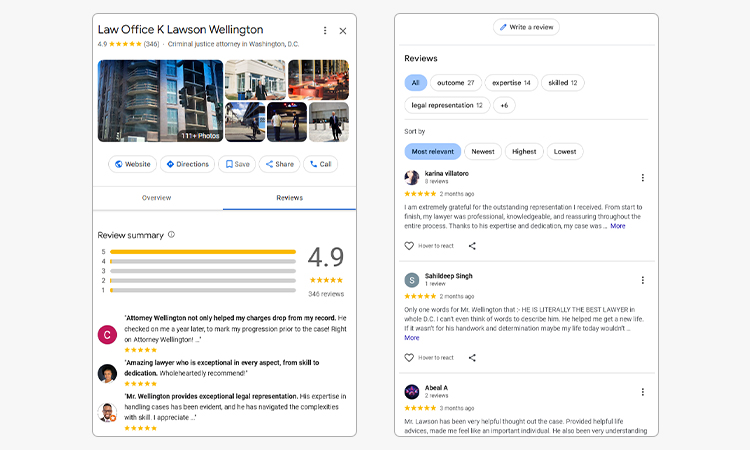
Online reviews are one of the best media through which you can improve your law firm’s digital reputation. According to a 2025 Wiserreview study, 41% of consumers say they are more likely to read reviews when browsing for businesses.
The reviews and ratings from your existing clients will serve as social proof for your law firm’s reliability and credibility. It will generate more client trust and confidence regarding your law firm’s expertise. Here are the 5 major review platforms where your law firm can receive client reviews:
- Google Reviews
Google reviews are one of the most crucial platforms for a law firm’s client feedback. Higher and consistent ratings on Google reviews, which are also detailed, significantly boost local SEO and visibility in online search results.
- Sulekha & JustDial
These are two major key business listing platforms in India when it comes to legal services. It allows users to actively find local firms and read online reviews. However, some recent legal developments have specifically highlighted regulations regarding the advertising of legal services on these platforms.
- Trustpilot
This specific review platform is used to build your clients’ trust and generate positive reviews from satisfied ones. Trustpilot is specifically effective for law firms that want to showcase a higher level of client satisfaction to a broader audience.
- Yelp
It’s a significant platform for law firms to manage their online reviews. If your law firm receives negative reviews, it can spread quickly and damage your online reputation overnight. Yelp reviews require prompt and professional responses to maintain the online reputation of your law firm.
- Search Engine Presence
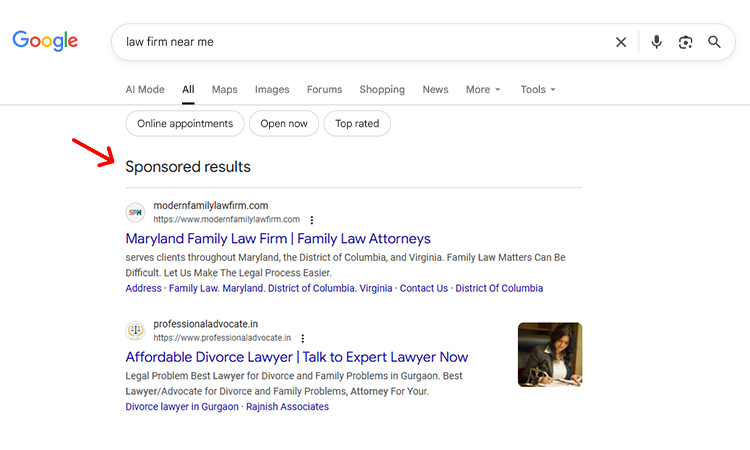
How your law firm appears online determines how many clients it can attract through search engine presence. When your prospective clients search for legal help, your law firm must appear prominently and professionally, with a positive online reputation.
- Visible on Search Results
Law firms must optimise for ‘near me’ queries and secure a top spot in the ‘local pack’ to outrank their market competitors. It involves initiating the protection of your law firm’s name across the search engine results and search ads as well. Because this may attract qualified leads.
- Branded Search Control
It significantly involves protection from mild to severe reputational damage. If your market competitors bid on your law firm’s name in search ads, including the firm name, lawyer name, and even misspellings. It will ensure the searchers reach you or your law firm, not any of your market competitors. When your law firm’s search presence is perfectly optimised for the branded keywords, whenever they search for your brand name.
- Webinars and Content Quality

You must produce high-quality content for your law firm, especially for promotional purposes. It will position your law firm as a trusted authority and help you convert visitors into your clients. Apart from this, it will build expertise, experience, authoritiveness, and trustworthiness (the E-E-A-T).
- Professional Website
As a law firm owner, you must develop a secure and mobile-friendly website that quickly loads, which is extremely crucial for retaining users. When your law firm has a website, your potential clients can get an idea of your legal offerings even when they don’t visit your office or consult you personally.
Your website will serve as the hub for your online reputation, a hub where your visitors can check bios, case studies, and testimonials.
- Blogs
When it comes to online reputation management for law firms, you must prioritise blogs as one of your primary types of authoritative content. You can regularly publish insightful blogs on legal topics that can showcase your expertise as a knowledgeable legal resource. Blogs are the ideal medium of content that you must produce to address common client concerns and improve search rankings. It will help you showcase your law firm’s legal expertise in the best possible light.
- Case studies
Your detailed accounts of your past successes showcase your law firm’s ability to solve problems. These case studies act as strong social proof that influences the hiring decisions of your company. It demonstrates your ability to resolve problems for various clients across various industries.
- FAQ Pages
You must create an FAQ section for the law first, through which you can directly answer questions of your potential clients. Those potential clients who are actively searching for legal help can earn featured snippets at the top of the Google results. It will also showcase your legal expertise and knowledge before they even call your team.
You should try to add all the trending questions and answers to the FAQ section to improve your website’s search engine ranking.
- Social Media Presence

Social media is a huge medium for law firms to actively engage with their followers and build their brand authenticity. Social media platforms like Facebook, Instagram, and LinkedIn offer a platform where law firm owners can humanise their brand and directly engage with their potential clients.
It is the premier network for professional legal firms and their lawyers, where they can share their services. Law firm owners need to focus on leadership through consistent sharing of legal insights. They can also provide updates on various major case law and company news.
They need to optimise their company page on LinkedIn and engage in targeted B2B networking for clients.
It is one of the most essential social media platforms for community building and client trust building. On Facebook, law firms can share educational content, their legal case success stories, and behind-the-scenes glimpses to showcase their firm’s culture. You can use Facebook to monitor your public sentiment and manage client reviews to directly engage with community members through the comment section.
This specific social media platform is ideal for law firms, specifically for visual storytelling and emotional connection. Instagram is best showcasing the complex legal procedures and services in a more fun and engaging way.
Law firms use infographics and high-quality photos of community service, team spotlights, and video content like Reels to build a ‘human’ brand image. Law firms can focus on engagement rather than just broadcasting.
- Twitter (currently known as X)
It is ideal for real-time engagement and branding for your law firm. You can use X for sharing quick updates and legal news commentary. On Twitter, law firms can engage in real-time industry conversations and use this specific platform for rapid response from their Twitter following by monitoring brand mentions.
- Media Coverage and PR

How the major media publications cover your law firm plays a crucial role here. It provides third-party validation for your legal expertise and reputation that you have built throughout the years.
- Brand Mentions in News and Legal Publications
You need to proactively secure coverage in local and national news. And for significant case wins, your firm’s expansion, and new partner hires. You need to produce thought leadership articles for your law firm, establishing it as an industry expert.
It is about building a strong relationship with journalists. It will also provide you with quick commentary opportunities during breaking news stories. Law firm owners must secure inclusion in legal directories or awards to increase visibility and credibility.
5 Common Reputation Management Challenges Faced by Law Firms
Just like any other online marketing strategy, reputation management for legal professionals comes with some challenges as well. Identifying these challenges well in advance can help law firms and legal professionals prevent major reputational damage due to those challenges.
Here is a list of the top 5 reputation management challenges law firms commonly face. Let’s have a look:
- Prevalence of Negative or Fake Reviews
Law firms are associated with critical and informed decisions. Online review platforms like Google, Yelp, and Facebook often have negative or fake reviews. Those reviews can actually make or break your law firm’s online reputation.
Even a single bad review can cause a significant decrease in your client’s trust. If your law firm faces such a decrease in its review count or experiences the prevalence of fake reviews, your reputation can be at stake.
- Who can write the reviews? Your market competitors, automated bots, and non-clients can share fake or negative reviews, intending to distort your law firm’s star rating and damage its credibility.
- Misrepresentation in Media Coverage
A law firm is involved in high-profile and contentious litigation. It is more likely to frequently face negative media attention and misleading media coverage. And media coverage can be sensationalist as it focuses on negative aspects or frames the firm. It can also unfairly showcase your legal expertise.
Unverified and premature media reporting can portray your law firm as guilty before a court verdict and damage a firm’s online reputation. A misrepresentation of your online media coverage can result in a ‘trial by media’ that undermines the presumption of innocence and creates a negative public perception, which is often extremely difficult to reverse.
- Legal Advertising Restrictions
Law firms are heavily regulated regarding how they can promote their services, unlike other traditional businesses. Regulatory bodies, including the Bar Council of India or the State Bar Associations, often restrict direct solicitation of work and the use of flashy advertising.
These types of restrictions make it difficult to counteract negative publicity, as most law firms cannot implement traditional marketing tools to rebuild their image as they mostly rely on more subtle and complaint marketing strategies.
- Lack of Online Presence
A weak or non-existent online presence of your law firm can be a major detriment in today’s digital-first world. There are many traditional law firms that lack a strong website, SEO strategy, and active professional social media profiles like LinkedIn.
If your law firm has a robust online presence but cannot showcase its successes or establish thought leadership in the competitive market. The situation allows negative content to dominate the online search results when someone searches for your law firm’s name or any similar branded keywords.
- Poor Client Communication
Effective reputation management for law firms mostly starts with client service. If your law firm is involved in poor client communication, it can drive negative reviews. Clients are more likely to have high anxiety related to their legal issues. In such situations, if the communication is also poor from your law firm’s end, it can create more reputational issues.
You must provide regular updates to your clients regarding the process in the case and set realistic expectations. A lack of transparency in the final billing or case updates can lead to client dissatisfaction that often leads to negative online reviews and poor word-of-mouth referrals.
A Comprehensive Guide to Online Reputation Management for Law Firms: 6 Best Strategies to Follow
Now it’s time to know about the thorough process of online reputation management for law firms. Here is a quick and complete ORM strategy guide law firms must implement to build and manage a positive online image. Let’s have a look:
Strategy 1: Encourage Positive Client Reviews

Reviews are the social proof that you can leverage to encourage your potential clients to choose your legal services over your other market competitors. However, review generation is not an easy process! It requires an ample amount of time and constant effort.
In simple words, you need to ask your clients (even the satisfied ones) to share their experience with your legal services. Have a look at how you can encourage your clients to leave reviews:
- Ask Satisfied Clients for Feedback
Time plays a huge role in successfully generating positive reviews from your satisfied clients. You must know how to ask for a review when their satisfaction level is at its peak. The time must be 3-5 days after the successful case resolution or a positive consultation session.
You must send personalized review requests to your clients, and don’t opt for generic message templates. When the satisfaction level is high, it increases the chances of getting a positive client review within time.
- Automate your Review Collection Process
You can use legal case management software and review management tools to send the automated email sequences. Through the automated systems, you can send text reminders. The automation ensures consistent review follow-ups without manual effort. Through these tools and their automation features, you can collect positive reviews seamlessly.
- Simplify the Review Submission
You need to reduce friction and provide direct links to the review platforms like Google, Facebook, and Yelp. This will make the online review management process extremely seamless. When you provide the direct link to the page, your existing satisfied clients can easily share their reviews.
You need to clearly outline the steps to submit a review or provide short templates to make it more effortless for your clients to share a review.
- Leverage QR Codes or Links
You must incorporate review QR codes and links into your email signatures, physical marketing materials, such as business cards or office signs, and invoices.
- Why QR codes? You must use QR codes to allow clients to scan and instantly reach the review page on their mobiles.
A professional review management service from a reputable online reputation management agency can help you navigate the complex ORM landscape for your law firm.
Strategy 2: Respond to Reviews Professionally and Empathetically
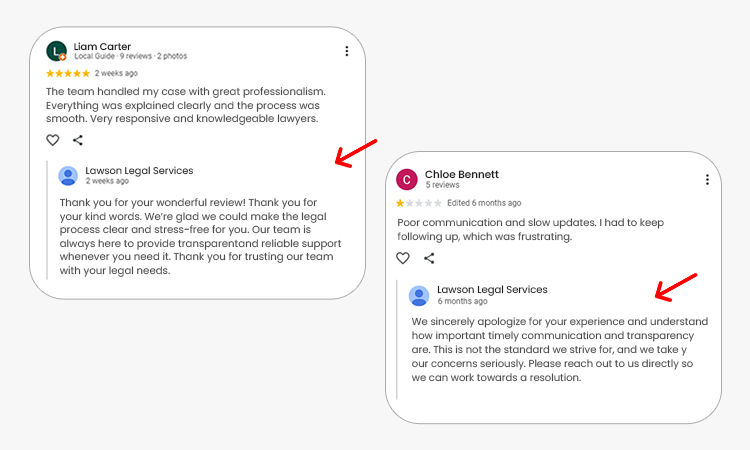
Now that you already have an idea of how you can successfully generate reviews from your satisfied clients, it’s time to know how you can respond to the reviews.
How you’re responding to the reviews plays a major role in showcasing how much you care about your clients’ opinions. The following is a quick guide to effective review response generation management:
- Handle Negative Reviews Calmly
It’s quite natural for law firms to receive negative reviews. But you shouldn’t react to the negative reviews emotionally or defensively. Even if the review contains extreme criticism, you must respond to it with utmost professionalism and empathy.
- Maintain Confidentiality of Your Clients
You should never reveal specific details, confirm your client relationship, or post private information in a public response. You must use neutral language and invite the reviewer to privately discuss the matter offline.
Maintaining the ultimate level of confidentiality can help you earn your client’s trust and brand credibility.
- Thanks for the Positive Reviews
After a successful positive review sharing, you must publicly acknowledge the satisfied clients for sharing their experience on a public platform. It helps you build a positive online reputation for your law firm. Trust us, it will only take a short and grateful response to achieve the client’s loyalty.
- Don’t Ignore Neutral Reviews
It’s common to receive neutral feedback as well. Apart from positive and negative feedback, you can receive neutral reviews. Many law firm owners may ignore those reviews as they are not specifically positive or negative. But they shouldn’t – responding to those neutral reviews can showcase that your law firm is active and committed to premium-quality service for every client.
Responding to a neutral review can help you turn a mediocre experience into positive feedback.
- Send Prompt Responses to Reviews
Just like a prompt review request, you need to ensure your response to a review is also on time. Imagine responding to a higher online rating and a detailed review after one week! The reviewer is more likely to perceive that you don’t care much about your clients’ feedback and appreciation.
When you respond to a review within 24-48 hours, it showcases that your team is attentive and takes client feedback seriously.
- How to Handle Fake Reviews for Your Law Firm?
Apart from positive and negative reviews, your law firm can also receive fake reviews. Most fake reviews are often shared by the market competitors with the intention of maligning your law firm’s image.
Handling fake reviews is a skill – a swift and professional approach to protect your reputation. Now the question comes – how can you identify the fake reviews?
If you cannot identify them and take necessary precautions, it can damage your reputation further.
- Identify Fake Review Patterns
Effective fake review management is one of the most crucial strategies of online reputation management for law firms. Here is a quick guide on how you can identify fake reviews for your law firm. Always identify the following patterns in your responses –
- No records of the database of a client’s name and purchase history
- Lack of specific details about the legal matter or case
- No previous review history/only one review/many one-star reviews within a short timeframe
- Multiple negative reviews
- No profile photo and details
- Generic language, vague, and highly emotional phrases
- Respond to Fake Reviews
Let’s know how you can respond to fake reviews, as not responding to fake reviews can escalate the situation further and showcase the fake review as real client experience.
- You should never argue or make emotional responses to a fake review.
- Keep your response polite and professional.
- We suggest that you not disclose any confidential or sensitive information of your client or the legal case involved.
- Always mention that you have not found a record of the reviewer’s association with your law firm. You can also invite them to contact your team personally.
- Report the Fake Reviews
If a fake negative review is harming your law firm’s online reputation, you must report it with the help of the ‘Report’ feature of Google Business Profile, Yelp, and other review sites. However, it requires you to submit the evidence to the specific platform where you want to report a review.
The evidence is important to show that the specific review has violated their content guidelines.
Strategy 3: Optimize Your Law Firm’s Online Presence
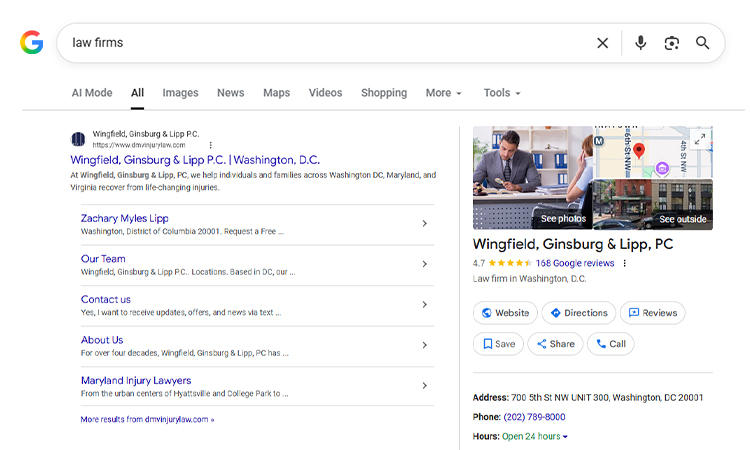
Now it’s time to optimize your law firm’s online presence.
It’s more than just mere keyword stuffing! From optimizing your online content to ranking it for generative engine results to structuring content to be used by various AI tools. It also includes implementing the strategies for local search via the Google Local 3-Pack.
- How to Rank for Branded and Service Keywords?
Firstly, you need to rank your law firm’s online presence for branded keywords, such as your firm’s name or service-related keywords. Implementing this type of keyword can help you build topical authority and trust.
For this, you need to –
- You should not rely on only one ‘service page’; you must create separate and comprehensive pages for each legal service you provide.
- You must include the primary keyword and your law firm’s location in the H1 tag of your content, webpage URL, and meta description.
- You must implement the LegalService and ‘Attorney’ schema to signal Google and other search engines your legal practice areas, location, and fees. It will help your content rank for rich snippets.
- Don’t forget to add an attorney bio page, including the full names, bar numbers, and case results of all the legal professionals associated with your law firm.
- Top Local SEO Strategies of Your Law Firm
Below, we have talked about how you can rank your law firm for relevant local searches:
- You need to claim, verify, and fill out all the little details of your law firm on its Google Business Profile.
- Always add consistent and updated NAP details, such as your law firm’s name, address, and phone number.
- You must send GBP review links to your clients directly after a successful case resolution.
- Try to earn qualified links from local and authoritative legal sources, such as non-profit communities, local chambers of commerce, local sports team sponsorships, and local legal bar associations.
- If you serve multiple locations, you need to create unique and high-quality landing pages for each location.
- Create SEO-Optimised Valuable Content
When you produce SEO-optimized content for your website, it will naturally rank your legal practice or law firm for relevant search queries.
Always remember that the content you will create for your law firm must answer specific and conversational questions to rank in AI summaries. The following are 4 major types of content that you must create for your law firm:
- Legal Guides – You create a comprehensive guide on your local legal services. It will help you showcase your authority on your local services to both the online searchers and AI search engines.
- FAQs – Don’t forget to structure your content in a Q&A format that answers real client queries. For such FAQ pages, you can add the FAQ schema to make them directly appear in search results.
- Case Insights – Always showcase successful outcomes of your legal cases. However, you need to maintain the ultimate level of confidentiality and not disclose any crucial details of your clients’ cases and identities. You need to narrate the entire problem, your law firm’s strategy to resolve the issue, and the outcome it has achieved. It proves expertise and converts your visitors into your loyal clients.
- Blogs – As a law firm owner, you must avoid the ‘what is’ or ‘definition’ articles. We suggest that you write about the local legal news, recent statutory changes, and deep dives into specific case issues.
- Video Content: You need to create a short video to explain complex legal procedures and service offerings. You can also create FAQ videos and host the video on YouTube. Don’t embed them, as Google prioritizes multimedia content to rank them in their search results.
Strategy 4: Leverage Social Proof
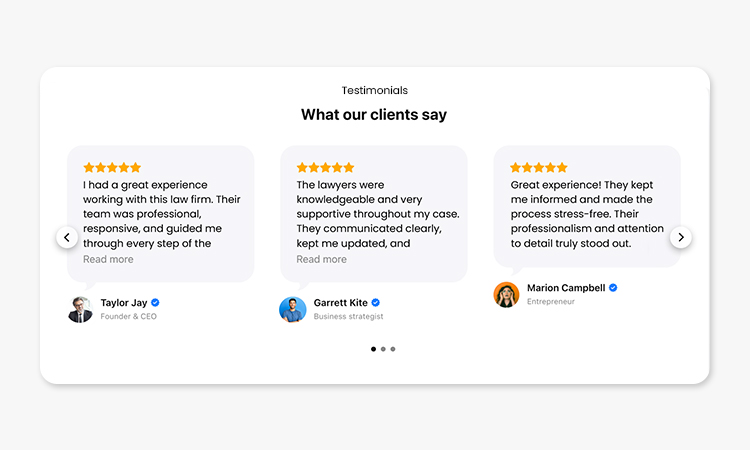
Showing the real clients’ experiences can help you achieve your potential clients’ trust and encourage them to hire legal services from your law firm. It acts as social proof for your law firm to potential clients.
Here are three main types of social proof or user-generated content that you can leverage for your law firm’s promotion:
- Testimonials
Client testimonials and feedback can help you showcase the real positive experiences of your clients related to their legal services. Let’s know how you can leverage the testimonials for your law firm:
- Use after the service: You need to collect the client testimonials through simple surveys that you should immediately send after a successful case completion.
- Focus on emotion and relief: You must encourage the clients to share their satisfaction, relief, and trust.
- Utilize video testimonials: Always promote short and well-shot video clips where your clients are talking about their positive experience. Such videos will help you build immense trust in your potential clients.
- Verify and add context: You must pair quotes with first names, their initials, location, and service type to enhance the credibility of your legal brand.
- Be compliant with ethical guidelines: While utilizing your client testimonials, you must ensure that those testimonials are genuine and not misleading. Those testimonials should not guarantee outcomes. Law owners must obtain written permission to utilize the testimonials. We suggest that you not offer any kind of incentives for reviews, as it can violate the ethical guidelines of the platform.
- Client Success Stories
Now, it’s time to know how you can leverage client success stories. Let’s have a look:
- Structure it as a story: You must structure testimonials as a ‘mini case study’ that outlines the case issue, the solution, and the positive outcome as well.
- Humanize the case: Apart from structuring the story, you must highlight the human element of your legal work. You need to focus on your client’s journey rather than just the result. Humanizing the case is all about making the story relatable to prospects.
- Use ‘Before and After’: You need to highlight the issues before you took over a legal case, and the severe reputational consequences the client has experienced. You should also highlight the stability or positive outcomes achieved through your legal services provided.
- Showcase diversity: You must ensure the client’s success stories perfectly represent a variety of legal practice areas and case types to demonstrate the breadth of the law firm’s expertise.
- Case Wins (without violating confidentiality)
Showing your case wins is crucial to effective online reputation management for a law firm. You need to demonstrate your case wins as social proof of your legal brand reliability and credibility.
- Make the details anonymous: Law firm owners must protect their privacy by sharing success stories without revealing their clients’ names. They should specifically personalize the narratives of their case wins and the type of challenges your law firm has solved, rather than disclosing the identity of the client.
- Focus on the local strategy: You need to highlight the innovative legal strategy or expertise that your legal team has used to solve the problem.
- Utilize the quantifiable results: you shouldn’t use broad claims; use tangible metrics, including the expected statistics.
- Generalize case details: You need to discuss the kind of dispute the legal case has involved without revealing the identifiable facts.
Strategy 5: Monitor Your Reputation Regularly

Last but not least, law firms need to know how they can monitor their reputation. Implementing the ORM strategies is not enough; you need to monitor what is working and what is not.
- Key Performance Indicators to Monitor Regularly –
There are some key performance indicators that you must regularly track to monitor your law firm’s online reputation. Have a look:
- Average Star Ratings – The average number of star ratings your law firm has received from the clients after successful case completion
- Review Velocity – The volume of new reviews to understand whether there is a steady flow of recent reviews
- Review Response Time – How much time does it take you or your team to respond to the reviews, especially the negative ones
- Review Sentiment Analysis – The tone of the majority of reviews to identify recurring issues
- Search Engine Visibility – How likely clients are to recommend your law firm on a scale of 1-10
- Google Business Profile Interactions – How often your law firm appears in the local map pack for relevant keywords like ‘lawyer near me’
A Pro Tip: You need to track calls, direction requests, and website clicks directly initiated from your law firm’s Google Business Profile.
- Website Engagement Metrics – How long visitors stay on the site, and whether they use chat functions or fill out intake forms
- Referral Rate – How often existing clients recommend your law firm
- Client Retention Rate – The percentage of clients who return to your team for additional matters
- Social Media Mentions – How your brand is perceived in social media platforms, such as LinkedIn and Facebook
5 Most Helpful ORM Tools Law Firms Must Employ
The right implementation of the helpful tools can make the process more seamless for the law firm owners who don’t have proper knowledge of how to get started with even the basic online lawyer reputation management.
Here is a list of some popular ORM tools that law firms must consider implementing to boost their ORM efforts:
| ORM Tools | Features to Use |
| 1. Google Alerts | • A free tool that sends email notifications when new content matches specific keywords • Allows you to immediately identify new blog posts, news articles, and forum mentions • Helps in setting alerts for your law firm’s name, individual attorneys, and key competitors |
| 2. SEMrush | • Comprehensive digital marketing suite that offers proactive ORM features • Helps identify potential reputation threats before the situation escalates • Analyzes sentiment and improves SEO |
| 3. Hootsuite | • A social media management tool that allows for monitoring multiple social media accounts • Helps in monitoring LinkedIn, X, and other social sites • Enables proactive risk management and allows teams to spot misinformation or negative trends |
| 4. Podium | • A customer interaction platform that centralizes reviews, text messaging, and web chat into one dashboard • Streamlines the process of requesting the client reviews through SMS and email • Ensures generating reviews as soon as a case concludes |
| 5. Reputation.com | • An AI-powered, enterprise-grade reputation management platform to manage the entire reputation experience • Offers comprehensive tools for monitoring reviews across hundreds of platforms like Google, Yelp, and Facebook • Identifies patterns in client feedback and monitors multiple offices in a single dashboard |
3 Legal and Ethical Considerations in Reputation Management for Law Firms
Online reputation management for law firms requires balancing visibility with strict ethical guidelines for the law firms. It must adhere to the Bar Council advertising rules and the strict avoidance of claims about expertise. Law firms must maintain client confidentiality throughout the overall reputation management process.
Let’s know about these legal and ethical considerations in law firm reputation management:
- Bar Council Rules on Advertising
Advocates and law firms are strictly forbidden from advertising or soliciting work either directly or indirectly. You must ensure the legal profession remains a profession rather than just a commercial trade. If there are any changes to the Bar Council of India Rule 36, it will allow only basic details, including name, address, and contact information.
The BCI strictly forbids legal influencers and practitioners from promoting legal services, banners, social media, and online platforms. It also involves warning of suspension or removal from the rolls.
- Misleading Claims
All marketing materials, such as websites and social media, must be factual, honest, and not at all misleading. The law firms must avoid claiming to be an ultimate expert or knowledgeable resource in the market, unless the firms are officially certified to do so. Apart from this, the comparison of legal services with other law firms in a factually substantiated way is strictly prohibited.
- Confidentiality and Client Privacy
When it comes to legal firms and their services, confidentiality is paramount. Legal professionals must not reveal information regarding cases or clients in marketing materials, testimonials, or case studies without explicit and written consent. Digital marketing must adhere to the legal standards, such as India’s Consumer Protection Act (CPA), to ensure that user privacy is strictly not violated during lead generation.
FAQs
Here are some frequently asked questions and answers related to the online reputation management process for law firms and legal professionals:
Ans. Firstly, you need to document the evidence, including the screenshots. After collecting them, you can report them to platforms like Google and Yelp for privacy violations, if it is necessary. We suggest that you consult an internet defamation attorney for further legal assistance. To maintain the ultimate level of confidentiality, you must avoid disclosing client details and post a professional response stating you cannot discuss specific cases. Apart from this, you can bury the negative review with new positive feedback by sharing new and high-quality content.
Ans. Yes, negative reviews can significantly harm a law firm’s digital reputation by decreasing client trust in your legal expertise. It can help you lower the search rankings and reduce your opportunities to earn potential leads. You must maintain a balanced and authentic online profile with thoughtful responses. It often builds more long-term credibility than a perfect score for your law firm.
Ans. When you want to build an effective online reputation for your law firm, you must know that this is a long-term strategic process. It generally takes 6-12 months to show significant and desired results. However, setting up online profiles, getting initial reviews, and seeing minor SEO movements can occur within 3-6 months. Apart from this, a substantial authority and a dominant search presence usually require at least a year of consistent effort from a law firm’s end.
Ans. Yes, as a law firm owner, you can receive false or negative reviews on platforms like Google and Yelp if they violate policy guidelines on false content, spam, harassment, and conflicts of interest. To remove them, you need to report those reviews directly through your law firm’s online profile. However, complete removal of these reviews is not guaranteed, as the specific platform will thoroughly investigate the review and the reason for reporting.
Ans. Complete repair of the damaged reputation of a law firm takes a minimum of 4-12 weeks, if it’s related to repairing the minor issues. It takes 6-12 months to repair severe and public reputation crises. You need to understand the fact that repairing the online reputation of a law firm or repairing its issues is a long-term strategy and requires consistent and long-term behaviour change.
Conclusion
Law firms and legal professionals often require a robust strategy plan to build their online image. Without a positive online presence, a law firm cannot grow in today’s digital-first competitive legal industry. Building a long-term online reputation is something you cannot achieve overnight! It requires an ample amount of time and constant effort, most specifically a well-developed strategy plan.
We hope our comprehensive guide to online reputation management for law firms will help you navigate the complexities of online image building and management.
If you still don’t know where to start, we advise you to consult with a reliable online reputation management agency to seek their expert guidance and assistance.

