





Imagine receiving fake reviews for your business on a popular platform like Google. Embarrassing, right? We know you’ve worked tirelessly to build your online reputation by treating your customers with care and providing top-tier service. But a one-star review from someone you don’t even recognize as a client, detailing a negative experience with your business that never happened, can tarnish your online image overnight and affect your potential customers’ trust. All you need is a mindful strategy to handle fake Google reviews effectively.
Do you know that nearly 10.7% of reviews on Google are fake?
Yes, you heard that right! Fraudulent Google reviews are a serious threat to your personal and business reputation. While fake reviews with no response from your end can showcase the feedback as real customer experiences, abusive or angry responses, even to the fake negative reviews, can deter customer trust. Even Google may not rank your business higher if it receives too many fake reviews.
Before you panic or respond in frustration, let’s explore a comprehensive process to address fraudulent Google reviews and safeguard your online reputation. In this thorough guide, we will explore how you can identify, report, and remove fake reviews from Google.
Understanding Fake Google Reviews
We all know what fake reviews can be—they are mostly fabricated, inaccurate, and incentivized client feedback. Fraudulent reviews you receive on Google often violate the platform’s policies, which aim to manipulate your business ratings and online search visibility.
However, Google prohibits fraudulent content, spam, and conflicts of interest, specifically reviews that are not based on real experience. When a review violates these policies, it can result in removing the review, warning labels, and often a complete suspension of your Google Business Profile.
Understanding Google’s Policy on Fake Reviews
Google showcases reviews that represent genuine customer experience. Understanding these policies can help you navigate the complex landscape of Google review policies. Let’s have a clear idea of the Google review policies:
- No fake content: The reviews on Google must not be fabricated, incentivised, or posted by someone who has no experience with a business.
- No incentives: You cannot offer discounts, money, or gifts in exchange for reviews, as incentivized reviews are strictly prohibited.
- No spam/hate speech: Google reviews must not contain spam links, explicit content, or irrelevant commentary.
- No review gating: Google, as a platform, doesn’t allow discouraging and prohibiting negative reviews while encouraging the positive ones.
- Conflicts of Interest: Businesses or individuals cannot review themselves or their competitors on Google. They cannot even ask their friends or families to review their own businesses.
- Overview of Google’s Review Policies
Here is an overview of Google’s review policies:
- Accuracy and Relevance: Google reviews should be based on real and firsthand customer experiences.
- Restriction of Content: Google strictly prohibits off-topic, fraudulent, and spammy content in a review.
- Misrepresentation: Google, as a platform, prohibits impersonation or misleading information in a review.
- Consequences of Violating Policies
Now we will know the major consequences of Google review policy violations. Let’s dive into the details of the list:
| Consequences of Policy Violations | What Is It? |
| 1. Suspension | Complete suspension of the Google Business Profile and deletion of your online presence |
| 2. Removal of Reviews | Removal of the entire review or some parts of a manipulated review |
| 3. Warning Labels | The appearance of the ‘This profile has a suspicious review activity’ banner that can damage your potential customers’ trust |
| 4. Lower Rankings | Reduced visibility in search results |
| 5. Legal Action | Encouragement or development for fake reviews that can be considered fraud or illegal |
- Importance of Google’s Review Compliance
Google reviews are crucial social proof for individuals and businesses. You must be thinking, why is review compliance so important? Let’s have a look:
- Credibility: Authentic reviews on Google are more likely to build customer trust and enhance your overall brand reputation.
- Performance: When your client reviews are properly compliant with Google, it ensures that the reviews assist in ranking. On the other hand, fraudulent reviews can ruin your business listing across search rankings.
- Fair play: Google review compliance ensures a fair and competitive environment for all types of businesses.
You can seek professional online review management services to make your client reviews perfectly compliant with Google.
4 Types of Fake Google Reviews
Fake Google reviews are designed to manipulate a business’s online reputation, with 90% of them eventually removed by Google’s automated detection systems.
Who posts these reviews? These types of reviews are often posted by Google accounts that have not genuinely experienced the service that they have talked about in their reviews. These reviews are often flagged by vague language and a lack of details.
- Competitor-generated Negative Reviews
These types of reviews are often referred to as ‘vandalism’ as they are mostly shared by your market competitors. They are more likely to share fake one-star reviews with the intention to malign your online image.
- Characteristics:
- Mostly about service or quality
- Lack of specific details about a visit
- Claims regarding the business are a scam
- Purpose:
Mostly to the competitor’s overall rating and boost their own – it often involves coordinated attacks and where multiple fake accounts attack one specific business at once.
- Bot-generated Spam Reviews
People often generate spam reviews with the help of AI tools. These tools generate automated scripts and share these reviews as real individuals.
- Characteristics:
- Identical and repetitive wordings
- Poorly translated languages across multiple reviews
- 5-star ratings without text
- 1-star ratings with only emojis
- Purpose:
Rapidly manipulating search rankings or lowering ratings as part of a coordinated spam campaign.
- Paid Positive Reviews
Nowadays, to win over a competitive digital scenario, many businesses and agencies often purchase bulk positive reviews. Such reviews are often shared online to artificially inflate the business’s online ratings.
- Characteristics:
- Over-the-top and vague praise
- Appreciation from online profiles that reviewed 1-3 businesses in their lifetime
- Purpose:
Intended to offer incentives, such as money, discounts, and free goodies, in exchange for positive reviews.
- Irrelevant or Off-topic Reviews
These reviews often don’t relate to the product or service that is provided by the business. Such reviews violate Google’s content policies and can be removed by the platform itself.
- Characteristics:
- Complaints regarding the business’s political views
- Irrelevant topics
- Mistaken review intended for a different or similarly named company
- Purpose:
Intended to harass, spam, and simply reflects a misunderstanding of what your business actually does or offers
5 Key Reasons Why Fake Google Reviews are Harmful
Fake Google reviews can cause significant risk to businesses, specifically reputational damage. It can often cause long-term damage to an individual’s or a business’s online reputation, which far outweighs any short-term perceived benefits.
If you’re ignoring the fake reviews you’ve received on Google, and choosing not to respond to them, you’re making a huge mistake!
Today’s consumers and search algorithms are increasingly adept at identifying this kind of deceptive practice, as it turns fabricated reviews into a major liability for an individual or a business. Let’s have a look at the list of 5 major reasons why fraudulent Google reviews can be extremely harmful for your digital image:
- Major Damage to Brand Credibility
After years of effort, you have built a strong foundation of online reputation for your business or your professional authority. You have built your customer trust and long-term relationships with your customers.
A bunch of fake reviews shared by your competitor can destroy your reputation and customer trust. It can severely damage your business’s credibility.
How? When your customers notice unnatural patterns in your Google reviews, such as an influx of reviews over a short period, ‘too perfect’ reviews, or generic phrasing, they will perceive them as suspicious. If you’re caught using fake reviews for your business, it’s next to impossible for you to regain your lost customer trust. In severe cases, it can even position your company as a dishonest one.
- Loss of Potential Customers
The loss of trust comes with the loss of your potential customers. According to a 2018 study by Power Reviews, 97% of consumers rely on reviews for making purchase decisions.
If your potential customers suspect any kind of review manipulation on a major platform like Google, they will lose their confidence in your brand’s credibility and choose your competitors over your business. Your potential customers will not purchase from your business if they notice low Google ratings or a bunch of suspicious Google reviews. It can often lead to a major loss of revenue and reduced word-of-mouth referrals for your business.
- Legal and Ethical Concerns
Do you know that buying positive reviews, incentivizing or fabricating them, is unethical?
In many jurisdictions and Regulatory bodies like the Federal Trade Commission in the US and the Competition and Markets Authority in the UK, fake reviews are perceived as deceptive advertising. If you, as an individual or your business is found engaging in these kinds of practices, you can face severe penalties, including hefty fines and potential lawsuits from your competitors or regulators.
- Lower Search Rankings on Google Search
Google is more likely to rank businesses that are high in authenticity and use sophisticated AI algorithms to identify unnatural review patterns.
If your business is flagged for using fake reviews to enhance your Google review count, Google may punish you by removing those fake reviews. It can lower your company’s local search rankings. In severe cases, Google can even completely suspend the Google My Business listings. Your company’s online presence can majorly lose its visibility, and your website can lose traffic.
- Negative Public Perception
If your business uses fake reviews to position itself as a company with higher Google ratings and more positive reviews, it can lead to major public backlash that can often spread through social media and online forums. When it comes to negative publicity, it can create a ‘PR disaster’ for your business.
It makes the situation more challenging for you to build a positive online image in the future. Do you know that a single and high-profile incident related to fake reviews can result in years of negative search results? It can cause a ‘cycle of declining’ online reputation for your company, which can be extremely difficult for you to break.
How to Identify Fake Google Reviews: 4 Major Signs of Fake Google Reviews
Now the question comes – how can you identify fake Google reviews among the bulk of feedback you receive every day from your customers?
We know that it’s quite difficult! When you receive a large volume of reviews, detecting the fake ones can be a daunting task for you because some fake reviews can be just like the real client experiences.
Don’t worry! We are here for your rescue! Below, we have discussed the most common signs of fraudulent Google reviews. You can effortlessly detect the fake reviews by identifying these common signs. Have a look:
- Suspicious Reviewer Profile
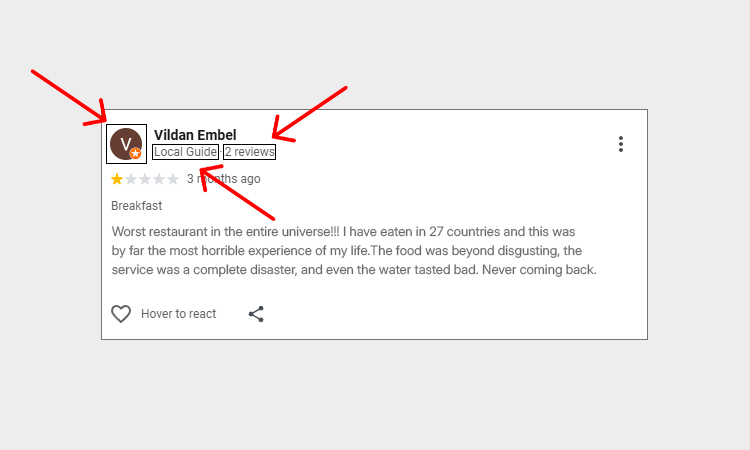
You must take a close look at the reviewer’s profile first, as it can often reveal the real identity of the reviewer. You can easily know whether the reviewer is a real person or an AI-generated bot.
Check for these signs when reviewing the reviewer’s profile:
- No Profile Picture – If the profile has no photo, cartoon avatars, stock photos, or generic names.
- Low Review History – If the reviewer’s account has left only one or two reviews in the past, or a reviewer’s account has a history of giving only 1- or 5-star ratings
- Geographical Inconsistencies – If the reviewer has left feedback for your business in different cities or countries within a very short period of time
- ‘Local Guide’ Misconception – If the reviewer’s profile has a ‘Local Guide’ badge, you should not trust this type of profile before fact-checking them for once, as they often produce fake reviews by using the ‘Local Guide’ badge to appear more legitimate.
- Vague or Over-the-Top Content
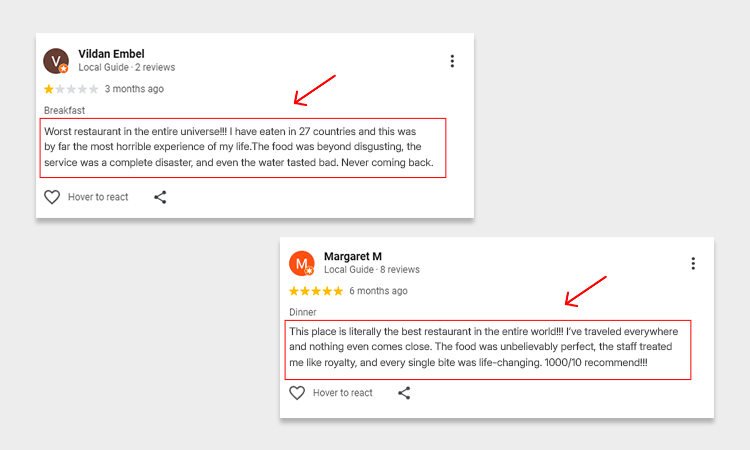
Occasionally, you may notice reviews containing vague or over-the-top content. This is mostly because the fraud reviewers often quickly write reviews that lack genuine customer experience details.
- Lack of Specific Details: If the review contains generic language and could apply to any business other than your company, and lacks details like specific products purchased, staff names, and service dates
- Overly Enthusiastic Praise: If the review uses hyperbolic and extreme language without context, such as ‘Best product I have used!’ or ‘Worst place in the town!”
- Repetitive Phrasing: If the reviews contain identical phrases, spelling errors, and word structures that indicate that those reviews are AI-generated
- Irrelevant Content: If the reviews contain irrelevant content related to services, products, and amenities that your company doesn’t offer in reality
- Overly Enthusiastic Praise: If the reviews contain overly enthusiastic praise or appreciations for a business or individuals
- Constant Grammatical Errors: If the reviews contain a lot of silly grammatical mistakes
- Suspicious Timing and Patterns
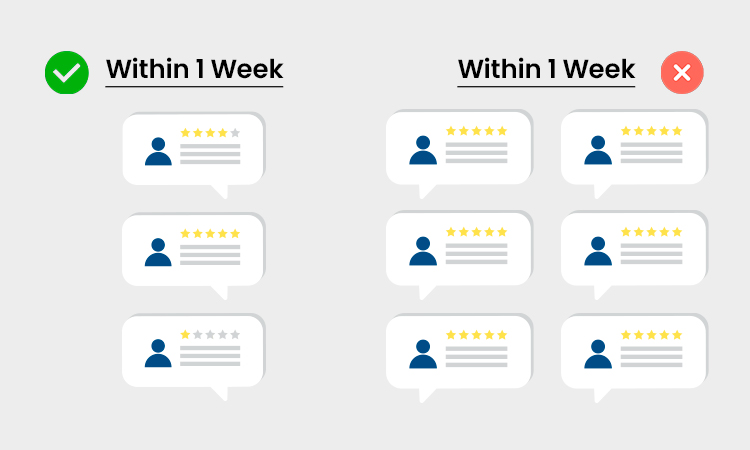
Fake reviews are rarely organic—you can see them appearing in unnatural waves. The timings of sharing those reviews and their patterns are more likely to be suspicious.
- Review Bombing: If you notice a sudden increase in 5-star or 1-star reviews within a short period of time (for example, ten reviews in one hour after weeks of silence), it can indicate a coordinated effort of bombing your Google presence with too many positive or negative reviews.
- Unnatural Timing: Many reviews are posted at irregular times (e.g., in the middle of the night), which can be a major sign of a fake Google review.
- Inaccuracies and Irrelevance
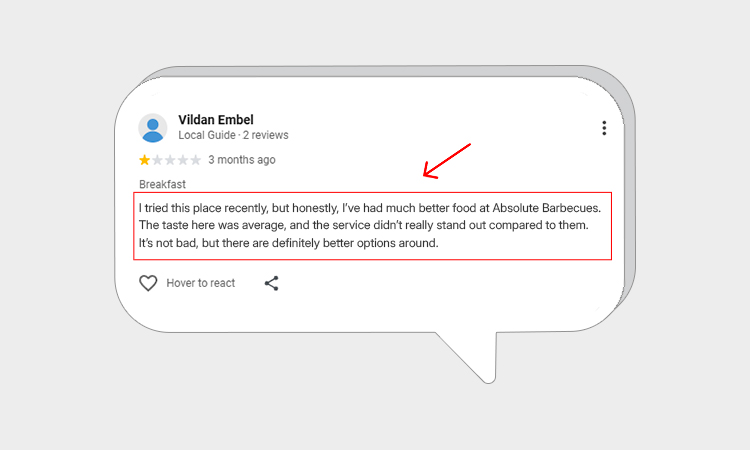
Fraudulent reviews often mix up facts through incompetence or by targeting the wrong business. If the reviews contain inaccuracies or irrelevance in context, the reviews are more likely to be fraudulent.
- Mentions of Incorrect Products and Staff: If the reviewer cites a manager or employee who doesn’t work in your company anymore, or mentions products your company doesn’t sell.
- Mentions Competitors: If the review actively encourages your clients to visit one of your market competitors, this is a major sign of a ‘fake negative review’ campaign
- Incoherent Content: If review content makes little to no sense, has poor grammar, is badly translated, or contains scripted grammar, the review is more likely to be fraudulent.
How to Effectively Remove Fake Reviews from Google: An Ultimate Guide for Individuals and Businesses
Now that you have a clear idea of how you can seamlessly detect fake reviews on Google, it’s time to learn how you can remove them before they cause major reputational damage to your online reputation.
Here is a complete strategy guide for you on how to remove fake Google reviews. Let’s have a look:
Strategy 1: Flag the Fake Review
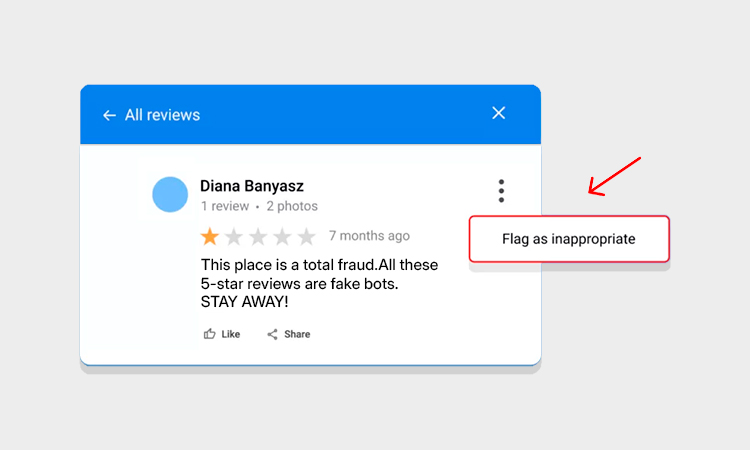
Effective Google review management strategies require you to flag the specific review. Flagging a review means you’re signaling to Google that the review is causing extreme damage to your personal or business reputation—Google needs to remove the review.
Flagging or removing the review requires you to follow certain steps. In this section, we will talk about the procedure.
- How to Report a Fake Review on Google?
To report a fake review on Google, you need to flag the content for violating the platform’s policies. If the review content contains spam, impersonation, and irrelevant details, Google will definitely remove the review from its platform. Please let us know how you can report or flag a review.
- Step 1: Identify the Violations
Firstly, you need to verify whether the review breaks Google’s content guidelines or not. You can consider a review to be a Google policy violation if it contains the following:
- Conflicts of interest
- Impersonation
- Off-topic content
- Spam
We have already talked about the most common signs of fake reviews on Google. You need to detect those signs to identify the policy violation.
- Step 2: Flag the Review in Business Profile and Maps
Now it’s time to learn how you can flag a fake review in your business profile and on Google Maps.
- Firstly, you need to sign in to your personal or your company’s Google Business Profile.
- Secondly, navigate to the specific review you verified as fake in the review section.
- Click on the three-dot menu in the dashboard and select the ‘Report Review’ or ‘Flag as inappropriate’ button.
- You need to choose the most suitable policy violation category among ‘Spam,’ ‘Off-topic’, and ‘Conflict of Interest’.
- Step 3: Use Google Business Dashboard
Now you need to use the GBP dashboard to properly track the flagged reviews. Locate the review in the dashboard and click on the flag icon, as it can directly trigger a review of the policy violations by Google.
- Step 4: Employ Review Management Tools
You need to use the specialized review management tool that Google offers. You can find the tool on your GBP profile and select your business.
- Firstly, click on ‘Report a new review’ for removal.
- You need to locate the review and choose the reason why you think that the review has violated the platform’s content policies. Then submit your report and wait for a response from Google’s team.
- Step 5: Report the Review to Google Support
If the review still appears after you have flagged it, you can contact Google Support. You can find the details through the Help Center option – it will help you to initiate a more formal review reporting process.
- Step 6: Provide Evidence to Support Your Claims
Please remember to collect and provide proper evidence to support your claims. Proper evidence submission can help you strengthen your claims.
List of evidence you need to collect –
- No purchase history of the fake reviewer
- Information regarding the reviewer was never your customer
- Inaccurate information provided by the reviewer
- Screenshots of personal attacks or fake profiles
Strategy 2: Contact Google Support
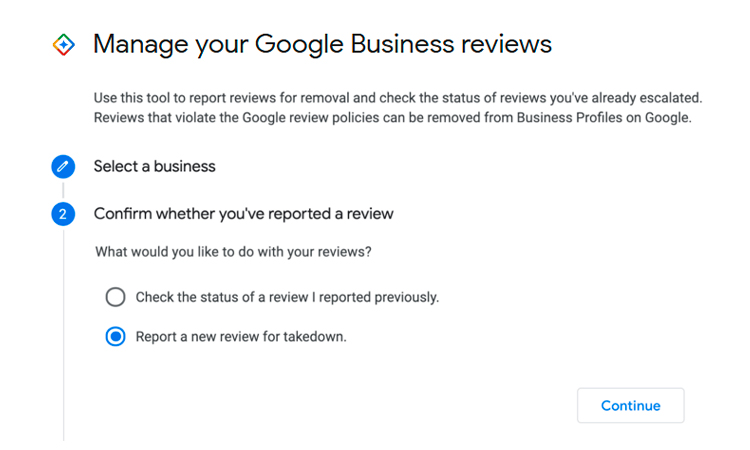
Other than using Google’s own Review Management Tool, you can formally appeal your claim of removing a fraudulent review through Google Support. You can escalate the issue through the Google Business Profile Help Community.
In certain extreme cases, you need to submit a legal takedown request for the specific review. You need to prove it to Google Support if a review has violated policies.
- When Flagging a Review Doesn’t Work?
Do you know that a flagged review can still appear on Google reviews?
Yes, you heard it right! It means that, despite flagging a review, the review may still appear on Google. It also means that Google’s automated systems or initial review did not find a policy violation in the review.
Wondering what to do if the flagged review still exists on Google? Let’s know the alternatives:
- Review Management Tool – You need to navigate to the Review Management Tool on Google and select your business. Now you need to click on the ‘Report a new review for removal’ to see the status of the flagged review.
- Second-time Appeal – If your first appeal fails, you can use the same tool to ‘Appeal eligible reviews’. Remember, you can only select up to 10 reviews for a second-time analysis by a human operator.
- Google Business Support Ticket – Another alternative is to contact Google Business Support through their Help page to raise a formal support ticket. However, you need to ensure that you have the case ID from your previous review reporting appeal.
- Various Legal Escalation Methods
Google may refuse to remove a review that is fake, defamatory, and damaging as well. For such cases, you can take legal actions as well. Here are some legal escalation methods you can consider:
- Legal Removal Request: You need to use the Google legal trouble-shooter to file a complaint against the review, which is fake, defamatory, and majorly violates your legal rights.
- Cease and Desist Letter: These letters are intended to threaten legal action for defamation. You can send these letters to the reviewer who has shared the fake review.
- Court Order: If the specific review is defamatory, you can definitely pursue a lawsuit. You can even send a court order to Google to force the removal of the review if the court deems the content illegal.
- Illegal Activity Reporting: This is only applicable for severe cases of harassment or defamation. You can report the fake review to law enforcement and submit that report to Google.
Strategy 3: Prioritize Legal Actions
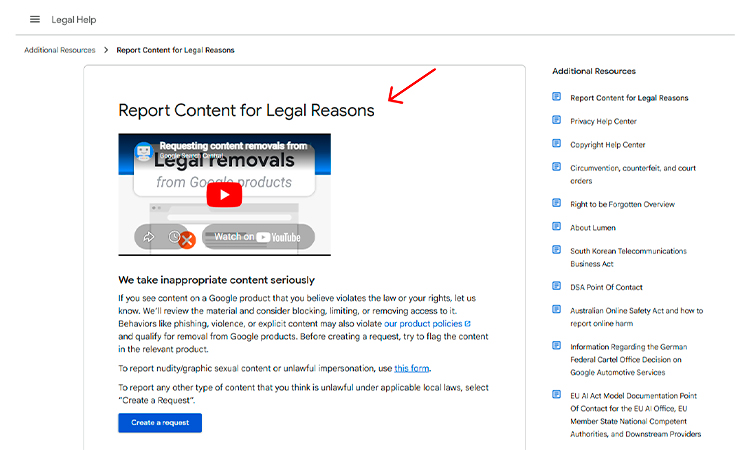
For severe cases, when Google has not removed a review even after you have flagged it as fake, you must prioritize escalating the issue to Google’s legal department. After exhausting the standard reporting options, you can prioritize legal action as the last option to completely remove the defamatory or fake review that violates platform policies.
- When to Consider Legal Steps?
You can consider taking legal actions against the malicious review, when –
- The review makes false statements of fact that cause measurable harm to your personal or professional identity
- Multiple fake reviews suddenly appear from a competitor or a disgruntled party
- Reporting the review as a violation and or having a one-time appeal is denied
- The reviewer is an ex-employee or competitor
- The review claims illegal activity, fraudulent service, and health safety violations
- Which Documents Are Required?
Without gathering substantial evidence, you cannot proceed with sending a Cease and Desist letter or a lawsuit. The following are the documents you need to collect and provide:
- High-quality screenshots or snapshots of the review with the user’s name
- Screenshots of the reviewer’s profile showing other suspicious reviews as well
- Your CRM records, POS system, and appointment logs are showing no customer matching the reviewer’s name, date, and specific interactions
- Details of your communication with them before the review that contradict the reviewer’s claims
- Documentation that indicates a drop in sales, negative impacts on inquiries, and canceled appointments after the review is shared
- A formal Cease and Desist letter drafted by an attorney for defamation/harassment
- Already pursued legal channels, and a court order confirming the review is defamatory
Strategy 4: Respond to Fake Reviews
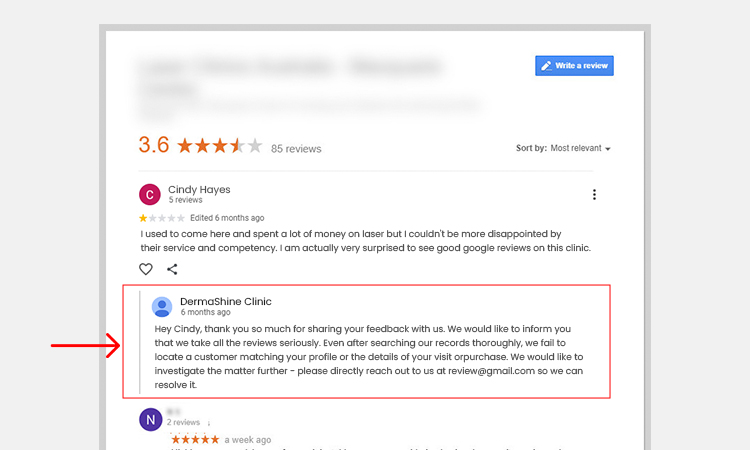
You need to respond to the fraudulent reviews on Google as a critical part of reputation management for individuals and businesses.
Most people still feel that avoiding responding to fake reviews is an option to prevent online arguments. But it is not! When you respond to even a fake review, it showcases your professionalism, vigilance, and dedication to providing high-quality customer service.
- Stay Calm and Professional
You need to avoid being emotional, angry, and defensive while responding to a fake review. You must not share a defensive response, as it can make your business look unhinged, even if you’re right!
You need to remember that you’re responding to your audience, who can be your potential customers. If you respond thinking that you’re replying to the fake reviewer only, it shouldn’t be the case. Don’t forget that hundreds of your potential customers will read your response, no matter how defamatory the fake review was.
- Acknowledge and Clarify Your Statements
Start with a neutral greeting to acknowledge the review and clarify your statement. You can start your response by mentioning a simple ‘Thank you!’ However, you must not apologize for a situation that never happened, even to boost your reputation.
You can also gently state that you cannot find any record of the reviewer in your system. You can provide the direct contact number or email ID in the response for the reviewer so that they can easily contact you. And the fun fact is that most fake reviewers never contact you to get their issues resolved.
If the review is about a product or service that you don’t offer, politely state that you do not provide them.
- Example Samples of Fake Review Responses
Here are two samples of fake review responses you can take references from:
Sample 1:
“Hey (reviewer’s name), thank you so much for sharing your feedback with us. We would like to inform you that we take all the reviews seriously. Even after searching our records thoroughly, we fail to locate a customer matching your profile or the details of your visit or purchase. We would like to investigate the matter further – please directly reach out to us at (email ID/Phone) so we can resolve it.”
Sample 2:
“Thank you for the feedback. We take utmost pride in providing excellent service. However, the details in the review don’t align with our records or our business offerings. We’re committed to maintaining a trustworthy presence for your personal or professional identity. We’ve already reported this review for further analysis. Kindly contact us at (email ID/phone number) to discuss the issue further.”
Strategy 5: Prevent Fake Reviews
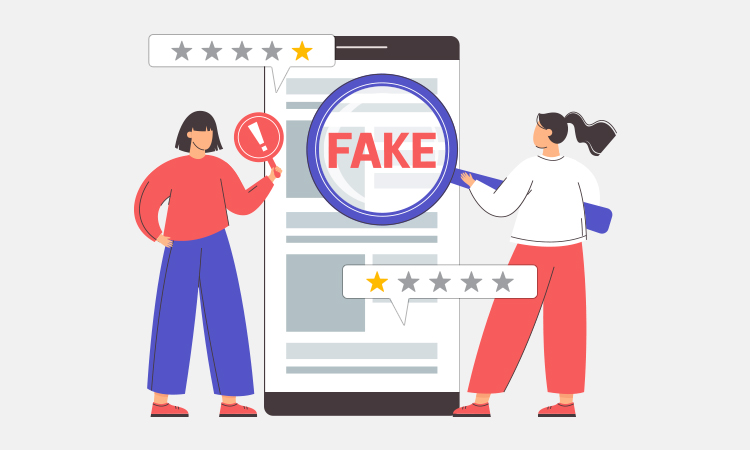
Do you know that you can also prevent fake reviews?
Yes, you can prevent fake reviews by implementing several effective strategies. Let’s have a look at the list of strategies:
- Encourage Honest Reviews from Satisfied Customers
You can ask your satisfied clients to share genuine positive reviews. You can send them automated review requests to your customers. After 1-2 days of providing a service, you can ask your satisfied clients to share their real experiences with your company. When you receive positive reviews, it can naturally push down the negative, fake ones in the search engine result pages.
- Build a Strong Review Strategy
Proper planning boosts your efforts for effective review management. Thus, it’s important to build a solid review management strategy first to deal with fraudulent reviews. When you already have a proper plan to deal with the fraudulent reviews, it will be easy for you to implement the strategies.
- Regularly Monitor Reviews You’ve Received
You must monitor the reviews you’ve received from your clients. A thorough and regular monitoring of your reviews can help you spot the fake ones quite quickly. The faster you detect the false reviews, the less negative impact they can have on your personal and business reputation.
Top 5 Reputation Management Tools to Handle Fake Google Reviews
Though the process of detecting and effectively handling fake Google reviews is quite complex, implementing some helpful reputation management tools can help you effortlessly accomplish the process.
Here is a list of the top 5 reputation management tools you must employ to identify and deal with fraudulent Google reviews:
| Online Reputation Management Tools | Features to Use |
| 1. Birdeye | • Top-rated AI-powered platform for multi-location businesses • Analyzes reviews for ‘spam’ or ‘slander’ • Provides real-time alerts and allows businesses to flag fraudulent reviews immediately from a centralized dashboard |
| 2. Brand24 | • A comprehensive social listening tool that helps track brand mentions across the web • Offers an AI-driven anomaly detector that you can use to identify sudden spikes in negative emotions • Allows for proactive fake review attack management |
| 3. Thrive Local | • Boosts your business’s local SEO through reputation management • Provides a dedicated ‘fake review checker’ • Provides an AI-powered analyzer to identify fake reviews among the bulk of other reviews • Allows automated review requests through email and SMS for more than 100 review sites |
| 4. Reputation | • Provides a ‘Reputation Score’ that generally benchmarks location performance and helps identify a sudden, suspicious decrease in your online ratings • Offers AI-powered insights and deep analytics to detect sentiment analytics • Offers features to manage and respond to reviews across more than 250 cities |
| 5. Customer Alliance | • Monitors online presence and provides authenticated review systems • Helps in generating verified reviews that reduce the overall impact of unverified fake reviews • Allows automated review solicitation, semantic analysis |
4 Common Mistakes to Avoid while Dealing with Fake Google Reviews
When dealing with fraudulent Google reviews, you must adopt a strategic, calm approach. Making some common mistakes can prevent you from achieving your desired goals. While dealing with fake reviews, if you act emotionally or completely ignore the reviews, it can damage your business reputation.
Identifying the common mistakes can help you avoid making them and ensure removing the fake reviews before they damage your personal and business reputation:
Mistake 1: Ignoring Fake Reviews
The most common mistake is to believe that if you ignore a fake review, it will naturally go away. Let us tell you that it will not. Your potential customers read your client reviews to make informed decisions. Most individuals and businesses ignore fake reviews that allow the review to act as the ‘truth’ or ‘real customer experiences.’
What to do? You need to respond that you have no record of their visit or purchase, along with no client history. You need to immediately flag the fake reviews as inappropriate to Google.
Mistake 2: Responding Aggressively
Are you one of those who respond to negative reviews in anger? If yes, the situation can be problematic for you! Your business is very likely to receive negative reviews along with positive reviews – some of the negative ones can be fake as well. If you respond to these reviews with anger, sarcasm, or accusations, it makes their business appear unprofessional.
Such an angry response, even to a fake review, showcases to your potential customers that your business is difficult to deal with, no matter whether the review is fake or not.
What to do? You need to stay calm and factual while responding to the fake reviews. You shouldn’t use any type of abusive language while communicating, as it can violate Google’s guidelines.
Mistake 3: Posting Fake Reviews to Counterbalance
Even if your business is struggling to grow in today’s competitive market, you shouldn’t buy fake positive reviews to counterbalance. You should never buy or create fake positive reviews just to build a positive online reputation for your business.
Posting fake reviews violates Google’s policies. If you are caught for once, your Google Business Profile can be suspended completely, which is more damaging than receiving a 1-star review.
What to do? You need to focus on building a strategy to encourage your satisfied customers to share their real experiences. Those real and positive reviews will naturally dilute the fake reviews.
Mistake 4: Not Monitoring Reviews Regularly
If you don’t prioritize regularly monitoring your Google reviews, you may not get to identify the fake ones. Those fraudulent Google reviews can appear online for weeks, and they can even damage your local search rankings. An influx of fake reviews can significantly damage your business’s average Google ratings and harm your ability to be found in relevant ‘near me’ searches.
What to do? Even if you’re receiving a good flow of reviews, you must monitor the reviews to keep track of the fake reviews. You must set up notifications in your Google Business Profile to receive regular alerts for new reviews, as the process will help you immediately detect and flag fraudulent reviews.
FAQs
The following are some frequently asked questions and answers related to the process of fake review removal from Google:
Ans. Yes! Google can automatically remove fraudulent reviews. But it requires you to report the specific fake reviews to initiate the process with Google. Google has an automated system to detect and remove spam content from its platform. You need to report suspicious reviews through your personal or business profile or use their Removal Tool. Additionally, you can appeal decisions to remove malicious, off-topic, and non-genuine reviews.
Ans. The complete review removal from Google takes 24-48 hours. It takes this much time for automated systems to process a report, but manual appeals or complex cases of review removal can take a few days to several weeks, and sometimes it can take more than 60 days. A straightforward policy violation is easy to remove quickly, while the overall process depends on the violation type, Google’s current request volume, and evidence provided.
Ans. Yes, your competitors can post fake reviews for your business with the intention of maligning your personal or business reputation. This practice is unethical and often illegal, violating FTC guidelines. The enforcement can be inconsistent, and it makes it essential to actively report and document the actions to get them completely removed.
Ans. If Google declines your request to remove a review even after you flag it, you can appeal the decision through the Google Review Management Tool if the option is still available. If this appeal is also denied, the best option to deal with such a fake review is to respond to it professionally to showcase to your potential customers that your business is engaged and active. You can also encourage positive reviews from your satisfied customers to bury the fake reviews.
Ans. Google’s review removal tool is a dedicated and official feature that allows individuals and business owners to report and manage their reviews on their Business Profile, which specifically violate Google’s policies. It allows you to flag inappropriate content and track the status of your reported reviews. You can also file an appeal if a review violation is not initially removed.
Conclusion
Dealing with fake Google reviews is a daunting task for today’s modern businesses. Just like genuine positive reviews and criticism, you can also receive fake reviews from your competitors and AI bots. However, this doesn’t mean your reputation is helpless. You can consider implementing effective strategies to remove fraudulent Google reviews.
Our comprehensive guide on the Google review removal process will help you deal with fraudulent reviews in a proactive and systematic approach. You will detect red flags, report violations, professionally respond, and remove the negativity with genuine customer feedback.
A reliable online reputation management agency with a team of skilled ORM professionals can help you effortlessly identify and effectively deal with fake reviews on Google. If the process seems complex to you, you can seek professional assistance from such a renowned agency.

