





In today’s digital-first world, dentists need to build a solid online reputation and digital presence for their practice. Reviews play a huge role in building or destroying a dental practice’s online reputation. Just think – what does a patient check when searching for a dentist for their dental needs? Reviews of other patients, right? When a dentist has a strong base of positive reviews, more patients are likely to choose their services over competitors. And to encourage positive reviews and build a solid digital presence, dentists must prioritize effective dental review management strategies.
While providing exceptional dental care is a non-negotiable factor in the dental sector, actively managing your patients’ experiences and their reviews is what helps you acquire new patients.
A 2020 survey shows that nearly 77% of patients turn to online reviews as the first step of searching for a new physician.
Yes, you heard that right! Now you can imagine how important it is to manage the patient reviews your dental clinic or practice has received online. In this comprehensive guide, you’ll learn about the effective review management strategies for dentists to help you build a positive reputation with 5-star reviews. Let’s get started with the detailed definition of review management for dentists:
What Is Dental Review Management?
Review management for dentists refers to the active process of monitoring, generating, and responding to reviews that patients leave across major review platforms, such as Google, Facebook, and other industry-specific sites. Effective review management for dental practices can help professionals maintain a positive, reliable, and high-ranking digital reputation.
Those who have just started their journey as dentists, as well as established dental experts, must prioritize patient review management to boost their patients’ trust, local SEO visibility, and attract new patients by highlighting the dental practice’s quality of care.
7 Key Reasons Why Review Management is Crucial for Dentists
When dentists effectively manage patient reviews, they gain an extensive list of benefits. A strong and positive patient review base can help professionals improve their local search rankings and build prospective patients’ trust.
It also helps them detect reputational issues in advance, before they escalate, and reduce the damage from negative patient feedback. Here is a list of 7 key advantages dentists can leverage with online review management:
- Boosts Local Search Rankings
Do you know that search engines like Google use quantity, speed of acquisition, and diversity of patient reviews as key ranking factors in their local search results?
Yes, you’ve heard that right! When a dental practice has a strong base of positive reviews, it showcases that your dental practice is active and relevant. It will also showcase how your existing patients are satisfied with your dental services. It will directly help you make your dental practice appear in the ‘Local-3 Pack’ (mostly the top three local listings) when a patient is actively looking for a local dentist.
- Builds Patient Trust and Credibility
According to a 2026 BrightLocal study, 47% consumers won’t use a business that has fewer than 20 reviews. When searching for a reputable dental practice, most prospects try to find a reliable dental care service provider with a strong review base.
Most potential patients are more likely to trust online reviews just as they do personal recommendations. When your dental clinic or practice achieves 4.8 or higher online ratings from its patients through effective review management strategies, they naturally earn a positive online reputation, followed by a steady patient acquisition flow. The online reviews can act as social proof that your dental practice is trustworthy and professional.
- Drives Patient Acquisition
If you have a robust, well-managed patient review profile, it directly influences the decisions of your future patients regarding choosing your dental practice among your competitors. Reviews act as real experiences of patients who have already hired dental care services.
Patients will check these reviews to decide whether a specific dental care provider is right for them or not. A positive review base built through effective patient review management can help you attract new patients and ensure more appointments, as those reviews highlight the USPs of your dental care expertise.
- Detects Reputational Issues in Advance
Effective dental review management requires you to constantly monitor and track your dental clinic’s positive presence and digital reputation. Monitoring your online reputation can help you get real-time, actionable insights into your patient experience.
You can easily identify issues regarding your dental practice that can majorly damage your online reputation. For example, if you get multiple positive patient reviews regarding long wait times, cold staff behavior, and high costs, it’s a sign of a reputational issue. Regular review monitoring can help you address these operational issues before they damage your dental clinic’s online reputation.
- Offers Competitive Advantages
In today’s digital age, when people search for a dentist online, they may find many reputable dental professionals and their clinics across the web. They’re more likely to get confused while choosing a suitable dental care service provider.
Effective review management helps professionals generate a huge number of positive patient reviews that can help them stand out in a competitive dental sector. By providing you with a significant edge in local search, it can help you outrank your local competitors whose dental care clinic is still there in the area but has fewer or older reviews.
- Mitigates Damages from Negative Feedback
Negative reviews are inevitable for dental practices. Active management of patient reviews allows you to reduce the reputational damage to your dental practice. Regular monitoring allows you to address the negative feedback and take necessary precautions before they harm your public image.
As a part of the Dentist review management strategy, responding to negative reviews can help you resolve the issue and turn a negative patient experience into an opportunity to regain their trust. It often turns patient dissatisfaction into a business opportunity and prevents severe reputational damage.
- Positively Impacts Dental SEO
Beyond just ranking in maps, effective review management strategies help you generate a solid number of patient feedback after a successful dental treatment service. New reviews provide fresh, user-generated content to your dental clinic’s online profile that most search engines love.
Search engines like Google are more likely to rank such high-authority user-generated content that contains keywords related to your services, like dental implants, whitening, affordable dental service providers, and friendly hygienists. It improves your website’s online search visibility for specific, high-value treatments.
Where Patients Leave Dental Reviews: Top 5 Review Platforms
Not every digital space is specialized for leaving reviews, specifically patient feedback.
There are some most popular platforms where your dental patients can share their feedback regarding a dental care service. As a dentist, you can target these platforms to reach a wide audience and acquire new patients by highlighting the USPs of your dental care treatment.
- Top 5 Popular Review Platforms Dentists Can Target
The following are the top five platforms that you must prioritize to manage your dental clinic reviews:
| Top 5 Popular Review Platforms | Why Is It Important? |
| 1. Google Business Profile (GBP) | ● A dominant platform that accounts for 57.5% of all worldwide reviews ● Crucial for the local SEO of a dental clinic as it appears directly in Google Search and Maps ● The most trusted source for patient reviews |
| 2. Practo | ● A leading healthcare platform to list your dental clinic and manage appointments ● Allows for online booking and automated appointment reminders via SMS/email ● Provides high visibility among urban patients who are searching for specific dental specialties |
| 3. Healthgrades | ● A leading healthcare-specific platform with more than 30 million monthly users ● Provides comprehensive, verified, and detailed feedback ● Builds credibility among patients |
| 4. JustDial | ● A massive, widely used local search engine ● Helps in listing your dental care services for local searches ● Offers extensive and detailed profiles with real-time reviews |
| 5. Facebook | ● More than 3 billion active users ● Popular digital space for patient recommendations within the local community groups ● Best for reviews related to dental clinic photos and interactions |
5 Common Patient Review Challenges Dentists May Face
Just like the benefits, patient reviews come with certain challenges as well. Identifying these challenges can help dental professionals detect the issues and take necessary precautions well in advance.
Below, we have explained the 5 most common patient review challenges dentists may face:
Challenge 1: Negative Reviews due to Pain or Fear
Do you know that almost 36% of the population is suffering from dental anxiety, while 12% are experiencing extreme fear.
So, dental anxiety is a thing! When a patient experiences dental pain, their fear often causes a negative interaction. They’re likely to leave a 1-star review just because they experience discomfort or perceive rough treatment. Such reviews are also considered negative patient feedback and can question a dentist’s credibility.
Challenge 2: Complaints about Treatment Pricing
Apart from dental anxiety, ‘sticker shock’ is also a major challenge most dentists may face. It is one of the leading causes of negative reviews. Your current and prospective patients
often find procedures like dental implants and cosmetic procedures extremely expensive or overpriced. So, they leave reviews complaining about the unexpected costs and lack of insurance for those dental treatment services.
Challenge 3: Waiting Time and Staff Behavior
Many dental clinics have long wait times, and the front-desk staff working there often misbehaves with the patients or their families while communicating. This can be a major reason for them to leave a negative review regarding the dental clinic, especially if the patient parties have an unpleasant experience while visiting the clinic during an appointment or surgery.
If a patient feels that their time is disrespected, they will leave a negative review, and you can’t help it. Thus, apart from enhancing their clinical skills, the dental professionals must focus on their clinic environment as well.
Challenge 4: Fake or Competitor Reviews
Dental professionals are more likely to receive fraudulent or vulnerable reviews from fake profiles (who were never their patients) as well as competitors. Such reviews are often intended to damage their reputation as a dental professional. They may often contain false claims about their dental surgery safety or poor treatment results, severely impacting their online reputation.
Challenge 5: Low Review Volume
Many dentists struggle with lower review volume, as they often don’t know how to generate new reviews from their patients. They often lack a review management system or a professional team that can help them navigate the complexities of patient reviews.
It may sound weird to you, but most of your satisfied patients don’t feel a strong need to leave feedback unless you ask them to. That’s why their total number of patient reviews is less than what their competitors have.
Core Components of Online Review Management for Dentists
Effective online review management is a huge part of dentists’ reputation management services. Specialized ORM agencies will help you manage and monitor a large volume of patient reviews across multiple social media sites. From drafting HIPAA-compliant responses to building patient trust and securing a prominent local presence, effective review management plays a significant role for dentists.
Here are 4 major components of dental review management you shouldn’t avoid focusing on:
- Review Monitoring
When you track your online reputation and what is being said about your practice in real-time, it helps you understand where your dental expertise is lacking and where it is performing well.
Generating online reviews is not enough!
How you monitor the patient reviews matters the most! Here is a quick guide on how you can effectively monitor your reviews:
- How to Track Mentions across Platforms?
Tools like Google Alerts send you real-time notifications whenever someone mentions your name as a dentist or your dental clinic’s name online. It notifies you through SMS or email alerts when your dental practice’s name, specific dentists’ names working in your clinic, and even misspellings are mentioned.
- How to Get Real-time Alerts?
You need to configure these review monitoring tools for email or push notifications for all the new reviews your dental practice receives across the web. That’s how you can ensure prompt responses to every review you receive; otherwise, a delayed review response may turn into a negative experience and damage your dental clinic’s reputation.
- Review Generation Strategy
If you’re a dentist, you must have a clear idea of the techniques you must leverage to generate a noticeable number of dental clinic reviews. It’s not just about asking your patients to leave a review after they receive a successful treatment service from your clinic – it depends on:
- When do you request the patients to leave a review?
- How are you requesting the review from your patients?
- Are you following ethical ways?
- Are frequent review requests affecting your patient experience?
If you’re now thinking – why ask for reviews? Patients will spontaneously share reviews after a dental treatment or service.
So, let us tell you that, no, they won’t. Until you ask for it, most of your patients are not likely to share their reviews even if they received a positive experience at your dental office. Dental professionals can seek tailored dentist reputation management services for their expert guidance on effective patient review generation.
Now, let me know how you can request reviews from your satisfied patients ethically and professionally:
- Ethical Ways to Request Reviews from Happy Patients
Timing plays a huge role in ethically requesting patient reviews. Below are some tips to request reviews from your happy clients.
- Choose the Right Time: Dentists must send review requests right after a successful dental appointment or procedure. It’s mostly because, during that time, a patient’s satisfaction level is more likely to be the highest.
- Train Your Staff: At your clinic, you need to train your front-office staff regarding the techniques they can use to ask for feedback at the time of checkout. You should also train them to focus on the happy clients rather than those who have a negative experience during treatment.
- Never Bribe for Reviews: You shouldn’t offer incentives or any type of discounts in return for positive reviews from your patients. This may violate the review platform policies and other ethical standards.
- Send SMS and WhatsApp Follow Ups
Text messaging and WhatsApp messaging are the two most convenient ways to send review request follow-ups. You can immediately send automated, personalized review requests through SMS or WhatsApp messages right after a patient visit, appointment, or treatment. In such requests, you can also incorporate a direct link to the review platform you specifically prioritize.
- Post QR Codes at Clinic
If you have a physical clinic in a location or multiple locations, you must display QR codes of your review page at the checkout desk. Apart from this, you can also print the QR codes on your business cards and promotional flyers that will take people directly to the review submission page.
- Professionally Respond to Patient Reviews
Just like you generate new reviews from your patients, how you respond to those reviews also plays a major role. When you professionally respond to every review you receive, it shows that you listen to your patients and you care about their opinions.
- Examples of Review Response Templates
Effective review response drafting and sharing are crucial to dental review management. Here are some examples of dental review responses from where dentists can reference.
- For Positive Reviews:
“Thank you for your kind words, (patient’s name)! We’re thrilled to hear you had a positive experience at our clinic. Kindly share with us your surgery progress report when you visit our clinic for post-surgery consultation. We look forward to seeing you at your next dental check-up.”
- For Negative Reviews:
“Thank you for sharing your experience with us! We’re sorry to hear that you experienced a long wait time during your visit. We value our every patient’s time and strive to stay on schedule regarding patient appointments, surgery timings, and routine check-ups. We apologize for the inconvenience caused to you. At (your dental clinic’s name), emergency appointments occasionally cause delays. However, we will review this with our appointment scheduling team to improve. Please reach out to us at (your dental clinic’s phone number) to discuss the issue further.”
- For Neutral Reviews:
“Hey, (patient’s name), thank you for sharing your child’s positive experience at our dental clinic. At (your dental clinic’s name), our team works hard to make dentistry comfortable for all ages!”
- How to Calmly Handle Negative Feedback?
When responding to negative feedback, you must maintain your calmness and professionalism. No matter how much criticism a negative patient review involves, you cannot respond to it using the same tone.
- Be prompt while responding to negative reviews; try to respond within 24-48 hours.
- You must apologize for the inconvenience caused to the specific patient, even if you disagree with the review. You should always empathize with the patients’ perspective.
- As a dental professional, you can politely ask the patients to call your client support team to resolve the issue privately. It’s necessary to prevent a major escalation of the concern and protect your professional reputation while ensuring patient satisfaction.
- Avoid Patient Confidentiality Breaches
Avoid compromising your patients’ confidentiality by never revealing their medical records, identity, or other details. Never reveal any protected health information in a response. Never confirm the reviewer is a patient or discuss treatment details while responding.
Instead of using a generic template, you can use a personalized response to the reviews by incorporating the details mentioned in the reviews. Even if the review is inaccurate, you must use a generic response.
- Prioritize Review Removal and Dispute Process
While most online review platforms don’t allow permanent removal of negative reviews just because they are harming someone’s reputation. If you don’t like negative reviews, this is not a valid reason to remove them. Such reviews can only be removed if they violate the platform policies.
- How to Remove Reviews from Online Platforms?
Here are some quick step-by-step guides to remove negative reviews from major online platforms.
Google allows the removal of reviews that violate its policy on spam and fake content, off-topic, or illegal content. To remove a Google review from the platform –
- Firstly, you need to locate the review on the platform and then click on the three-dot menu.
- Select ‘Flag as inappropriate’ and use the ‘Review Management Tool’ of Google to report the review and check its status.
- If the request is rejected by Google, you resubmit a one-time appeal.
- If it cannot be removed, then you can also consider responding to it politely to mitigate reputational damage and show the potential patients you care about their opinions.
It’s another major review platform that dentists must focus on while managing online patient reviews. As this social media platform doesn’t have a direct ‘delete’ button for removing individual reviews (this is not called ‘Recommendations’).
You need to follow these steps to remove Facebook reviews.
- Firstly, click on the three dots on the recommendations and select ‘report’.
- If you have many fake reviews, you can completely turn off the reviews tab. For this, you need to follow these steps:
Setting > Templates and Tabs > Reviews > Turn Off
Note: This specific process hides all the reviews, including the positive ones.
- If possible, address the most complex complaints and criticisms offline. Try to resolve the issue directly by communicating with the user to encourage patients to take it down.
- Practo
Practo has a strict policy and moderation team for feedback. This is one of the most popular review platforms for healthcare professionals like dentists.
- You can contest feedback within 15 days of submission feedback within 15 days of submission. This process mostly removes it while the matter is under investigation.
- You can report non-compliant feedback to the client support team of Practo.
- You can use the ‘Feedback Blur’ feature of the tool to report the specific review.
- You can also escalate the issue to the Grievance Officer if the issue remains unresolved.
- Healthgrade
This is another major dental review platform that active dental care providers use for their patient review management. If any specific review has violated the guidelines of the platform, such as containing vulgarity, personal attacks, or misinformation, it will be easier to remove that specific review from Healthgrades.
Here is the process dentists should use to remove a review from Healthgrades.
- Click the ellipsis in the top-right corner of the comment box to report the review.
- Then, you can reach Healthgrades support directly to argue that a review is false by providing evidence, if possible.
- You can also generate new, positive reviews to push down the negative Healthgrade reviews.
- JustDial
In the 5th number, we have listed JustDial as it allows for the reporting of fraudulent or abusive reviews. Let’s have a look at how you can remove your dental reviews from the platform:
- You can use the reporting feature of JustDial ‘Report’ or ‘Flag’ option next to the review on your vendor dashboard.
- Contact the customer support of JustDial if a review is fake or malicious. You can contact JustDial’s support team with evidence to request removal.
- When to Seek Legal Assistance?
If a review contains defamatory, false, and malicious information that can cause significant damage to your online reputation. Additionally, if it constitutes unlawful harassment, dentists can contact a legal professional specialized in defamation.
You can also hire an ORM agency that also offers personalized legal assistance for dental practices.
A Step-by-Step Review Management Guide for Dentists
Now that you know how to manage your patients’ reviews and feedback, it’s essential to learn how to do it with ultimate perfection. Here is a comprehensive guide on effective online review management strategies for dental professionals:
From thoroughly auditing your online presence to generating positive reviews from your patients and monitoring the review trends on a weekly and monthly basis, our guide will cover every single aspect of your dental review management requirements.
Step 1: Audit Your Online Presence
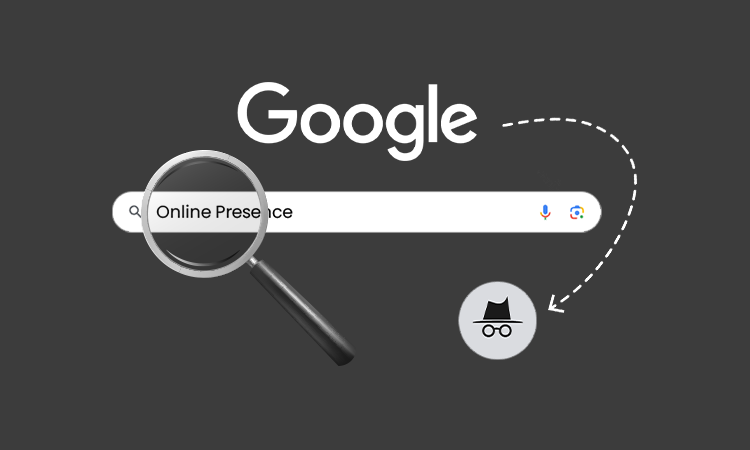
The first thing you should do is to audit your dental practice’s reputation and online presence. It will help you understand what’s working for you and what isn’t. A thorough edit can also help you effectively monitor where your dental practice stands across the web.
- Search for Your Name or Your Clinic’s Name as a Dentist
To perform a thorough audit, you need to follow certain steps. Let’s have a look:
- Firstly, use the incognito mode of the browser you’re using, so that you don’t get to see the personalized search results based on your search history.
- Search for your name as a dentist or your dental clinic’s name on the search engine. Search for ‘your name + dentist’, ‘your dental clinic’s name’, ‘your clinic’s name + location’, and ‘specialist’s name working at your dental clinic + location of your clinic’.
- Check the key platforms, such as Google Maps and Google Business Profile.
- You must check your dental clinic’s presence on specialized health directories, such as Healthgrades, Vitals, WebMD, and Zocdoc.
- Don’t forget to check the social media platforms like Facebook, Instagram, and LinkedIn.
- You can also check your dental clinic’s presence on community forums like Nextdoor.
- Ensure your dental clinic’s or practice’s name, address, and phone number are consistent across all platforms. If there are discrepancies, it can reduce the trustworthiness of your dental expertise.
- Identify Existing Ratings
Now, it’s time to note down things that you have identified during the thorough audit. Let’s know what the things are that you must document:
- Total Volume and Star Rating: The number of reviews and the average rating on every platform.
- Recency of reviews: Patient reviews from the last 3-6 months, and old reviews that are more than 1 year old.
- Your market competitors: 3 competing dental clinics in your location, their total number of reviews, ratings, and speed of response to the reviews.
- Your review response status: Whether you’re responding to reviews or not, the response time, the tone and quality of your replies.
- Perform Detailed Public Sentiment Analysis
Now you need to perform a detailed public sentiment analysis based on your patient reviews. Here’s how you can perform the detailed analysis:
- Dentists need to find the recurring themes in both the positive and negative reviews. The common topics in the patient reviews often include: patient wait times, staff friendliness, and billing.
- You can categorize the patient reviews into some major sentiments, such as:-
- Who do your existing patients love? Is that gentle or modern equipment?
- What has caused frustration? Is that your staff’s rudeness, unexpected costs, or long patient wait times?
- Are there any generic comments that lack proper details?
- You should also identify unmet expectations that will tell you about the gaps in service quality. You may not find such gaps in generic monitoring, as they are not so obvious, such as poor communication regarding your dental treatment plans or excessive patient wait times.
- You can use sentiment analysis tools to identify such gaps if you have 100 reviews or more, to automatically categorize patient reviews.
Step 2: Optimize Your Google Business Profile
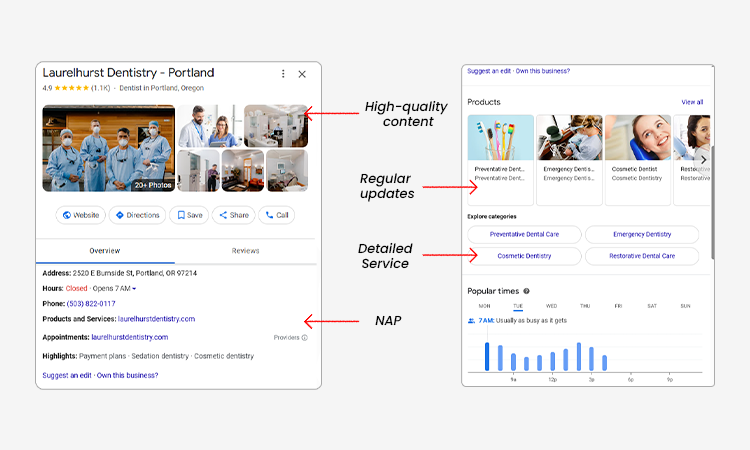
Now it’s time to effectively optimize your dental clinics’ Google Business Profile. This is the most important online platform for dental professionals to showcase their address, phone number, and patient reviews, gaining long-term trust.
Google reviews are what you receive through your dental clinic’s Google Business Profile tool. How you implement strategies to manage your Google reviews plays a huge role in the success of your dental review management.
Here’s what you need to do to optimize for your clinic’s GBP:
- Update Your NAP and Ensure Consistency
The NAP details play a major role here. You need to ensure that your dental clinic’s name, address, and phone number are accurate and consistent across the online platforms. These three details are the top-ranking factors for local SEO, meaning that if these are accurate and consistent, it can rank your dental practice higher for relevant local searches like ‘top dentist near me’ and ‘best dental clinic near my location’.
- Make sure your NAP details are consistent across your website, social media pages, and all online directories.
- You can use a local phone number for your clinic rather than a toll-free number to improve your local search rankings.
- If your dental clinic operates across multiple locations, you need to create a separate and unique GBP for each to avoid confusion among your potential and existing patients.
- We suggest that you perform an NAP audit to correct the information if there are any inaccuracies in the information. Inaccurate NAP details often confuse search engines.
- Add Dental Treatment Categories
You must add the categories of your dental practice to the GBP profile of your dental practice. Those categories tell Google exactly what dental care treatment services you offer. It will also help your dental practice appear in relevant online searches.
- Primary Categories: You can set this to ‘Dentist’ or ‘Dental Clinic’.
- Secondary Categories: Identify your practice’s category, such as ‘Cosmetic Dentist’, ‘Orthodontist’, ‘Emergency Dental Service’, or ‘Pediatric Dentist’.
- Detailed Service: You must manually and specifically list all the dental care services your clinic offers, such as Teeth Whitening, Porcelain Veneers, and Dental Implants.
- Don’t Forget to Incorporate Before/After Images
When it comes to dental treatments and enhancements, visuals can create a huge difference in your patients’ trust. It is crucial to patient conversions as high-quality photos increase patient engagement online and generate a sense of trust among them.
- High-quality content: You need to upload professional and well-lit photos of your clinic’s exterior, reception area, treatment rooms, and staff.
- Before/after photos: You can showcase the results of your dental treatments to prove your expertise. But to use the photos, you need to take the patients’ consent first.
- Regular updates: You can also upload the photos regularly on your dental clinic’s GBP profile to make it appear fresher and more active.
- Add FAQ Section
Dentists can also incorporate an FAQ section into their GBP profile to address concerns before they even reach out to them for their requirements.
- Proactive Seeding: You must train your staff to ask and answer the most common questions that your potential and existing patients may have regarding various dental care treatments.
- Key Topics: Always try to cover the most common questions about dental care insurance acceptance, parking, wheelchair access, and what they can do during a dental care emergency.
- Monitor Daily: You can also use the GBP dashboard to check for new questions and respond quickly to those, showing your activeness and engagement.
Step 3: Create a Review Generation System for Your Dental Clinic
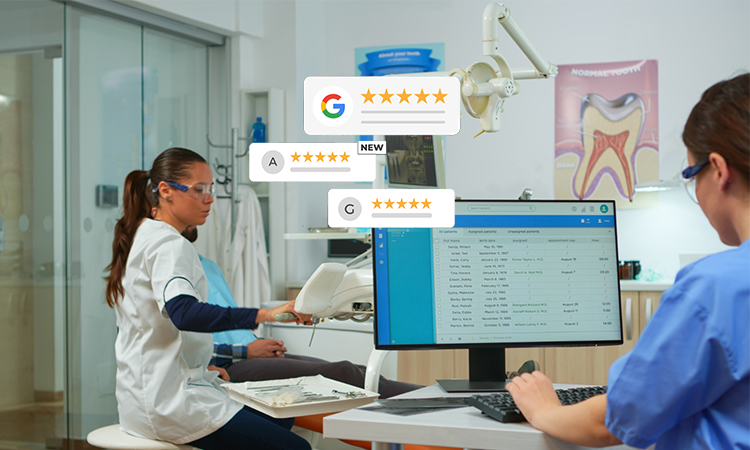
A seamless review generation system can create a huge difference in your patient feedback generation technique. Though this may take enough time, once you create the system, you can leverage a list of benefits.
Here’s how you can create a review generation system for your dental review management:
- Train Your Staff to Request Feedback
Do you know that your team is your strongest asset for securing patient reviews?
Yes, you’ve heard that right! Once your team is trained enough to professionally and effectively ask for reviews, you don’t need to worry about your dental practice’s review generation.
When your staff asks for patient reviews on their own, it shows the patients that you care about their opinions and feedback.
- You must train your staff to ask for feedback from the most satisfied patients when their satisfaction level is the highest.
- Train them to identify the happy moment, specifically after a successful, painless, and satisfying procedure.
- Instruct the patients on how they can identify the positive verbal cues, such as ‘My teeth feel amazing!’ or ‘The implant is much more painless than I thought!’
- For those staff who are new to the team, you can provide them with simple scripts like – “Hey (patient’s name), we’re glad to know that you had a great visit at our clinic. Would you like to share your experience in a quick Google review?’
- You can also incentivize or reward your staff for meeting monthly, achievable goals for generating a certain number of reviews.
- Post-Treatment Review Message Flow
After the patient receives dental care treatment from your clinic, your staff must send a manual request to them, encouraging them to share genuine reviews. You can use a Practice Management Software (PMS) or a dedicated reputation management tool like Birdeye or Podium to automate the review request follow-ups.
- You must send a tailored post-visit request through SMS or email a thank-you message. Don’t forget to include a direct link to your GBP review page.
- We also suggest that you laminate a branded card at the reception desk with a QR code that helps patients to find the review page.
- If you receive no response from the patient within 1-2 days, we suggest that your staff send a gentle and one-time reminder message.
- Always ensure that once a reviewer leaves a review, he/she must be removed from the future, automated review requests for that specific visit.
- Timing Strategy for Review Generation
When you’re sending the review request to the patients plays a huge role in determining whether you will receive the review or not. When a review request is sent too late or too early, it can be ignored by the patient.
The reason? The patient may think that it is no longer necessary to share a review, as a long time has passed after he/she received a review.
- The ‘Golden Hour’ – The highest success rate for receiving a dental review occurs when you immediately request it after the treatment is completed.
- Optimal SMS Time: You can send an SMS request 1 hour post the appointment, as it’s the ideal time to send an automated text message for requesting reviews.
- Best Time to Ask: Some surveys have revealed that there are some days, like Tuesday, Wednesday, or some Thursdays, that are considered the best days when you can expect higher patient engagement and the likelihood of receiving reviews. It is mostly because most patients are busier on Mondays or weekends.
- Schedule Automated Requests: You can automate your review requests by using certain tools to ensure the requests are sent within 24-48 hours after more intensive treatments like implants or Invisalign. Automated review requests can help you allow the patients evaluate the result of the dental procedure.
Step 4: Manage Patient Reviews for your Dental Clinic
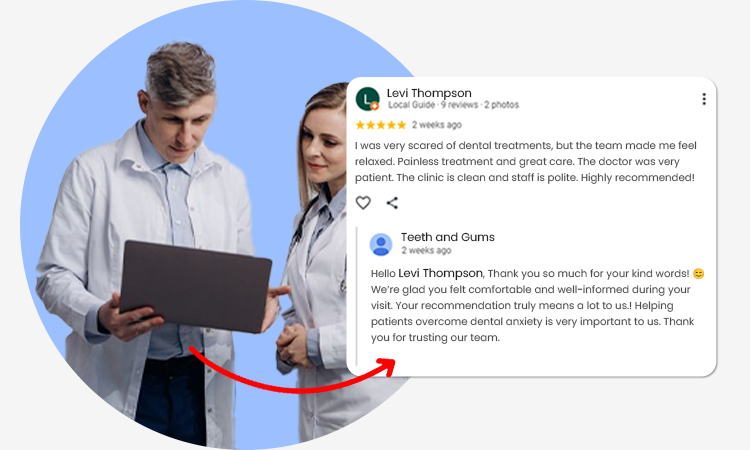
You should manage your patient reviews effectively to ensure a steady stream of new reviews from your satisfied clients. Here you can follow a comprehensive process to manage your patients’ reviews and ensure the success of your dental review management process:
- Ensure 24-48 Hour Response Window
As we have already mentioned, how you can ensure 24-48-hours of timeliness to respond to positive and negative reviews, along with the neutral ones. Prompt responses to reviews can help you demonstrate that your dental practice greatly values patient feedback and is strongly dedicated to care. It can significantly mitigate the impact of negative reviews.
You can turn on notifications for your Google Business Profile to receive instant alerts for new dental reviews.
- Maintain a Personal Yet Compliant Tone
Even if a review is harsh and involves criticism, you must keep your response professional and empathetic. Keep your calm while responding to such reviews. Never mention the patient’s name, their specific treatment, appointment date, or other major details in the response, as it may violate the HIPAA guidelines. You should not confirm in the response that the reviewer is a patient or reveal their real identity.
- Never Argue with the Reviewers in Public
While responding to patient reviews, you should never argue with the reviewers in public. As it can escalate the situation and damage your online reputation. Don’t ever forget to engage in an online debate with the reviewer or try to correct their facts online. A defensive review may seem negative to your potential patients. Always thank the reviewers for taking their valuable time to share their feedback, even if the review is negative.
- Acknowledge Concern
You can address specific and objective complaints to understand the feelings of the reviewers. It will help you understand what has impressed the reviewer and what has not. You can apologize for the negative experience or the frustration caused. Admit your faults if a specific error is mentioned in the review.
- Invite Offline Resolutions
If the review contains severe criticism, you must take the discussion offline. Arguing with the reviewer is not a great idea, though! Rather, you should direct the conversation away from the public forum through an email or phone call.
While responding to the review, you should provide the contact details, such as phone number or email Id. This way, you can personally communicate with the reviewers, know about their concerns, and resolve the issue offline without damaging your online reputation.
Step 5: Improve Patient Experience

You can improve your patient experience by elevating their visit to your dental clinic. From reducing the long wait times for your patients to improving your overall treatment experience, you can help your practice receive more reviews from your clients.
- Reduce the Waiting Time at Your Clinic
The first thing you can do is to reduce the wait time for your patients. When your patients need to wait for a long time, it significantly impacts their overall experience at your clinic, no matter how premium your dental care treatments are. To reduce your long waiting times, you need to:
- Use digital and real-time queueing systems to allow your patients to monitor their place in line when waiting in a queue.
- Such systems can also help you receive notifications when a patient waits in the queue for more than a specific time.
- You can use a 24/7 online booking system and send automated SMs reminders to your patients. You can also collect your patients’ information and insurance details before they arrive and eliminate paper-based delays.
- If a delay occurs, you inform your staff and the waiting patients every 10-15 minutes regarding the delay. They must apologize for the inconvenience and provide updated estimates.
- Regularly analyze patient flow to identify the gaps in your dental review management strategy. You can ensure adequate staffing during the peak hours at your clinic.
- Ensure Transparent Billing
You shouldn’t opt for surprise billing as a major cause of patient distrust and distress. It can question your expertise and reliability. You can offer ‘a good-faith estimate’ of costs for services. Apart from this, you can break down the treatment service bills into specific, easy-to-understand services.
Always try to provide multiple payment methods for the convenience of your patients. You can use online portals and installment plans to reduce financial anxiety. You can ensure front-desk staff clearly explain your bills, insurance coverage, and out-of-pocket costs to your patients.
- Comfort-focused Communication
Patients often feel anxious or vulnerable during a dental visit. You must focus on providing a comfort-focused communication environment to make your communication feel safe and cared for.
While communicating, always avoid complex medical jargon and use simple words instead to explain diagnoses and treatments.
Step 6: Prioritize Legal and Ethical Considerations
As a medical care professional, dentists also must prioritize legal and ethical considerations. Let’s have a look at how you can consider the legal and ethical healthcare guidelines.
- Patient Confidentiality Laws
You should never use your patients’ names, photos, or specific health information without taking their proper consent. Apart from this, you can use digital tools and configure them to protect patient health information (PHI).
- Incentivized Reviews
Offering rewards or incentives for positive reviews is extremely risky. We suggest not considering such illegal practices. Incentives like free dental checkups or dental care freebies must not be tied to positive patient sentiment or a 5-star review.
- Medical Advertising Regulations
Dental care ads must be truthful and shouldn’t convey anything that doesn’t align with the real treatment outcome. Otherwise, the advertising is evidence-based and non-misleading. You should avoid exaggerations and or claims of ‘miracles’ through the ad content.
- Transparency through Testimonials
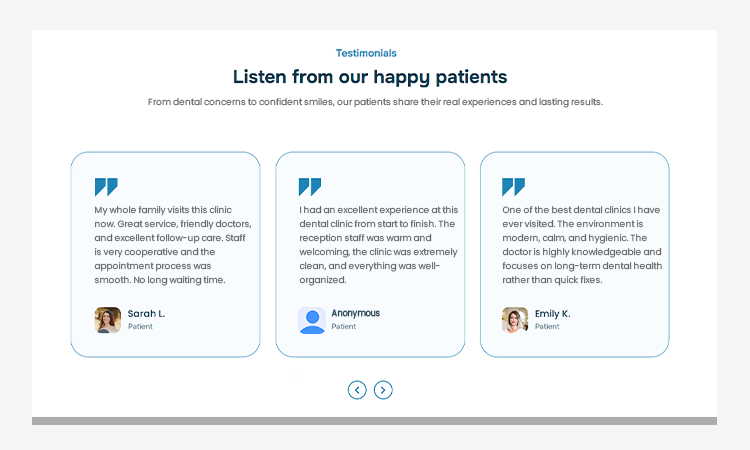
The patient testimonial you will share across the web shouldn’t be fraudulent or AI-made. Those patient feedback and treatment success stories must be authentic and anonymized if necessary. You should disclose any type of materialistic relationship to maintain your brand credibility.
Step 7: Track and Measure the Success of Your Review Management Strategy Plan

Now that you have a clear idea of the strategies you need to implement to manage your dental reviews like a Pro, let’s have a clear idea of how you can track or measure the success of your dental review management plan:
Major KPIs to Track –
Here are the major key performance indicators (KPIs) that dental professionals must track to measure success-
- Average Star Ratings – Overall sentiment of your patients and the average online ratings you have received from your patients.
- Total Number of Reviews – The volume of reviews your dental practice has received from your patients across online directories, Google, and industry-specific major reviews sites.
- Review Response Rate and Time – The average rate and time of responses to the patient reviews.
- New Patient Conversion Rate – How many patients have converted, seeing your dental clinic’s positive reviews.
- Number of Patient Complaints – The total number of complaints your dental clinic has received through the online patient reviews.
- Review Referral Rate – How many patients have referred your dental expertise to their family and friends.
Top 5 Helpful Tools for Dentists to Effectively Manage Patient Reviews
Now that you have a clear idea of the strategies that dentists must implement to improve their online reputation, there are certain tools that you can use to make the dental review management process more seamless.
Here are the top 5 helpful tools that dentists must employ for their review management process. You need to perform a detailed review monitoring tools comparison and choose what suits your requirements the best. Let’s have a look!
| Tools Name | Features to Use |
| 1. Birdeye | ● All-in-one reputation management and automation ● Helps in aggregating reviews from 150+ sites, such as Google, Healthgrades, and Facebook, into a dashboard ● Allows you to automate review requests ● Uses AI to generate responses and offers HIPAA-compliant, two-way texting |
| 2. ReviewTrackers | ● Ideal for multi-location dental groups and detailed analytics ● Focuses on monitoring and analyzing sentiment across various platforms ● Provides deep analytics based on patient insights ● Provides strong, customizable reporting tools |
| 3. GatherUp | ● Best for small to mid-sized dental practices and local SEO ● Offers a user-friendly interface and allows seamless review generation ● Helps with local SEO by directing patients ● Enables in-office review collection through QR codes |
| 4. Google Alerts | ● Ideal for free, real-time monitoring of online mentions ● Sends notifications through email/SMS absolutely free of cost ● Essential for tracking new reviews on smaller niche review sites ● Helps in tracking new online reviews |
| 5. Google Analytics | ● Directly manages your important review source ● Helps you manage how people find your online profile across the web ● Offers direct access to read, respond, and flag reviews for your practice |
Future Trends in Dentist Review Management
From passive text collection to an active, AI-driven strategy, the future of dentist review management is rapidly evolving. These trends often indicate that online review management will be completely integrated with patient care by leveraging technology.
Here are the top 4 trends that can shape the growth of dentist review management:
- Video Testimonials
In previous times, more people used to share text-based reviews. But now, with the rapid popularity of advanced technologies, video testimonials are replacing those text-only reviews as they capture the emotion, facial expressions, and genuine reactions of the reviewers more accurately. Additionally, polished testimonial videos are completely taken over by ‘selfie-style’ videos.
- AI Review Responses
Nowadays, most dentists and dental clinics are turning to generate personalized responses to their patient reviews, including the positive and negative ones. AI has not only helped them customize their responses but also enabled them to respond to reviews within minutes, without any delays. Apart from this, dentists can leverage advanced AI tools to analyze the context and sentiment of a specific review across multiple online platforms, such as Google, Yelp, and Facebook.
- Voice Search Optimization
As a dentist, you may receive conversational queries from your potential patients, and answering patient questions is crucial. In the USA, more than 19 million adults have used voice assistants to search for healthcare-related information. They mostly used SIRI, Alexa, or Google Assistant to find dentists near their location. So, when you optimize your dental clinic or practice for voice searches, it ranks for the voice search queries, even the reviews.
- Integration with Tele-Dentistry
Do you know that future review management will be directly integrated into tele dentistry platforms? Yes, you heard that right! Nowadays, people have less time to visit a dentist for a regular check-up. So, they often choose dentists who offer the facilities of tele dentistry. Additionally, it offers a virtual consultation experience for the patients, so they often opt for it more than they choose a physical meeting with the dentists for a regular checkup. Patients can also use apps to send their treatment progress photos to the dentists.
FAQs
Here are some frequently asked questions and answers related to effective online reputation management for dentists:
Ans. Patient review management is completely ethical and legal for dentists. The process that you follow must adhere to strict patient privacy laws like HIPAA and other ethical guidelines. Dental professionals must avoid disclosing the protected health information of their patients while responding to their patient reviews. Furthermore, they shouldn’t offer incentives to the patients in return for their positive reviews, and ensure handling all the patients’ feedback with honesty and transparency.
Ans. Yes, you can. Hiring an ORM agency for effectively managing your online reviews can prove to be a game-changing decision for your dental clinic. Such agencies often have an expert team of ORM professionals who will recommend the most effective strategies that can help you build a solid patient review base. They will also help you boost your patient trust, increase your online visibility, and manage reviews across major online platforms.
Ans. Professional review management for a dental clinic generally costs between $99 – $350 or more per month, depending on the complexities of the project. The services also involve determining the pricing of the professional review management. You can contact the client support team of the ORM agency to know about their specific pricing for their review management services.
Ans. Yes, it can be. You can either contact the reviewer to delete a review that he/she has shared about your dental clinic or practice, or report the review following the review platform’s reporting tool. If the patient review has violated the platform’s policies or terms of service, the negative review can be deleted. However, you cannot remove a review just because it is negative, as patients can leave such feedback if they’re not satisfied with your dental care services.
Ans. Dentists can improve their patient reviews by providing high-quality dental care to their patients. Additionally, providing direct review links via SMS or email can streamline their feedback process, as the patients will find it more convenient to share the reviews. Dentists can also utilize automated surveys and QR codes in the dental clinic. When you respond to every review, it also shows how much you value your patients’ opinions.
Ans. A dentist review management service is generally specialized, designed to monitor, generate, and manage patient feedback across the web. Dentists can build trust and improve their practice’s search engine rankings by hiring a professional dentist review management service. They can even gather positive reviews from their satisfied patients and ensure the review generation process maintains a high-quality online reputation.
Ans. No, it doesn’t. Online review management for dentists generally does not guarantee a specific result. The success of the review management process generally depends on various factors. For example, removing all the negative reviews for dentists depends on the specific platform, such as Google, Yelp, and Facebook. ORM agencies cannot control these third-party platforms. It also depends on your patients’ opinions.
Conclusion
Reviews play a huge role in managing patient reviews and leveraging those to promote the USPs of your dental care service. While positive reviews can help you showcase the great features and treatment facilities of your dental care clinic, even a single negative review can destroy your years of effort to build and maintain a positive reputation for your dental practice.
When you effectively monitor and manage your dental clinic’s online reputation, it helps you identify the reputational risks in advance and prevent major damage.
We hope that our comprehensive guide to dental review management will help you navigate the complexities of patient review management and effectively utilize the reviews to acquire new patients. Still confused? We suggest you hire a Comprehensive Online Review Management Agency to seek their professional guidance.

