






In today’s highly competitive digital world, an architect’s online reputation is more likely to be defined by their client reviews. While a single glowing review can majorly validate your creative vision as an architect, unmanaged negative feedback can ruin your years of hard work to build a strong online reputation. That’s why managing architect reviews is the non-negotiable strategy to build a positive reputation across the digital space.
Do you know that more than 87% of clients search online before choosing an architecture firm? And the first thing they will come across while searching for an architect is the client reviews.
Always remember: Your potential clients don’t just look at your visual portfolio; they actually look for real human experiences of partnering with you as an architect.
Welcome to the complete guide to excel in strategically managing your online client reviews for your architectural expertise. Explore this blog and learn the secrets to generating more online reviews, leveraging those to accelerate your lead generation, and turning the client feedback into your greatest marketing assets.
What Are Architect Reviews?
Architect Reviews refers to the public feedback an architect receives from his/her previous and existing clients across online review platforms, such as Google Business Profile, Yelp, Houzz, Facebook, Clutch, and more. The clients will evaluate your design skills, project management abilities, service pricing, and communication expertise in online reviews for architects.
These reviews help future clients thoroughly examine an architect’s reliability, credibility, creativity, and expertise to make an informed decision in choosing the best resource for their needs.
- Key Aspects of Architect Client Reviews
The following are 5 major aspects of clients’ reviews for architects:
- Design Vision – The functionality, the aesthetic appeal, and the creativity of the delivered project.
- Quality – The overall quality of the delivered project.
- Project Management – The assistance you have provided for coordinating with the contractors, building regulations, and managing local permissions.
- Budget and Timelines – If the project is completed within the promised timeframe and budget limits.
- Communication and Collaboration – How well you’ve communicated with the client, listened to their concerns, taken necessary actions to resolve issues, and incorporated feedback into their strategy plan.
Why Online Reviews Matter for Architects?
For an architect, online reviews serve as social proof for their reliability, brand credibility, and expertise. The feedback you receive from your clients plays the role of modern word-of-mouth, through which you can turn your past positive client experiences into a powerful digital asset.
From building your potential clients’ trust and confidence to strengthening your brand reputation online and improving your architectural expertise’s overall online presence, online reviews impact an architect in many ways.
- Builds Brand Credibility and Authority
When you successfully earn positive reviews as an architect, it helps you drive growth for your business and establish authority in today’s highly competitive industry.
As architecture is a high-stakes and expensive investment, positive reviews provide social proof, showcasing to potential clients that you can successfully and seamlessly manage large-scale projects even after maintaining the budget, while delivering the best quality.
- Improves Local Search Rankings and Online Visibility
Search engines like Google prefer ranking businesses with higher online ratings and positive reviews. These search engines heavily rely on your review volume, the keywords in reviews, and star ratings.
When you consistently earn reviews from your local customers, and they use keywords like ‘best architects in (your service area name)’ in their reviews, it directly boosts your expertise’s positioning in local searches and Google Maps. It makes your architect practice easier to find.
- Strengthens Brand Reputation
When an architect manages their reviews proactively, they can highlight their strengths through positive reviews. You can promote your positive reviews to showcase your clients’ best experiences with your services.
When you gracefully handle architect reviews, such as generating more positive reviews and responding to even constructive criticism, it demonstrates your accountability and client care abilities. It can help you to build a strong online reputation and long-term brand equity.
- Influences Client Decision Making
The positive reviews your existing or previous clients have shared significantly influence
your potential clients’ decisions in choosing your architectural expertise over your competitors.
When they get to know about the real experiences of your clients with your practice, they will feel more encouraged to consider your expertise. According to a 2025 study by Medium, 54% of consumers now trust online reviews as much as they do personal recommendations from their close ones. There will be no hesitation from their end regarding your reliability and credibility.
- Increases Client Inquiries and Conversions
Effective review management ensures you have a strong and five-star online review profile across platforms like Google Business Profile and other review sites. The more positive reviews search engines will rank about your architectural expertise, the more likely you are to get client inquiries and meaningful opportunities to convert those qualified leads into paying clients.
Detailed client feedback majorly validates an architect’s design expertise and influences potential clients to choose your expertise without any hesitation.
5 Major Types of Architect Reviews
Online reviews for architects are crucial for building public trust and attracting new prospects. Architects can receive five major types of reviews from their clients, including positive, negative, neutral, short, and detailed reviews. Each type of review plays a different role in building and managing an architect’s online reputation.
Let’s explore these 5 major types of reviews you can receive as an architect:
- Project Delivery Reviews
These reviews examine the overall process of turning a design concept into a successful architectural project completion. In these reviews, clients highlight how you, as an architect, handle site analysis, manage contractors, and navigate complex local regulations. These reviews can be found on Google Business Profile and Yelp.
- Design Aesthetics & Functionality Reviews
These online reviews for architects strictly focus on the final product. Reviewers often mention how well the architect has interpreted the client’s visions into a reality by maximizing the spatial flow, utilizing natural light, and integrating sustainable or innovative materials. Architects can find these reviews on online platforms like Houzz and Architizer. These glowing design reviews often attract clients who prioritize style and innovation.
- Communication & Problem-Solving Reviews
These reviews analyze an architect’s ability to listen and how he/she effortlessly explains technical concepts. These reviews also talk about how an architect gracefully acts when supply chain issues or on-site design changes occur suddenly. You can find these reviews in Trustpilot and specialized niche directories like Angi. These specific reviews showcase to future clients that the architect is patient, accessible, and has a calming presence during reputation crises.
- Budget & Timeline Management Reviews
These reviews talk about the practical and business-critical realities of construction. In these reviews, clients evaluate how closely the final project matched the initial fee structure, targeted move-in date, and material costs. These architect reviews are commonly found on the Better Business Bureau and Houzz. Positive reviews related to the budget and timeline management of an architect demonstrate financial transparency and project efficiency.
- Peer & Technical Reviews
These technical reviews are often shared by contractors, fellow architects, and engineers. They evaluate the constructability of the blueprints and the accuracy of the CAD/BIM models, along with the overall adherence to building codes. Architectural professionals can find these reviews on internal debriefs, industry trade journals, and project management software. Through the reviews, potential clients can get an idea of the quality control and structural integrity. Effective management of these reviews helps architects build a solid online reputation.
6 Best Platforms Architects Must Prioritize for Effective Review Management
Now we will talk about some important online platforms that help architects in effectively managing their online client reviews. Exploring this list can help architects make informed decisions and choose the right platform to manage reviews effectively while supporting their business goals.
In this section, we have talked about 6 major online platforms best for managing online reviews for architects:
- Google Business Profile
As we all know, Google is the primary search engine where people search for businesses, especially the local ones. A 2026 Searchendurance study has revealed that businesses with a Google Business Profile (GBP) are 2.7x more likely to be trusted by customers, as compared to those businesses that have no Google Business Profile.
When you optimize your review profile on GBP and encourage your clients to share their reviews on it, it helps your business appear in the Google Map Pack, driving calls, website clicks, and direction queries.
Effective Google review management requires you to claim your business profile, fill out all the necessary information, like your business name, address, and phone number (the NAP details), and enable the reviews feature.
- Yelp
This is another popular review platform that architects must prioritize to manage their client reviews. Yelp is one of the most reliable and high-ranking directories that you must prioritize having a business profile on. Managing Yelp business reviews can help you to make your architectural practice rank higher for standard web searches while putting your client reviews front and center.
- Houzz
It is a dedicated review hub where clients share their visual reviews with real images of home renovation, design, and architecture. Your business profile on Houzz can help you attract a highly targeted audience of homeowners who are actively looking for a reliable and skilled architect. You must list your architectural practice on this platform, as it can boost your organic leads and request your satisfied clients to share project testimonials.
Among all the other social media platforms, Facebook is one of the most popular ones with a massive user base. It may seem casual, but it is highly effective when it comes to providing trustworthy social proof for your potential clients.
Your potential clients are more likely to rely on Facebook to check the ‘legitimacy’ of your architecture business. They can view tagged project photos and even read personal recommendations from their friends in their Facebook networks.
You must keep your Facebook page updated by highlighting all your latest work and project milestones. However, you must ensure that the Recommendation feature on your Facebook business page is switched on.
- Clutch and Design Directories
This is another highly regarded online review platform for architects, especially for verifying B2B service providers. If you deal with commercial architecture or B2B development, having a completely optimized profile on Clutch and other design directories is non-negotiable for you.
As Clutch directly verifies client reviews through direct interviews, it lends extreme credibility to your B2B project history. You just need to claim your business profile on the Clutch Architecture Directory.
- Industry-specific Review Platforms
Some niche directories are specifically designed for the architecture and construction industry. It helps establish your architectural business’s true authority. These are the platforms personalized to architects, helping architects highlight peer recognition, professional competency, and design quality.
Architects need to research and list their practice in the regional and global architecture-specific directories. This practice will help you position your expertise as a knowledgeable resource in the architecture industry.
4 Common Challenges Architects Can Face in Managing Their Client Reviews
Though online reviews offer a list of benefits for your architectural business, professionals can experience certain challenges while managing architect reviews. Effective review management for architects is a structured process that increases the chances of experiencing some common challenges while managing client reviews.
Identifying these challenges can help architects avoid them. Let’s have a look at the 4 most common client review management challenges:
Challenge 1: Handling Fake Reviews
Do you know that your market competitors, ex-employees, and even AI chatbots can post fake reviews or poor online ratings for your practice online? Yes, you have heard that right! Dealing with fake reviews is a common challenge.
Solution: You can identify those fake reviews by detecting the patterns. After identifying them, you must send professional yet brief replies to those fake reviews stating that your firm has no record of collaborating with that specific reviewer. You can seek professional review management services to take down those fake reviews from online platforms if you think that these reviews are negatively affecting your business reputation.
Challenge 2: Dealing with No Reviews
If your online review profile is filled with old and irrelevant client feedback, your potential clients may perceive your business as inactive. A lack of recent reviews can also make your firm look untrustworthy to new qualified leads.
Solution: You need to automate the process of post-project follow-up. Consider sending a polite and direct request immediately after a successful project delivery. You can also send direct links to your online review profiles on major directories like Google Business Profile and Houzz.
Challenge 3: Managing Negative Feedback
As an architect, you may receive negative client feedback, too. Dealing with these reviews can sometimes feel like a daunting task. If you avoid engaging with these negative reviews, they may majorly hurt your local search rankings and deter your potential clients.
Solution: Though the feedback involves constructive criticism, you must consider responding to it professionally. Architects must address these valid complaints and acknowledge the inconvenience experienced by the clients. We suggest that you take the conversation offline if you think that you may engage in arguments with the reviewer on a public forum.
Challenge 4: Dealing with Unclear Design Scope
Another crucial challenge an architect can face is that clients often send design notes through scattered channels like WhatsApp, phone calls, emails, or texts. These channels make it difficult for the architects to track the project approvals and version control.
Solution: Always consolidate your communication with your clients. You can also directly ask your clients to use a centralised architectural software or a comprehensive client portal to log all the comments on your plan.
How Architects Can Get More Reviews: A Complete Strategy Guide
You can spend months and even years perfecting your structural nuances, material details, and spatial flow as an architect, but if your online review profile lacks a good number of positive reviews, your expertise will be of no use.
Securing client reviews is not an easy job, especially for architects. It requires the architects to follow a systemic and client-centric approach to generate more positive reviews. Here is a quick guide on how architects can earn more reviews from their clients:
An effective review management strategy allows the architecture professionals to follow this approach to earn more client reviews.
Strategy 1: Ask Clients to Leave Reviews at the Right Time

Timing plays a huge role when it comes to determining whether you receive reviews from their clients or not. If you don’t ask them to share their feedback, even your satisfied clients may not leave a review. When you are asking for the reviews and when you are following up is crucial.
- Right timing to ask for reviews from your clients –
- Don’t ask too early when the client has not completely experienced the service.
- Never ask for reviews when the feeling of satisfaction has faded.
- You must immediately follow up after a successful project delivery or a highly positive event, such as a certificate of occupancy approval, or a successful final walkthrough, and project completion.
- Additionally, you can ask 2-3 months after the client has moved into the apartment or property and experienced the functionality of their new space.
Strategy 2: Make the Review Submission Process Easy

You should always remember one thing: your clients are busy. If they struggle to submit a review because of a complicated process, they may not feel encouraged to share a review. The review submission process must be less complicated; otherwise, it will result in abandoned requests.
- Always send direct links to your review pages with your review requests. You can either create a direct review link or QR code to directly send it with your review request email.
- The fewer clicks your clients need to make to reach from their own inboxes to the review submission inbox, the higher the chances they will submit a review for your business.
Strategy 3: Send Automated Review Requests

As an architect, if you rely on your memory to manually ask for reviews, it will be insufficient for you. Automation is crucial to make the entire review generation process seamless. Architects no longer need to send separate request emails to each client. By employing automation tools, they can use personalised templates and send requests when it’s the right time.
- We suggest that you directly integrate review requests into your project management software so that whenever a project is delivered successfully, the client receives a personalised review request.
- Even for the follow-ups, you can use an automated email or SMS platform to schedule sending your follow-up or reminder emails if the client still has not shared a review within 7-14 days of your initial request.
Strategy 4: Encourage Clients to Send Detailed Reviews
Encourage-Clients-to-Send-Detailed-Reviews
If you don’t make your clients understand the importance of detailed reviews to your business, they may just share a simple ‘Great work!’ compliment.
As compared to such reviews, a detailed description of a client’s experience with your architectural services carries more weight. These best architect reviews highlight your problem-solving, design process, creativity, communication skills, and other specific results.
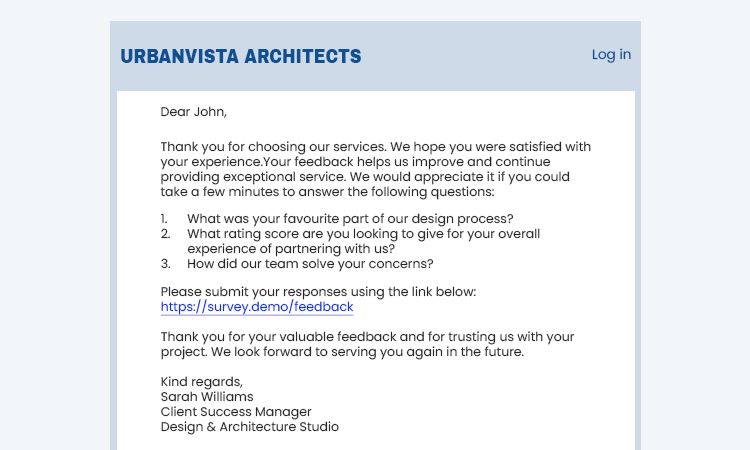
- You can help your clients write meaningful feedback by asking them to participate in a survey with specific questions in your request email. You can ask questions like:
- What was your favourite part of our design process?
- What rating score are you looking to give for your overall experience of partnering with us?
- How did our team solve your concerns?
- You can even provide a brief structure of an example of a strong and detailed review, so that they know what to highlight in their reviews.
Strategy 5: Promote Positive Reviews across Digital Channels

Your reviews are your portfolio that will speak about your reliability, credibility, and skills as an architect. In fact, when your previous or existing clients appreciate your services, they provide powerful trust signals to prospects at every stage of their buying journey. Generating reviews is not enough, you need to promote those reviews across digital channels, such as:
- Social Media – You can share your glowing reviews in high-performing carousels or engaging videos. You can post those reviews in your Instagram Stories, Facebook posts, or even Reels with beautiful renderings and professional photographs of the completed project.
- Industry Profiles – For this, you need to claim and manage your architectural practice on specific directories like Houzz and Architizer. So that it can maximise your practice’s local visibility.
- Website and Proposals – Architects must dedicate a testimonial section on their website, either on the homepage or on separate pages. You can pull specific quotes into your client proposals or pitch decks.
How to Respond to Architect Reviews?
The way you respond to a client review is as crucial as how you generate the reviews from your satisfied clients. Timely and meaningful review responses even accelerate your review generation process.
Do you know that 89% of consumers expect businesses to respond to their reviews? When you respond to every review you receive, it turns your satisfied clients into loyal brand ambassadors.
Not only the positive reviews, but even the negative reviews you receive require you to respond to them and address the concerns. Here, we have talked about how you can respond to the positive and negative architect’s reviews:
- Respond to Positive Reviews
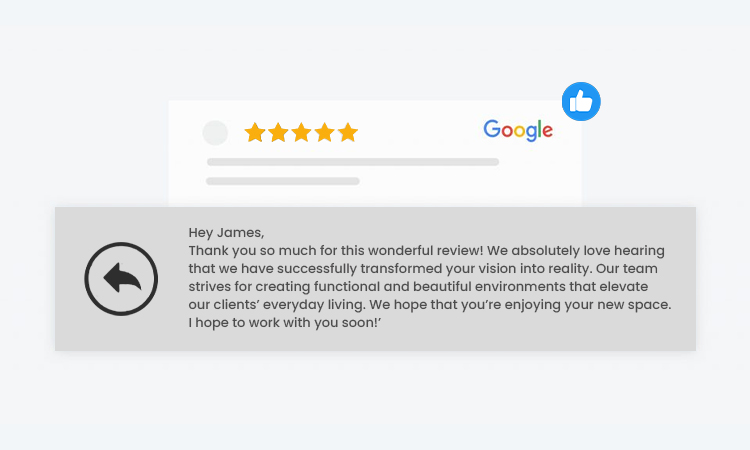
If your clients who have shared positive feedback don’t feel valued, they may not share any other reviews in the future. Here is a quick guide on how architects should respond to positive reviews:
- Professionally Thank Your Clients
Firstly, you need to professionally show your gratitude to the client who has shared a positive review. This way, you can make your client feel valued and heard for taking their time to share their experience.
- Personalise Your Response
Sending generic responses to positive reviews, such as ‘’Thank you!’ or ‘It means a lot!’ will not work. Most of your clients who have shared glowing feedback for your architectural services are more likely to expect personalised responses from your end. You must take time to send tailored responses to the reviewers, addressing them by their names, discussing their concerns, and providing suitable solutions.
- A Sample Example of Response to Positive Reviews
Below we have mentioned a sample of a response to positive reviews:
“Hey (your client’s name), thank you so much for this wonderful review! We absolutely love hearing that we have successfully transformed your vision into reality. Our team strives for creating functional and beautiful environments that elevate our clients’ everyday living. We hope that you’re enjoying your new space. I hope to work with you soon!’
- Respond to Negative Reviews
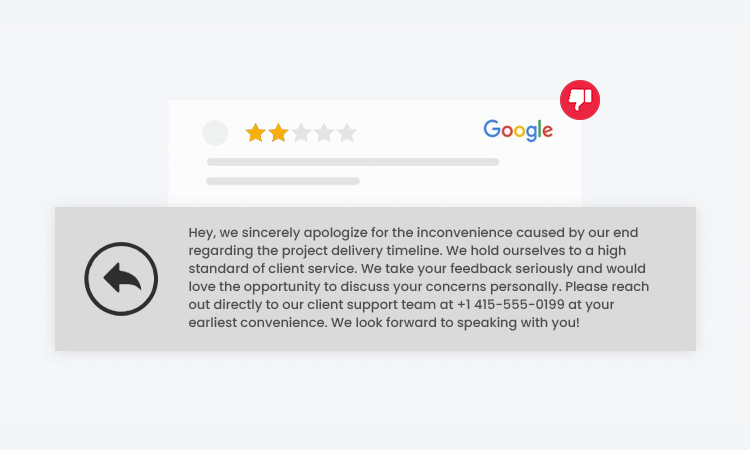
You shouldn’t avoid responding to negative reviews for architects. Many professionals often think that responding to negative architect reviews can higher the risk of online arguments with the reviewer. However, in reality, it is not. It can be a great opportunity to resolve issues and turn the negative client experience into an opportunity to regain the trust.
Here is how you can respond to the negative reviews:
- Address Client Concerns
Effective strategies to deal with negative customer reviews require you to acknowledge the concerns at first. You must address the exact issues experienced by your clients, such as delays, budget issues, design miscommunications, or overruns. You must validate their feelings but not necessarily admit your fault in the public forum.
- Offer Suitable Solutions
You must propose to the clients to have a personal discussion with you or your team if you think that communicating on a public forum can escalate more reputational issues. You can provide an email address or a phone number for your clients to contact your team and resolve the issue.
- Maintain Your Calm and Professionalism
No matter how harsh the criticism is, you must not respond aggressively. An architect must keep their calm and maintain their professionalism. While responding to a negative review, you should never argue with the reviewer or get defensive. Additionally, you shouldn’t blame the reviewer publicly.
- Avoid Using Professional Language
You should skip using professional language in your reviews. Excessive usage of technical language, architectural jargons, complex contract clauses, and building codes can make your response complex to understand for the reviewers. Always remember that not all your clients may be knowledgeable enough to understand the critical architectural jargon. Keep your response simple, human, and easy to understand for the common people.
- A Sample Example of Response to Negative Reviews
Below, we have provided you with a sample example of a response to negative reviews:
‘Hey, we sincerely apologize for the inconvenience caused by our end regarding the project delivery timeline. We hold ourselves to a high standard of client service. We take your feedback seriously and would love the opportunity to discuss your concerns personally. Please reach out directly to our client support team at (email address/phone number) at your earliest convenience. We look forward to speaking with you!’
How to Measure the Success of Review Management Efforts?
Now that you know how to effectively manage online reviews for architects, it’s time to tell you the secrets of measuring the success of your review management efforts. Tracking certain key performance indicators (KPIs) can help you identify the areas for improvement as well as the strategies working best for your business.
- KPIs to Track the Outcome of Review Management Efforts
The following are some major KPIs you must track to measure the success of your review management efforts:
- Average Star Rating – The overall grade of your business across multiple digital platforms, such as GBP, Yelp, Trustpilot, and more
- Review Recency – The timeframe of your recent client reviews.
- Review Velocity – The rate at which your new client reviews are published over a given period.
- Review Response Rate – The percentage of your client reviews you publicly reply to over a given period.
- Conversion Rate – The percentage of your potential clients who have taken a desired action (like booking a service) after reading your online reviews or interacting with your business.
- Customer Retention Rate – The percentage of your customers that you have retained over a specific time period.
Top 5 Review Management Tools Architects Must Prioritize Using
Managing your online reviews is a crucial task for architects as they need to invest their time into delivering personalized projects for their clients. Employing certain tools can help you simplify the entire process – so that building trust and earning higher-value projects no longer seem confusing.
Wondering which tool you should use to manage your architect client reviews?
Here, we have listed the top 5 tools ideal for review management for architects. The right comparison of review monitoring tools can help you choose the most suitable one that can help you achieve your review management objectives:
| Tools Name | Feature to Use |
| 1. Bluebeam Revu | ● A purpose-built PDF review and collaboration tool. ● Allows architects to collect feedback internally and from consultants in real time. ● An essential quality-control tool. |
| 2. ClearlyRated | ● Ideal for B2B experience management. ● Designed for a B2B architecture service firm Automates client satisfaction surveys and helps you calculate your Net Promoter Score (NPS). ● Publish verified testimonials to help architects build enterprise-level client trust |
| 3. Houzz Pro | ● Suitable for industry-specific marketing and client project management. ● Personalized for the design and construction industry. ● Allows architects to showcase their 3D models, manage client approvals, and collect client feedback |
| 4. Google Business Profile | ● A free platform to use as your architecture firm’s digital storefront. ● Helps you rank higher in Google Maps and Local-3 Pack with 10-3 reviews on your online GBP profile |
| 5. Podium | ● Ideal for sending automated review requests and B2B/B2C communication. ● Allows centralized messaging and review-generation platform. ● Allows you to reach the clients via texts rather than emails |
4 Mistakes Architects Must Avoid While Managing Online Reviews
No matter how much effort you have put into proactively managing online reviews for architects, making some mistakes can instantly ruin your hard work. In this section, we have talked about 4 most common mistakes architects make while managing their client feedback. Identifying these mistakes can help you avoid them:
- Ignoring Negative Reviews
Are you one of those who avoid responding to negative reviews? If yes, it can make your practice look like it majorly lacks transparency and only values happy clients. If you only reply to positive reviews and don’t address negative client experiences promptly, it can generate a negative perception of your brand online.
Fix: As an architecture professional, you must treat criticism as an opportunity to improve your offerings. You should always politely and professionally respond to negative reviews, address their concerns, and offer suitable solutions to resolve the dispute.
- Purchasing Fake Reviews
Engaging in malicious practices like buying fake reviews and ratings is a common mistake architects make. You shouldn’t even request your close ones to leave fabricated reviews on your online profile, as it can significantly damage your credibility. Google Business Profile has one of the most sophisticated algorithms that can easily identify unnatural or fraudulent feedback.
Fix: You can organically earn your reviews by ensuring to deliver excellent customer service. When you generate authentic client feedback, it showcases that your practice is genuine and trustworthy.
- Asking for Reviews Too Aggressively
Asking your satisfied clients to share their experience is a great strategy until you start overwhelming them with too many review requests. If you bombard your clients with constant and demanding requests to share reviews, it may feel pushy and even encourage them to leave negative reviews or completely ignore your review requests.
Fix: You must keep the process of sending review requests a natural process. Always send review requests at regular intervals and follow up when necessary. You must wait until the project is completed; send a personalized and warm email where you can express how much you value the client’s feedback.
- Sending Generic Responses
You shouldn’t send automated and generic ‘thank you’ templates to all your clients, as it may showcase your architectural practice as indifferent and robotic.
Fix: You can personalize your single response by addressing them by their name and referencing specific, unique aspects of their projects or experience. When you send customized review requests, it humanizes your brand and showcases that you truly appreciate their feedback.
4 Future Trends in Architect Reviews You May Witness
Now we will talk about the architect review trends you may have witnessed in the near future. Following these trends can help you adapt to new technologies and attract today’s modern client base.
The following are four future trends in architectural review that professionals can consider:
- Video Testimonials
Your written reviews can easily be overlooked. Most of your potential clients prefer video testimonials to know about the real experiences of your existing and previous clients who have used your services. Nowadays, many leading firms utilize various platforms to capture authentic client success stories through video shooting. When your potential clients see one of your previous clients describe their positive experience, it immediately builds their emotional trust.
- AI-powered Reputation Management
In recent times, artificial intelligence has completely shifted brand listening. From passive monitoring to predictive reputation management, AI has completely transformed how architects used to manage their online brand reputation. AI in reputation management helps you instantly analyze your client sentiment and identify the emerging themes across online platforms. It allows architects to address negative reviews, resolve the issues, and maintain a strong online trust signal.
- Visual Review Content
When it comes to architecture projects, the final product is highly visual. Nowadays, most of the clients share before-and-after photos, virtual walkthroughs, and 3D renderings through their online reviews. Visual reviews leave a great first impression on your potential clients, as visual reviews provide definitive visual proof that the architect’s design successfully translates into reality.
- Clients Valuing Transparency
Today’s clients demand honesty and the ultimate level of transparency from the business they seek services from. When it comes to maintaining open communication during billing, project timelines, and material sourcing, today’s clients heavily rely on reviews to verify whether the architect they have chosen was transparent and communicative.
Conclusion
It may sound surprising to you, but managing online reviews is crucial to architects. If you are an architecture professional, you must prioritize generating, responding to, and managing online reviews to build a robust reputation across the globe.
Managing architect reviews is not a cakewalk! It requires professionals to follow a strategic approach to proactively manage their client reviews and leverage them to attract new clients.
We hope that our comprehensive guide will help you navigate the complexities of online reviews for architects. Architects can seek expert advice by hiring a renowned online reputation management agency.
FAQs
The following are some frequently asked questions and answers related to architect client reviews:
Ans. The number of reviews an architect should have completely depends on his/her specific business goals. However, their Google Business Profile must have at least 10-30 genuine client reviews to rank higher in search engine results pages and build a robust online reputation.
Ans. Yes, an architect can remove fraudulent and malicious reviews from their online profiles if they think that these reviews can adversely impact their business reputation. Online platforms like Google Business Profile and Yelp have certain content guidelines that strictly prohibit spam, fabricated experiences, and conflicts of interest. These platforms don’t allow you to delete these reviews yourself, but you can formally flag those reviews for removal. Additionally, you can seek professional online review removal services from a reputable agency.
Ans. It’s difficult to choose one specific platform for managing architect reviews. It depends on the architect’s specific goals and review management requirements. It depends on whether you want to review system diagrams or manage the architectural review board process.
Ans. Online reviews significantly improve the search engine rankings of your architectural practice. Positive architectural reviews majorly boost the search engine rankings of your architectural practice. It provides vital trust signals to search engines, establishes local relevance, and improves client conversion rates as well.
Ans. An architect can immediately flag the negative reviews and provide enough proof that the review is inappropriate and has violated the platform’s content guidelines. He/she can even escalate the issue through the specific platform’s official support channels.

