






Own a law firm, but don’t know how to manage its online reviews? Effective online review management for lawyers is crucial, as online client feedback serves as word-of-mouth or personal recommendations. This is mostly because the outcome of the cases no longer defines your legal practice’s online reputation in today’s digital-first legal industry – your online client reviews do. Proactive lawyer review management tips can help you strategically manage and leverage the full potential of your client feedback.
Do you know that in 2025, 86.7% of people are more likely to use Google to research a lawyer? And the first information they come across is your client reviews.
Now you can imagine how important it is for lawyers to actively manage their online reviews to build a positive digital image. In this blog, we will explore how law firm owners can effortlessly generate and manage online client reviews, turning their happy clients into brand advocates to promote their legal expertise. Let’s scroll down the blog to get a list of review management tips for lawyers.
What Is Lawyer Review Management?
It refers to a strategic technique of generating, managing, responding to, monitoring, and promoting client reviews across legal directories and digital platforms like Google, Yelp, Avvo, and the like. By leveraging this strategic way, lawyers can build a robust digital reputation, establish trust with their prospects, and skyrocket their legal practice’s growth.
However, managing online reviews for lawyers is not a cakewalk! Lawyers must follow strict legal ethics and maintain client confidentiality while managing online reviews received from their satisfied clients. From guiding happy clients to share honest feedback and responding to those reviews to promoting these reviews across all major touchpoints, effective lawyer review management covers every aspect and beyond.
Why Must Lawyers Prioritise Effective Review Management?
Online review management for lawyers is no longer an optional strategy. Not investing in such a business-critical plan can prevent long-term success for your legal practice and deter your clients’ trust. On the other hand, mindful investment in professional lawyer reputation management services and following their suggested lawyer review management tips can help you effectively generate, manage, and promote your client feedback across the digital landscape.
Below, we will be talking about the major reasons why lawyers must prioritise online client review management. Let’s have a look:
1. Impacts Client Acquisition
A 2026 BrightLocal study has claimed that 41% of consumers are more likely to read reviews when they’re browsing for businesses. This study has shown that a majority of your potential clients rely heavily on the online reviews of your legal practice. They trust those reviews just as they do personal recommendations.
Lawyers with a strong online review profile will convert more client inquiries into signed contracts. Apart from this, you can directly drive revenue growth for your legal practice. The more positive reviews you generate from your satisfied client base, the more chances you will get to acquire new clients.
2. Safeguards Professional Ethics & Compliance
When you respond to online reviews professionally and empathically, you also need to respect the client’s confidentiality by aligning with ethical standards. Following effective lawyer review management tips help you easily detect and flag fake or unethical client feedback.
Apart from this, active review monitoring allows firms to protect their integrity and comply with the American Bar Association (ABA) or local or equivalent rules. Bar associations and legal codes strictly prohibit lawyers from sharing self-laudatory claims, misleading statements, and improper solicitation through review responses.
3. Mitigates the Damage of Negative Feedback
Lawyer review management helps you identify potential reputational risks by addressing negative reviews, responding to unhappy clients, or handling a constant flow of complaints. When you follow lawyer review management tips, it requires you to address and respond to negative reviews. This is the perfect opportunity to turn your unhappy clients into satisfied customers.
A steady flow of positive reviews can help you dilute the impact of one or two isolated negative reviews. It will protect your legal practice’s overall rating as well.
4. Boosts Search Engine Optimisation
Do you know that Google’s local search algorithms heavily rely on the quantity, quality, and frequency of online reviews? Effective lawyer review management can help you improve the local search rankings of your legal practice and attract nearby clients.
And it works vice versa. Improved online search rankings can ensure a steady stream of positive and recent reviews. It will signal to the search engines that your practice is active and that you provide one of the best legal services as a lawyer. A positive review profile boosts your online visibility and drives an exceptional amount of foot traffic to your office as well. So whenever your potential local clients seek local legal assistance, they think of you first.
5. Helps to Gain Valuable Operational Insights
As one of the most important lawyer review management tips, you can gain valuable insights related to your recurring operational bottlenecks. When you address reviews and learn about your clients’ pain points and concerns, it helps you know whether there are any client communication gaps or instances of service delays.
Analysing the client reviews allows you to optimise your resource allocation, refine your internal workflows, and even improve legal case outcomes. This directly impacts client retention for your legal practice.
6. Builds Long-Term Trust & Credibility
Effective review management helps lawyers generate positive reviews and testimonials from their satisfied clients. All of these serve as social proof for your legal expertise. It will prove how your existing clients trust your legal assistance when it comes to their legal requirements.
We all know that legal issues are often personal and stressful. So, your potential clients will only choose your firm if it demonstrates transparency and professionalism through positive reviews and high online ratings. Advanced review management helps lawyers build their brand credibility and client trust, boosting their future growth.
Top 10 Lawyer Review Management Tips Legal Professionals Must Follow
In this section, we will explore the top 10 most helpful lawyer review management tips and tricks to maximise the benefits of your strategy plan. The more effectively you manage your online reviews, the more opportunities you get to grow your legal practice’s online reputation.
Tip 1: Claim and Polish Your Online Review Profiles
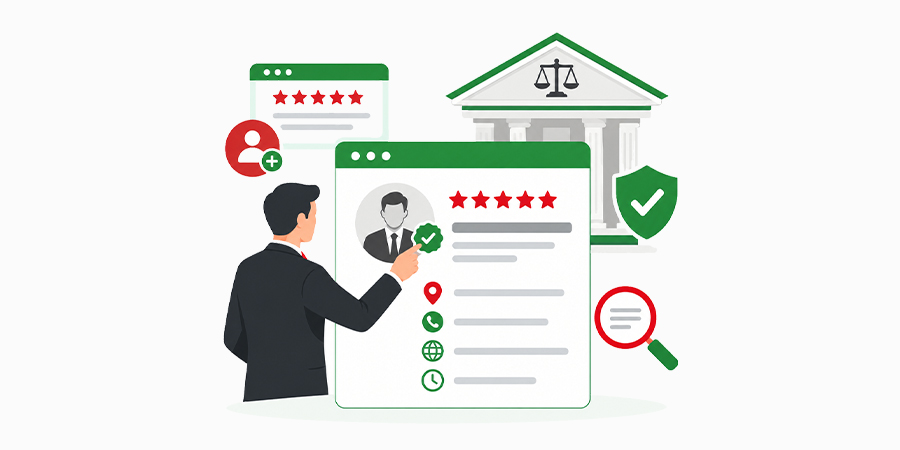
The first and foremost thing is to claim, verify, and optimise your review profiles across all popular legal directories and other popular platforms.
- Claim & Verify: Lawyers must claim their profile on Google Business Profile and other legal directories like Avvo. Managing Google reviews for lawyers is crucial to boost their online review profile. They must complete the video or alternative verification through Google Business Profile Manager.
- Ensure NAP Consistency: Secondly, it’s time to add all the important details like your legal practice’s name, address of your office, and accurate phone number to your profiles. Always ensure that these NAP details are accurate and consistent across your website, signage, and onlien legal directories.
- Avoid Stuffing: While managing your GBP profile and adding your business descriptions, you must avoid stuffing unnecessary keywords. Lawyers can use their firm’s name without appending unverified practice areas or location names.
- Select Proper Categories: As a lawyer, you must choose a specific primary category based on your legal service expertise (whether you’re a ‘divorce lawyer’ or a ‘personal injury attorney’); you shouldn’t just choose a broad ‘lawyer’ category.
- Fill All the Fields: Now, lawyers need to fill out accurate business hours, your staffed office address, and legal service descriptions in natural language.
- Add Visual Proofs: Following lawyer review management tips requires you to add authentic and geo-targeted images of your office and legal team to your legal directories and review profiles.
Tip 2: Turn Satisfaction into Stars: Prompt Happy Clients for Real Reviews
Reviews are the social proof that you can leverage to encourage your potential clients to choose your legal services over your other market competitors. However, review generation is not an easy process!
It requires an ample amount of time and constant effort.
In simple terms, lawyers need to ask their clients (even the satisfied ones) to share their experience with their legal services. Have a look at how lawyers can prompt their clients to leave honest reviews.
Ask Satisfied Clients for Feedback
Time plays a huge role in successfully generating positive reviews from your satisfied clients. You must know how to ask for a review when their satisfaction level is at its peak. The time must be 3-5 days after the successful case resolution or a positive consultation session.
Sending personalised review requests to your clients is one of the most beneficial lawyer review management tips. Don’t opt for generic message templates. When the satisfaction level is high, it increases the chances of getting a positive client review on time.
Automate Your Review Collection Process
You can use legal case management software and review management tools to send automated email sequences. Through the automated systems, you can send text reminders to your legal clients. The automation ensures consistent review follow-ups without manual effort. Through these tools and their automation features, lawyers can collect positive reviews seamlessly.
How to Simplify the Review Submission Process?
Simplifying the review sharing process is another major one among effective lawyer review management tips. Lawyers need to reduce friction and provide direct links to the review platforms. This will make the review submission process extremely seamless. When you provide the direct link to the page, your existing satisfied clients can easily share their reviews. You need to clearly mention the steps to submit a review or provide short templates to make it more effortless for your clients to share a review.
Leverage QR Codes or Links
Lawyers must incorporate review QR codes and links into their email signatures, physical marketing materials, such as business cards or office signs, and invoices.
Why QR codes? Using QR codes allows clients to scan and instantly reach the review page on their mobiles.
A professional review management service from a reputable agency can help navigate the complex online review landscape for your legal practice.
Tip 3: Master the Art of Review Replies!
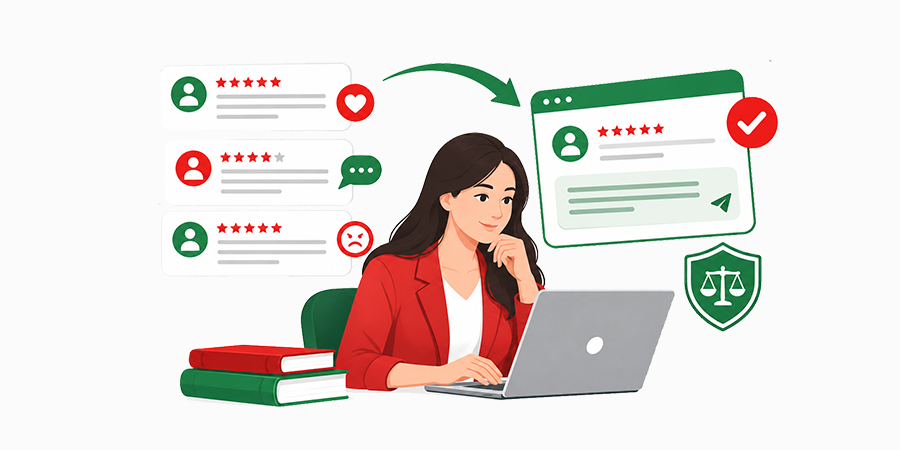
Now that you already have an idea of how you can successfully generate reviews from your satisfied clients, it’s time to know how you can respond to the reviews.
How you respond to the reviews plays a major role in showcasing how much you care about your clients’ opinions. The following are some quick lawyer review management tips related to review responses.
1. Handle Negative Reviews Calmly
It’s quite natural for lawyers to receive negative reviews. But you shouldn’t react to such reviews emotionally or defensively. Even if the review contains extreme criticism, you must respond to it with utmost professionalism and empathy.
2. Maintain Confidentiality of Your Clients
Lawyers should never reveal specific details, confirm your client relationship, or post private information in a public response. They must use neutral language and invite the reviewer to privately discuss the matter offline.
Maintaining the highest level of confidentiality can help you earn your client’s trust and brand credibility.
3. Thanks for the Positive Reviews
After a successful positive review sharing, you must publicly acknowledge the satisfied clients for sharing their experience on a public platform. Following these lawyer review management tips helps you build a positive online reputation for your legal practice. Trust us, it just takes a short and grateful online response to achieve the client’s loyalty.
4. Send Prompt Responses to Reviews
Just like a prompt review request, you need to ensure your response to a review is also on time. Imagine responding to a higher online rating and a detailed review after one week! The reviewer is more likely to perceive that you don’t care much about your clients’ feedback and appreciation.
When you respond to a review within 24-48 hours, it showcases that your client support team is attentive and takes feedback seriously.
Tip 4: Transform Criticism into Connection with Empathy and Professionalism!
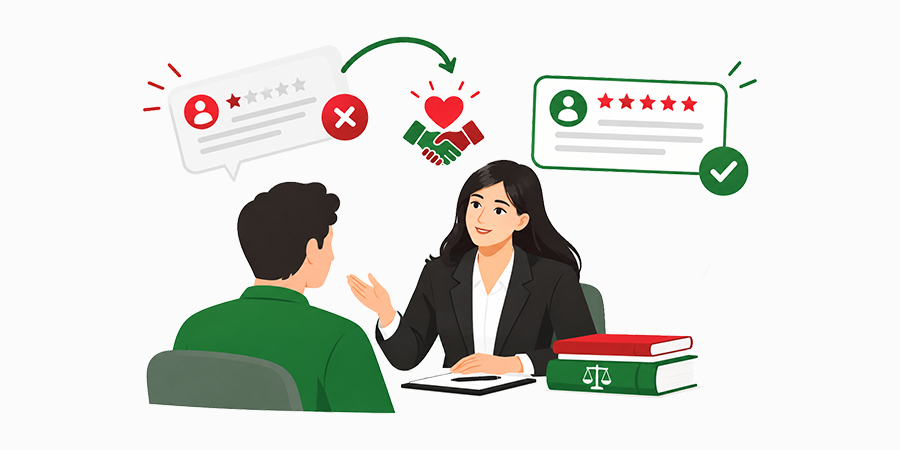
As a legal professional, you may receive negative reviews across major online platforms like Google. Following lawyer review management tips allows you to turn negative feedback into meaningful opportunities to showcase your commitment as a legal expert.
Here’s how lawyers transform criticism into interpersonal connections with those clients:
- Handling a negative review takes immense patience and accurate implementation of strategies. Firstly, you just need to analyse the review calmly before you respond to it.
- If the fault is at your end, you must apologise for the legal case outcome. Acknowledge the reviewer’s negative experience with your legal service without defending your side in the review response and throwing allegations.
- If the negative review is about a critical legal case, lawyers must consider taking the entire discussion offline by providing their official contact details to the reviewers.
- If you come across a fake and defamatory review, you must consider flagging or reporting it by using the respective platform’s built-in review reporting features. You can also hire professional review removal services! For example, lawyers can seek professional negative Google review removal services from an ORM agency to ensure a successful takedown of fraudulent reviews.
Tip 5: Monitor Reviews Across Multiple Platforms: Never Miss Out on Any!

There are multiple review management platforms available for lawyers and other legal professionals. You must focus on every platform related to your legal practice. Here are some major platforms lawyers can’t miss out when monitoring their client reviews.
| Review Monitoring Tools | Why You Must Focus? |
| Google Business Profile | It can be the primary driver for local online search visibility and local map rankings for your legal practice. |
| Dedicated Legal Directories | Lawyers can also prioritise specialised platforms like Avvo and Lawyers.com where their clients specifically look for attorney credentials and client ratings. |
| General & Consumer Sites | Legal professionals must monitor their client reviews across Yelp, Facebook, and the Better Business Bureau to get an idea of broad public sentiment. |
Following lawyer review management tips allows legal professionals to set up automated email notifications and dedicated ORM dashboards to get notified for every new review. If you have a robust in-house team, you can also assign your team members clear responsibilities for accurately monitoring every piece of feedback your legal practice receives.
Tip 6: Maintain Client Confidentiality & Honour Legal Ethics
As a lawyer, you should never share any case details or client information while responding to reviews. A review response should never include strategy discussions, personal identifying details, or any other confidential facts.
If any review demands such a response, you must ask for proper permission from the clients who have written the reviews before you share any details. While responding to a review, it’s important not to make unrealistic promises or advertise guaranteed outcomes.
Why Following Ethical Legal Standards Is Important?
Following lawyer review management tips requires you to align your review generation and response drafting workflow with local bar association advertising. Lawyers must strictly follow ethical codes according to major legal bar councils while managing their online client reviews.
Tip 7: Let Your Glowing Client Testimonials Promote Your Expertise!
Showing the real clients’ experiences can help you achieve your potential clients’ trust and encourage them to hire your legal services. It acts as social proof for your legal practice to potential clients.
Promoting your client testimonials is one of the most crucial lawyer review management tips. Lawyers need to demonstrate their glowing testimonials as social proof of their legal brand’s reliability and credibility.
- Make the details anonymous: Lawyers must protect their privacy by sharing success stories without revealing their clients’ names. They should specifically personalise the narratives of their case wins and the type of challenges you have solved as a lawyer, rather than disclosing the identity of the client.
- Focus on the local strategy: You need to highlight the innovative legal strategy or expertise that your legal team has used to solve the problem.
- Utilise quantifiable results: You shouldn’t use broad claims; use tangible metrics, including expected statistics.
- Generalise case details: You need to discuss the kind of dispute the legal case has involved without revealing the identifiable facts.
Where to Promote Your Glowing Client Reviews?
Lawyers can prioritise embedding positive reviews directly onto their website’s practice area pages where a majority of their prospects look for legal help. They can also promote their client reviews on their social media business pages or develop a dedicated ‘Client Success Stories’ page on their website.
Note: Lawyers should always seek proper consent before they use client reviews and testimonials for their promotional purposes.
Tip 8: Listen to Clients to Level Up Your Law Practice

One of the most beneficial lawyer review management tips is to use the data insights collected through the reviews to refine your legal services and improve your practice. Responding to your client reviews is not enough! When your clients see that you have acted upon their complaints, suggestions, and criticism, it leads to them sharing more positive reviews for your law practice.
- Identify the Patterns: Lawyers use review monitoring software or a spreadsheet to tag the recurring search terms mentioned in the reviews. It will help you identify which aspects of your legal practice are getting the most appreciation and which have the most failed case outcomes.
- Optimise the Touchpoints: After analysing your client reviews, lawyers can address the top three friction points highlighted in the reviews. This helps you maximise the benefits of your lawyer review management tips.
- Create a Feedback Loop: If you have an in-house team, you can assign your front-desk staff regarding how they can use a standard operating procedure based on the previously received negative or average reviews.
Tip 9: Prompt Honest & Regular Feedback without Breaking Legal Platform Policies
Effective reputation management for attorneys and lawyers requires you to prompt genuine feedback from satisfied clients without violating any legal platform guidelines. As a legal professional, you must make review generation, response drafting, and monitoring the same across platforms a routine.
For this,
- You need to add requests for online reviews for lawyers to your standard closing checklist.
- You can prepare the same polite scripts for every client, and you shoudl never pay for any reviews from your clients.
- Legal experts must not guide happy clients to public Google and Yelp pages when they’re funnelling the unhappy ones to a private review submission form.
- Earning reviews from your happy clients through transparent fees and fast communication is one of the most important lawyer review management tips.
Tip 10: Measure & Improve Your Lawyer Review Management Strategy Plan
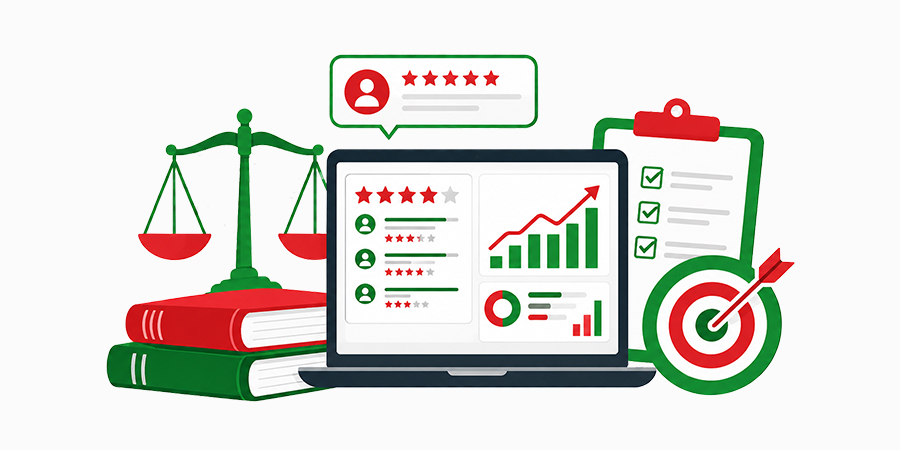
Now that you know how you can follow tips and tricks for effectively managing online reviews for lawyers, it’s time to know how you can measure the performance of your followed tips.
KPIs to Track:
Here is a list of key performance indicators lawyers must track to measure your lawyer review management strategy plan.
- Average Star Rating across Platforms: Your aggregate score across major legal directories to track overall brand health
- Total Review Volume: Total number of new reviews generated monthly or quarterly
- Review Response Rate & Speed: The percentage of incoming reviews you reply to and the average time it takes you to publish a response
- Sentiment Analysis Scores: The proportion of positive, negative, and neutral reviews to identify recurring legal service strengths or client pain points
- Review Request Conversion Rate: The percentage of clients who submit a review after receiving an automated request
- Client Acquisition Cost (CAC) via Reviews: How many new legal consultations or retained cases originate directly from your online profile views and review links
- Referral and Retention Rates: The relation between high client satisfaction scores and repeat business/direct word-of-mouth referrals
Top 5 Review Management Tools Lawyers Must Employ
Till now, we were talking about the most helpful lawyer review management tips. Now let’s get a clear idea of some useful tools that lawyers must use to maximise the benefits of following these tips.
Here is a list of the top 5 review management tools lawyers and legal professionals can consider using.
| Review Management Tools | Features to Use |
| Google Business Profile | • Optimises your legal practice’s appearance in local Google search results and Google Maps • Allows you to generate a clean and shareable short link to send to your legal clients through text or email • Provides an official platform to publicly respond to both positive feedback and negative client complaints |
| Birdeye | • Automatically allows you to send review requests to clients via SMS text, email, or customizable webhooks immediately after a case closes • Aggregates reviews from more than 150 legal and standard platforms into a single dashboard • Utilises built-in AI tools to draft tailored, professional responses to reviews |
| HiFiveStar | • Routes negative public reviews into a private internal form first and allows you to resolve issues directly before they hit public platforms • Features highly customizable message templates that align with your legal practice’s branding to increase client response rates • Helps generate dynamic embed codes to display your best 5-star reviews directly on your legal website |
| Cilo | • Automates the review request for client feedback • Ties review requests directly to specific case matter histories, ensuring you only request reviews from successfully closed cases • Tracks which legal service generates the highest client satisfaction scores |
| Avvo | • Operates as a dedicated, high-domain legal directory where reviews directly impact your proprietary “Avvo Rating” score • Allows other licensed legal professionals to leave professional recommendations on your Avvo profile • Displays your client reviews adjacent to your answers in the public Q&A forum • Allows you to seek professional negative Avvo review removal services to take down that harmful client feedback |
5 Common Review Management Mistakes Lawyers Must Avoid
Online client reviews act as modern word-of-mouth for lawyers. When you have a glowing online review profile, it showcases the credibility and reliability of your legal expertise – how people trust you when it comes to their legal needs.
On the other hand, a poorly managed review profile can make your prospects consult with your market rivals for their legal requirements. However, managing client feedback in today’s highly competitive legal industry can be extremely challenging due to certain major limitations, including strict ethical policies and client confidentiality requirements.
Here is a list of the 5 most common mistakes that lawyers must avoid to prevent ruining their onlien review management efforts.
Mistake 1: Ignoring Negative Reviews
Are you one of those lawyers who avoid responding to negative client reviews? If yes, you’re making a huge mistake! An unaddressed or unanswered online criticism can silently prove the claims mentioned in the negative feedback. It showcases that you’re indifferent as a legal professional or not concerned about your client satisfaction.
What to Do? Lawyers must consider responding to negative reviews promptly and professionally. We have already discussed how you can calmly handle negative online reviews for lawyers in our list of lawyer review management tips. Showcase accountability, apologise if necessary, and move the conversation offline to avoid online arguments with your clients.
Mistake 2: Buying and Posting Fake Reviews
As a lawyer, you should never attempt to buy fake reviews just to boost your online review profile. If you post artificial reviews and ratings on your review profiles, it can severely damage your online image and even penalise your account on various platforms for violating their content policies. Always remember, purchasing or posting fake reviews is a severe ethical violation for legal professionals.
What to DO? Lawyers should build their review profile organically. Always send review requests to your happy clients and guide them to share their real experience with your legal services.
Mistake 3: Pressuring/Offering Incentives for Five-Star Feedback
Many times, lawyers pressure their clients to share 5-star ratings on their preferred review platforms. This is completely unethical! As a legal professional, you should always encourage real client experience rather than forced appreciation. Additionally, offering gift cards, discounts, and free consultation facilities in exchange for positive reviews is strictly prohibited according to the majority of state bar ethics.
What to Do? Sharing incentivised reviews can result in permanently banning your legal practice’s review profile, as it majorly violates most platforms’ ‘terms of service’ policies. It can even question your professional integrity as a lawyer. One of the lawyer review management tips is to always keep your review requests transparent and ask your clients to share genuine reviews.
Mistake 4: Revealing Confidential Client Information
We know that handling criticism about your profession takes a lot of patience. It can be frustrating to respond to a completely inaccurate negative review. You are more likely to be defensive while responding to criticism, especially if it is inaccurate. If you fire back at the reviewer by revealing specific critical details about the case, it’s a catastrophic mistake that can have some severe impacts.
What to Do? Revealing confidential details about your client or the case violates attorney-client privilege according to ABA Model Rule 1.6. You should always keep your review responses generic and strictly compliant without mentioning any confidential client information.
Mistake 5: Making Unsubstantiated Claims about Legal Outcomes
Have you ever promoted a review that says ‘You guarantee a case win for every client you partner with’? If yes, this is a major mistake! You shouldn’t boast about specific win rates in your review responses, as it may be seen as misleading advertising of your legal expertise. Such unsubstantiated claims can create unrealistic expectations in your prospects.
What to Do? You must ensure your review platforms feature authentic, clear, and conspicuous disclaimers to highlight your past legal case outcomes. One of the significant lawyer review management tips is to regularly audit your public reviews and responses to ensure all of these perfectly comply with local attorney advertising guidelines.
Conclusion
Managing your online client reviews for lawyers is not something related to a one-time investment. Lawyers need to regularly monitor and refine their strategies to use the full potential of their client reviews and effectively boost their practice growth. It’s an ongoing commitment to build client trust, brand visibility, and market authority.
Apart from delivering outstanding legal services, lawyers must prioritise building a robust online review profile and use it as a powerful client-acquisition tool. We hope that our complete list of lawyer review management tips helps you achieve your desired online review profile for your legal practice.
Still confused about where to get started? Consider partnering with a renowned online reputation management agency to seek their expert review management assistance.
FAQs
Here are some frequently asked questions and answers on effective lawyer review management.
Q. 1 How long does it take to build a five-star online review profile for lawyers?
Ans. If you want to build a five-star online review profile for your legal practice, it generally takes 6-18 months to earn consistent client satisfaction and collect systematic reviews. However, effective review management for lawyers can bring noticeable digital visibility and ensure local map pack dominance faster.
Q. 2 How can lawyers get more Google reviews from clients?
Ans. Driving authentic online reviews for lawyers can take time, as it completely depends on client satisfaction. Lawyers must send the review request at the right time, when the positive service experience is top of mind for the clients. Additionally, they can provide proper guidelines to seamlessly submit a review on your Google Business Profile. They can also simplify the process of Google review submission and follow legal ethics to generate more Google reviews.
Q. 3 How often should law firms monitor online reviews?
Ans. Lawyers must prioritise monitoring online reviews at least twice a week. They can set up automated real-time alerts with the help of advanced tools to get immediate notification for every review they receive.
Q. 4 What is the “First 2-Hour Rule” when I receive a 1-star review?
Ans. The ‘First 2-Hour Rule’ is one of the most critical lawyer review management tips, as it is connected to how a legal professional should respond to online criticism. Legal professionals must wait for at least two hours before responding to a 1-star review. This way, they can prevent the ‘Emotional Clapback’ (their natural and defensive reaction) and an angry response when their legal expertise or services’ reliability is unfairly attacked online.
Q. 5 How do AI search engines comprehend a law firm’s online reviews?
Ans. AI platforms like ChatGPT, Google Gemini, or Perplexity don’t consider online reviews as star ratings. They thoroughly synthesise natural language text and cross-reference external platforms. Additionally, they evaluate pattern-based signals to understand a legal professional’s online reviews.

