





Imagine typing your company name on answer engines or AI-driven search engines, only to find a 1-star review, a misleading headline, or an outdated article. Embarrassing, right? Almost 49% of US adults use AI chatbots or answer engines such as ChatGPT, Copilot, and Google Gemini. If your business is not being cited or recommended by answer engines or AI-driven platforms, or is being negatively mentioned in AI search result summaries, you may be losing a significant number of potential customers. While effective answer engine optimisation is crucial for every brand in today’s competitive landscape, building a robust AEO reputation management strategy plan is also non-negotiable.
However, this is not enough either. You must have a clear idea of some significant elements you must consider while planning your AEO reputation management roadmap. In this guide, we have mentioned the top 7 must-know elements and how you can implement them in your AI reputation management strategy.
What Is an AEO Reputation Management Strategy?
AEO (answer engine optimisation) refers to optimising your online presence to make your brand positively cited or recommended by answer engine platforms like ChatGPT or Google Gemini. On the other hand, AEO reputation management strategies are about the practice of shaping how AI-driven search tools, answer engines or AI voice assistants showcase your brand, its reputation, credibility, and sentiment in their search results.
Unlike traditional SEO, AEO reputation strategy ensures answer engines retrieve positive, accurate, and authoritative data when an answer engine tool synthesises a direct summary or answers a user query realtyed ot your brand.
7 Key Elements You Must Prioritise While Building an AEO Reputation Management Strategy Plan
Through the above-mentioned definition, you must have a clear idea of an AEO reputation management strategy plan. Now we will talk about how you can ensure the success of your AEO strategy.
Including certain essential elements in your answer engine optimisation reputation management strategy plan can ensure delivering your desired results, such as positive brand mentions and authoritative content appearance across answer engines or AI platforms. Here we have enlisted 7 key elements you must prioritise while making a successful AEO reputation management plan.
Element 1: A Strong & Consistent Brand Presence

The first element of a successful AEO reputation management plan is a robust and consistent online presence of your business brand. It requires you to align your business identity and factual data across all major digital channels. This ensures that AI platforms easily recognise your brand entity as trustworthy and credible.
How Can You Build a Consistent Brand Presence?
Managing your brand presence online is a strategic approach. Here’s a step-by-step guide on how you can build a consistent brand presence across digital platforms.
Step 1: Maintain Information Consistency across Digital Channels
You need to check every online platform where your business appears. This will allow you to ensure the core facts perfectly match the AI answers. To ensure consistency, you need to update your business hours and holidays across maps and social profiles. Apart from these, your service details and business information must be the same and aligned across all the digital platforms.
For example, if your business hours are showing 10 AM – 5 PM on Google or 11 AM- 5 PM on Facebook, it may confuse the answer engines, and they may not cite your business positively in their recommendations.
Step 2: Keep Your NAP Details Accurate
Now you need to lock down your NAP details, such as your business name, address, and official phone number across all the online platforms. You must ensure that these NAP details are 100% identical on every listing your business has. When your business details are the same across all the platforms, your potential customers can easily find your business and related information when they need it.
Step 3: Align Your Brand Messaging across the Following Platforms –
Now we will talk about the platforms where you must align your brand messaging. Aligning your brand messaging across the internet is one of the most significant elements of a successful AEO reputation management strategy plan.
| Platforms | How Can You Use It? |
| Website | You can publish clear, answer-focused content and an expanded FAQ section on your website that can perfectly define your brand across answer engines. |
| Google Business Profile | We suggest that you verify your brand’s physical location and keep service categories updated on your GBP profile. Agencies that provide Google AI reputation management services consider this strategic GBP optimisation a non-negotiable technique. |
| Social Media | You can also share uniform company descriptions and use aligned visual branding on your brand’s social media business pages. |
| Business Directories | Businesses must submit identical descriptions of their businesses to citation sites and local chambers. |
| Review Platforms | Through these review platforms, you must monitor feedback and respond with a unified brand voice. The more glowing reviews you have, the more opportunities you get to appear on answer engine results. |
| Industry Websites | Brands can earn credible third-party mentions and guest post features to reinforce authority on a specific topic. |
Element 2: A Glowing Online Review Profile
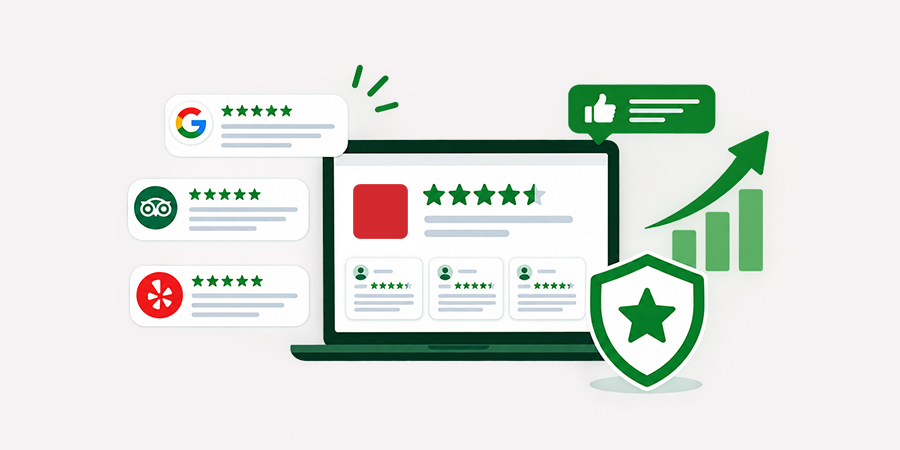
To boost your AEO reputation management strategy plan, you need to build a glowing online review profile. You need to follow a systematic approach to build that glowing profile with a generous number of positive customer reviews. Answer engines like ChatGPT mainly rely on these signals to cite or recommend your business.
How Can You Build a Glowing Review Profile across Online Platforms?
Earning 5-star online reviews from your satisfied customers is not a cakewalk for brands. The following are some crucial steps you must follow to build a positive online review profile.
Step 1: Monitor Reviews across Relevant Platforms
You cannot effectively manage something that you cannot track. Reviews are something that can create a positive AI perception of your brand and help boost your AEO reputation management strategy plan.
For this, you need to track major platforms like Google Business Profiles, TripAdvisor, Yelp, Zillow, Capterra, and the like. Software like Podium and Birdeye can help you aggregate your reviews into a single dashboard.
Additionally, brands can configure real-time notifications for new reviews. So they can easily detect and address urgent customer issues with immediate effect.
Step 2: Encourage Satisfied Customers to Leave Honest Reviews
Your happy customers are more likely to be the quiet ones. You need to nudge them a little to encourage them to share their positive feedback regarding your brand, its products, and services. The review submission process must be as seamless as possible! Follow proper timing, send direct review page links, and display clear QR codes at your store or on receipts to generate more customer reviews.
Step 3: Respond Professionally to Both Positive and Negative Reviews
No matter whether you receive positive or negative reviews, it’s important that you respond to every type of review. Don’t have enough time, or do you lack an in-house team? Or struggling with too many negative or fake reviews? You can consider hiring professional online review removal services from a renowned agency to ensure those harmful reviews are taken down from the internet.
Thank those who share positive feedback, acknowledge negative reviews, apologise sincerely if necessary, and provide suitable solutions. When you include relevant keywords and your business location in your responses, it helps search engines understand your business contextually.
Step 4: Identify Recurring Customer Concerns
While addressing negative reviews, you can identify recurring customer issues and improve those areas for your business growth. Imagine that you have received too many concerns through reviews; you can categorise them into factors like customer service, product quality, shipping delays, and pricing.
A 2024 Moz Study has claimed that only 3% of users risk a transaction with a business that has 1-star or 2-star ratings.
We advise you to fix the root cause, and you can collaborate with the operations team to fix the issue permanently. This way, you can turn a negative customer experience into an opportunity to regain the customers’ trust – this is a huge factor in a proactive AEO reputation management strategy plan.
Step 5: Avoid Fake, Misleading, and Incentivised Reviews
No matter whether you’re struggling to get reviews from your customers or receiving too many negative reviews, you should never engage in malicious practices like buying fake reviews or incentivising your customers in exchange for online reviews.
Element 3: High-Quality & Answer-Focused Content
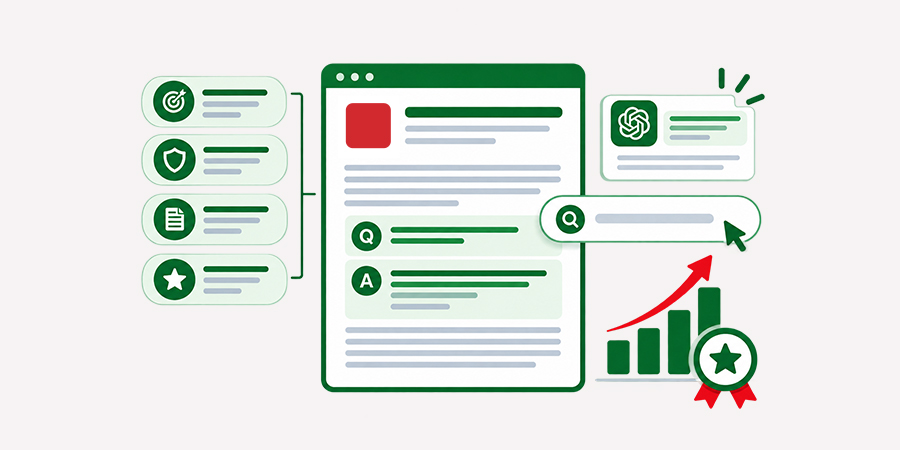
In today’s modern AI landscape, stuffing unnecessary keywords into your content is completely obsolete. AI-driven search engines, voice assistants, and large language models (LLMs) don’t rely on keyword density to cite content in their recommendations. They look for direct and reliable answers to respond to specific user queries.
Thus, you must create high-quality, answer-focused content and position it as the definitive source of truth for your niche industry.
5 Tips to Create Authoritative, Answer-Focused Content
Here we have provided you with a list of five essential tips to create authoritative and answer-focused content for your brand.
Tip 1: Create Content that Directly Answers Customers’ Questions
Answer engines prioritise content that helps a user find the answers to their questions. To create answer-focused content, you need to identify exact pain points, objections, and questions that your potential and existing customers can ask.
You should go beyond the basic FAQs and address unique inquiries regarding your brand, products, and industry standards. It will allow you to prevent competitors and third-party forums from controlling your brand narrative.
Tip 2: Target Conversational and Long-tail Queries
For a successful AEO reputation management strategy, you must prioritise high-authority content as a significant element. You need to shift your content strategy from relevant short-form keywords to long-tail and conversational keywords. This strategy helps you to appear in the search results or recommendations of voice assistants.
For this, you can phrase your headers as full questions and answer them in the body content using a professional and conversational tone.
Tip 3: Provide Concise Answers with Supporting Details
Answer engines like ChatGPT and Google Gemini often find ‘bite-sized’ summaries to display the content in featured snippets or voice responses. It also provides deeper context for users who want to read it further. You can structure your content to deliver a direct sentence answer below the question header by providing supporting details, expert quotes, case studies, and data points.
Tip 4: Use a Proper Content Structure – Clear Headers, Bullet Points, and Tables
In an AEO reputation management strategy plan, content structure plays a major role. As answer engines crawl and parse structured data more efficiently than blocks of unbroken text, you need to use a logical hierarchy of headers like H2, H3, or H4 to perfectly organise your thoughts.
- You can break down complex processes into numbered steps and bullet points.
- Use clear tables when you’re comparing items or displaying data within your context.
These two techniques make your content highly readable for both answer engine crawlers and human users. It also increases your chances of being cited or recommended as a top answer for answer engine queries.
Tip 5: Develop Your Content around the Following –
Now we will talk about the types of answer-focused content you must develop to be cited in answer engine recommendations.
| Answer-Focused Content Type | How Can You Use It? |
| FAQs | This Q&A format content helps you match exact user questions with immediate and direct answers, helping answer engine crawlers easily find the solutions to user queries. |
| How-to Questions | This step-by-step outline solves specific problems. You can use numbered lists for chronological steps to ensure each step starts with an imperative verb. |
| Comparisons | For this, you need to create a clear and step-by-step evaluation of products, services, and concepts. You can use tables to compare prices, pros/cons, and features so that answer engines can easily extract the comparison data. |
| Product/Service Questions | Such questions help you address specific user inquiries related to integrations, pricing, functionality, and compatibility. |
| Troubleshooting Queries | You can provide clear and diagnostic solutions to address common errors or product issues. Always break down the problem, the potential cause of the issue, and the exact steps needed to resolve it. |
| Industry-specific Questions | Answering such questions helps you establish the authority of your brand across answer engines. You must use precise terminology while explaining complex, niche topics, specific regulations, definitions, or trends. |
A Pro Tip! Don’t know how to strategically plan such content? You can partner with a reliable ORM agency to seek their personalised AEO reputation management services.
Element 4: Trustworthy Online Mentions & Brand Citations
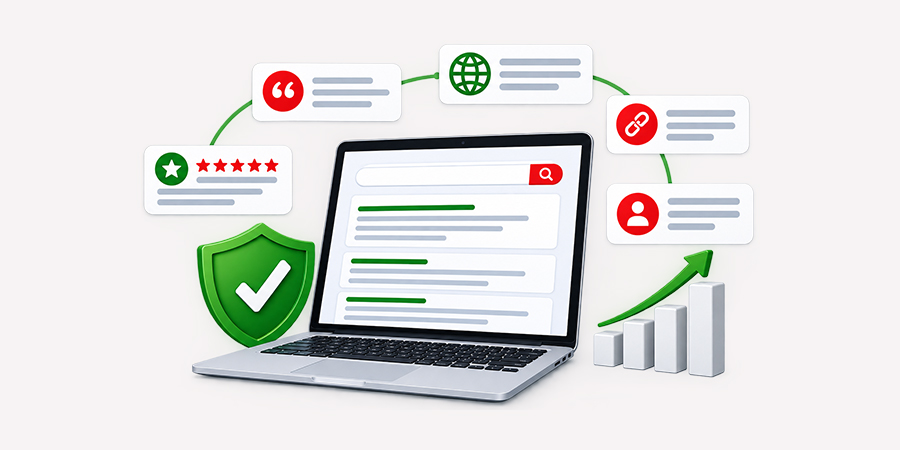
To earn reliable mentions from high-authority sources and brand citations, you need to boost your AEO reputation management strategy plan.
As a major part of answer engine optimisation, you need to build authority through validation from external and high-quality sources. Answer engines like AI-driven search platforms majorly prioritise your brand if your brand is frequently and accurately referenced across the web.
How Can You Earn Reliable Online Mentions and Brand Citations?
Now we will talk about how brands can strategically earn reliable mentions and brand citations.
Step 1: Focus on Quality and Relevance of the Source
Answer engine models don’t treat every mention equally. Firstly, they mostly prioritise the authority and context of the referencing site. You must seek citations from established industry publications, academic organisations, and recognised trade associations.
Even a single mention from a top-tier industry site carries more weight than other low-quality directories. You need to ensure that the surrounding text is highly relevant to your niche expertise. Additionally, you need to ensure your brand is mentioned within an expert discussion or comprehensive guide about your specific niche.
Step 2: Leverage Digital PR to Generate Meaningful Brand Coverage
Active outreach helps your brand secure organic and authoritative editorial links and brand mentions. To leverage digital PR, you need to conduct data-driven studies, surveys, and industry reports with a strategic approach. You can collaborate with media outlets and popular bloggers so that they frequently cite the original data sources.
A strategic and smart approach to digital PR can help you automatically earn high-value brand citations.
Step 3: Ensure the Accuracy and Consistency of the Third-Party Information
Accuracy and consistency play a crucial role in an AEO reputation management strategy plan. If you have conflicting data across the internet, it can confuse answer engine algorithms.
If different sites list various details regarding your brand, answer engines like ChatGPT and Google Gemini may perceive your information as unreliable. What you can do is maintain strict NAP details, including your name, address, phone number, and website URL and keep them identical across all platforms.
If a third-party site misspells your brand name/your name/links to an outdated landing page/shows incorrect product information, you must contact the site editor to request a correction.
Step 4: Build Professional Connections with –
To earn valuable mentions, you need to build professional connections with prominent organisations and professionals. Professional AI reputation management services include building interpersonal connections with the following organisations and professionals:
- Industry Publishers: You need to target trade magazines and niche authorities to build top-level B2B credibility.
- Relevant Bloggers: Businesses must partner with authoritative content creators, social media influencers, and bloggers who can help you directly communicate with your target audience.
- Journalists & Reporters: You must provide data insights or expert commentary to journalists and reporters so that they can cover your story in their publication.
- Local Publishers: We also suggest that you connect with community news outlets and local directories to enhance your regional presence.
- Professional Organisations: Earn opportunities to engage with industry associations and chambers of commerce for trusted, official citations.
Element 5: A Strong Brand Authority & Expertise

Do you know that authoritative content is the backbone of your AEO reputation management strategy?
Yes, you’ve heard that right! When you publish authoritative content online, it ensures answer engines trust your brand enough to cite your content in their direct answer.
5 Tips to Establish a Strong Brand Authority
Now the question comes: how can you build a strong brand authority and expertise? Here is a list of 5 best tips that you can follow.
Tip 1: Publish Original Insights, Research, and Guides
Brands can publish case studies on their websites along with data insights, research, and guides. The case studies that they should consider publishing must outline specific problems, strategic approach, and data-backed results.
Tip 2: Showcase Subject-Matter Expertise through Author Profiles
You can feature your client testimonials and reviews on your website. We suggest that you create a dedicated page to promote your glowing testimonials and customer feedback. These reviews will serve as social proof as well as demonstrate your subject matter expertise.
Tip 3: Support Claims with Credible Sources and Evidence
Nothing works without supporting claims, especially as an AEO reputation management strategy! Through your content, you must highlight industry awards, certifications, and media mentions to showcase that third-party websites, organisations, and online users have endorsed your brand.
Tip 4: Keep Your Content Updated
Never ever publish outdated content regarding your brand, or keep outdated content as it is across the internet. You can strategically promote user-generated content and ratings to show active engagement and customer satisfaction.
Tip 5: Create Authoritative Content Such As –
You can create authoritative content, including the following:
- Expert-led Articles: You can collaborate with in-house or external specialists to create deep-dive pieces on complex industry topics.
- Original Research: We suggest that brands can conduct proprietary surveys or data analysis to identify new trends that others in your industry will cite.
- Industry Reports: You can aggregate yearly or quarterly data into comprehensive guides that benchmark your niche industry’s performance.
- Case Studies: Brands can share detailed and real-world examples (case studies) of how your product or services can solve a specific problem with measurable data.
- Expert Interviews: You can organise Q&A sessions with recognisable industry leaders. This way, you can attract their audience and showcase your expertise as well.
- Thought Leadership: Publishing forward-thinking opinion pieces can help brands challenge standard industry norms or predict future trends.
- Educational Resources: You can also create comprehensive tutorials, whitepapers, and glossaries that you can simplify difficult concepts so that your target audience, as well as answer engine crawlers, can easily understand them.
- Expert Commentary: Last but not least, brands can add valuable and rapid-response insights to breaking industry news or trending discussions.
Element 6: Effective AI Search Result Management

The 6th element you must prioritise while making an AEO reputation management strategy plan is effective AI search result management. Just as you can manage your traditional search engine results, you can strategically manage your brand’s AI search results.
How to Strategically Manage Your AI Search Results?
Here we will explore how you can manage AI search results regarding your brand, its products/services, and other factors.
Step 1: Track Questions Your Customers May Ask
Answer engine crawlers prioritise answering direct user prompts, as this helps them to cite their answers easily. If your brand doesn’t explicitly answer your customers’ questions online, answer engines like ChatGPT and others are more likely to source the answers from your competitors or third-party sites.
Then, what can you do? You can collect recurring questions from your customer support tickets, CRM data, and sales team logs. You can also research informational search queries by employing certain tools.
Step 2: Monitor Your Brand Mentions across the Following Platforms –
- Search Engines: You must track your brand’s ranking for featured snippets, knowledge panels, and core industry keywords.
- Social Media Platforms: You can track direct tags, untagged brand conversations, and hashtags on digital platforms like Reddit, LinkedIn, and X.
- Review Websites: Brands must track review profiles on major review aggregators like G2, Trustpilot, G2, and Google Business Profile.
- Digital Forums: Meaningful discussions inside niche communities, developer hubs, and platforms like Reddit and Quora must be tracked by brands to identify positive and negative brand mentions.
- Relevant Third-Party Sources: You can also track industry publications, Wikipedia pages, analytical market reports, and popular news outlets to identify positive and negative media coverage.
Step 3: Monitor The Following Answers in AI Search Results –
As part of an AEO reputation management strategy plan, you may need to monitor a bulk of AI-generated answers. Below, we have mentioned some significant answers you must monitor in AI search results.
- Brand-Related Questions – “Who founded [your brand]?”, “Is [your brand] sustainable?”, or “What is [your brand]’s mission statement?”
- Product/Service Queries – “How does [one of your product names] work?”, “What are the specifications of [a specific product you offer]?”, or “Does [one of your services] include maintenance?”
- “Best” and “Top” Category Queries – “What is the best CRM software for small businesses?” or “Top-rated sports shoes in 2026.”
- Comparison Queries – “[your brand] vs [your competitor]” or “Is [one of your product A] better than [product B]?”
- Local Queries – “Where can I buy [a product name] near me?” or “Best [your product name] in [your service area] open now.”
- Customer Experience Questions – “How do I return an item to [your brand]?”, “Is [your brand name] customer service good?”, or “[your brand name] scams and complaints.”
- Industry-specific Questions – “How do you calculate ROI in [your niche industry]?” or “What are the new compliance laws for [your niche industry]?”
Step 4: Check Whether Your AI Answers Contain –
Now we will talk about what you need to check in the AI-generated answers to user queries. To boost your AEO reputation management strategy plan, you must check whether AI answers contain the following content.
- Accurate Brand Information – Whether AI search engines are correctly stating your company name, leadership, primary offerings, headquarters, and operational compliance standards.
- Outdated Information – Whether there is any existence of outdated information across AI answers, such as old pricing, discontinued services, superseded compliance standards, and former executives.
- Incorrect Claims – Whether there is any presence of AI hallucinations, like completely fabricated details regarding your products or services.
- Missing Context – Whether the AI-generated answers are technically true but misleading.
- Competitor Comparisons – How are the answer engines positioning your brand along with your market competitors? Whether they’re showcasing your USPs or compliance advantages?
- Positive or Negative Sentiment – Whether the overall tone of the AI-generated response is objective, enthusiastic, and subtly critical.
Element 7: Outcome Measurement & Continuous Optimisation

Last but not least, you need to strategically measure the outcome and continuously optimise your AEO reputation management strategy plan based on your measurement data.
How to Measure Your AEO Reputation Management Success?
Below, we have mentioned a step-by-step process for how you can measure your AEO reputation management or AI reputation management success.
Step 1: Establish Measurable KPIs & Track the Following –
Firstly, you need to establish measurable key performance indicators (KPIs). The following are KPIs you must prioritise tracking.
- The frequency and context of your brand mentions across authoritative industry blogs, news sites, and forums
- The total number of user reviews and the ratio of positive to negative sentiment across Google Business Profile, Trustpilot, G2, and Capterra
- Branded search visibility and answer-engine visibility, like how often your brand appears in traditional search snippets
- The percentage of times your brand has been cited or recommended by an answer engine for a query related to your industry or product
- Referral traffic and engagement, such as the volume of users who’re clicking your website link directly from answer engines and how they behave once they arrive at your website
- The percentage of answer engine-referred visitors who complete a desired action like signing up for a newsletter, making a purchase, or downloading a resource
- The consistency of your core entity data, such as your business’s NAP details (your brand name, address, and phone number) along with your executive names, business hours, and core services
Step 2: Compare Strategy Performance over Time
You must track historical data appearing in AI search results related to your business to understand if your AEO reputation management is working or not. As answer engines are continuously updating their models, your brand visibility is also changing every day.
You can record your initial brand citation share, AI platform visibility, and sentiment metrics before you launch your AEO reputation management campaign. Additionally, you can monitor your brand’s emotional tone.
Step 3: Identify Reputation Gaps & Content Opportunities
Answer engines are more likely to recommend your business only if they have the data to support it. You can identify the reputation gaps to pinpoint exactly where the answer engines lack information or hold outdated perceptions.
You can check what the answer engine results highlight about your market competitors but omit about your brand. You need to find third-party articles, forums, and directories where your business is positively mentioned yet lacks structured data.
Step 4: Use Insights to Refine Content, Reviews, PR, and Brand Messaging
Then, you must use insights you collect after measuring the KPIs and tracking your AEO reputation management strategy plan’s performance. You can also perform a gap analysis to optimise your brand presence online.
You can reformat your website content and implement clear Q&A formats, robust schema markup, and bulleted summaries. Additionally, you can also align your PR strategies with trust signals
Conclusion
Building an AEO reputation management strategy may seem like a cakewalk. But it’s not! It requires you to follow a strategic approach and implement some key elements to ensure the success of your strategy plan.
We hope that the 7 key elements we have mentioned in this blog will help you boost your AI reputation management efforts.
If you’re still confused about what to implement and what not ot, you can consider hiring a renowned online reputation management agency to seek their expert guidance.
FAQs
Here are some frequently asked questions and answers related to AEO reputation management elements.
Q. 1 How do AI-generated answers affect my brand’s online reputation?
Ans. AI-generated answers affect your brand’s online reputation by replacing traditional blue-link lists from search engines like Google with direct summaries generated by AI-powered platforms and answer engines like ChatGPT, Google Gemini, and Perplexity. This means that these AI-driven platforms shape public perception about your brand even before a user visits your website.
Q. 2 How often should businesses monitor their AEO reputation?
Ans. To ensure the success of an AEO reputation management strategy, businesses should monitor their AEO or AI reputation weekly or monthly. However, it completely depends on their growth stage and industry risks. This is because AI search results and algorithms can shift brand sentiment and visibility within 48 hours.
Q.3 How long does it take to see results from an AEO reputation management strategy plan?
Ans. It typically takes 2-4 weeks to see technical signals and quick-win brand mentions from an answer engine optimisation reputation management strategy plan. On the other hand, you can witness full multi-engine visibility within 3-6 months after implementing effective AEO reputation management strategies.
Q. 4 How does AEO reputation management differ from traditional online reputation management?
Ans. AEO reputation management strictly prioritises how AI-driven platforms and answer engines like ChatGPT, Google Gemini, and Perplexity synthesise, cite, and recommend your brand. On the other hand, traditional online reputation management focuses on managing visible links, reviews, and other search results that appear on search engine results pages (SERPs) of Google, Bing, or Yahoo.
Q. 5 How can businesses create a long-term AEO reputation management plan?
Ans. Businesses can create a long-term, successful AEO reputation management plan by building direct and answer-focused brand content. They also need to centralise accurate brand facts and continuously track how AI search engines cite or recommend their brand.

