





What people think about you or your brand can change faster than you blink – this is the harsh reality of today’s competitive digital scenario. You can no longer rely on traditional search engine results to identify public perception or your customer sentiment. 37% of consumers start their online search using AI tools such as ChatGPT, Gemini, or Perplexity rather than Google. How you or your brand appears in the AI search summaries plays a huge role in determining your online reputation. Here’s where AI reputation management strategies come into play!
You don’t need an enterprise budget to implement this specialised strategy plan and protect your digital footprint from AI algorithmic risks. Let’s explore our DIY guide, where we’ve broken down the top 10 strategies to dominate the generative search landscape with a stellar online reputation
What Are AI Reputation Management Strategies?
It refers to technical and content-focused tactics used to build, protect, repair, manage, monitor, and optimise what AI tools like ChatGPT, Google Gemini, and Perplexity say about you or your brand when someone searches for you.
As we refer to these AI platforms or tools as answer engines or generative engines, you can consider these strategies as some answer engine optimisation (AEO) or generative engine optimisation (GEO) techniques to build a robust reputation for you or your brand across AI platforms.
Wondering how it differs from traditional SEO reputation management?
Unlike SEO reputation management, AEO or GEO doesn’t solely focus on ranking your content or websites in Google and other traditional search engines’ results, but on building a reputation across the search engine landscape.
On the other hand, AI reputation management allows you to influence the data pools, live-scraping sources, and training weights that large language models (LLMs) use to generate instant textual answer summaries for user queries.
Why You Must Prioritise Effective AI Reputation Management Strategies
Now you must be thinking about why you must invest in effective AI reputation management strategies. From helping you to position your content across AI search summaries to shaping your mobility as an executive, AI reputation management provides an extensive list of benefits.
Here are some reasons why you must consider investing in an artificial intelligence reputation management strategy.
1. AI Search is Gradually Replacing Search Engine Links
A majority of searchers use AI query platforms like ChatGPT, Google Gemini, and Perplexity to get direct recommendations instead of browsing an extensive list of links and finding the right information.
As more people are turning to AI search rather than solely relying on Google results, it is gradually replacing traditional search engine results. How you or your brand appears on AI search results is what sets your virtual first impression. No matter whether you’re an individual or a brand owner, you must invest in effective AI reputation management strategies.
2. Large Language Models (LLMs) Aggregate Misinformation
Do you know that AI tools are capable of understanding human languages by processing a vast amount of text data? Yes, you’ve heard that right.
AI tools leverage large language models that constantly scrape web archives, which means the internal systems can identify outdated forum complaints, negative customer reviews, and old legal records. They also present such details in their search result summaries as relevant and current facts when someone actively searches for them.
3. AI Models Control B2B Buyer Shortlists
Corporate buyers and institutional investors are more likely to use AI prompts to analyse vendor vulnerabilities. This means an unmanaged or flawed AI sentiment profile can eliminate your personal or brand presence from consideration before you even pitch for a sale.
4. Traditional SEO Takedowns Don’t Clean AI Memory
Suppressing negative links from SERPs is not enough to stop AI tools from scraping the data. Deep-rooted machine learning training weights require you to have specialised Generative Engine Optimisation (GEO) expertise to adjust the model references.
5. AI Shapes Executive and Career Mobility
Executive recruiters, corporate boards, and venture capitalists tend to routinely run automated sentiment checks on leadership figures. This means an unmanaged personal AI profile of executives can create unseen hurdles for executives for their career growth. In a true sense, a stellar AI reputation shapes your mobility and boosts your career opportunities as an executive.
10 DIY AI Reputation Management Strategies for Your Personal and Brand Image
Yes, we know that building a robust AI reputation requires you to have relevant expertise and skills. If you have budget constraints to invest in professional AI reputation management services but have an expert in-house, you can consider following a DIY approach.
Here is a comprehensive DIY guide where we have discussed the top 10 AI reputation management strategies for individuals and businesses.
Strategy 1: Audit Your Existing Online Reputation
Firstly, your primary responsibility is to perform a comprehensive and objective audit of your existing online reputation and digital footprint. Before you start reshaping what AI platforms say about you or your brand, you must map out the data currently available for large language models (LLMs) to scrape, aggregate, and analyse.
Professional reputation monitoring services can help you proactively monitor your current online image and public perception across AI platforms.
- Search for Your Brand/Company/Executives/Products/Key Services
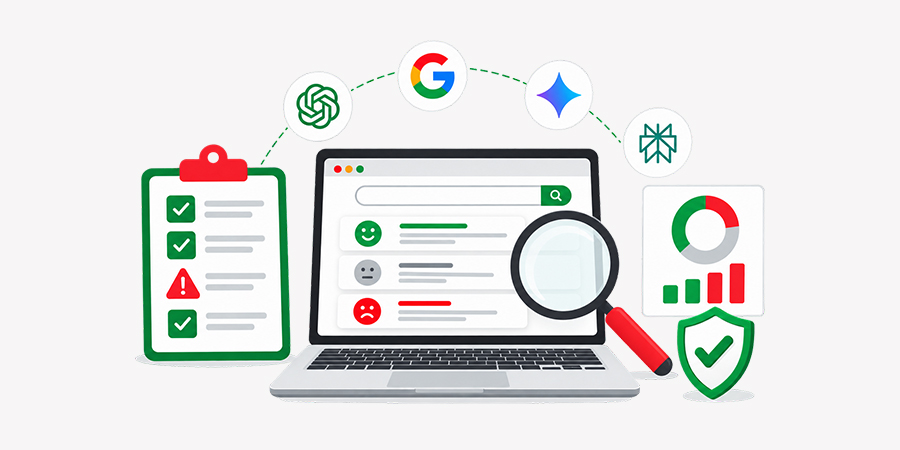
You can start by collecting the search data across generative AI platforms, such as ChatGPT, Google Gemini, and Perplexity. Knowing where your personal or brand reputation stands is crucial to AI reputation management strategies. For this, you need to follow these four steps:
Step 1: Open your browser in incognito mode, as it will prevent your personal search history from affecting your search results.
Step 2: Search for your full name, your organisation/company name, high-profile executives at your company, specific product lines, and the core services you provide.
Step 3: From the specific source URLs and exact text or sentiment generated by the AI platforms to the severity of the threats and the date you observed them, you must document everything on a spreadsheet.
Step 4: You can also group your logged data into actionable categories, including “Review Mitigation”, “SEO Suppression Required”, “Fact Correction”, or “Immediate Legal Takedowns”.
Pro Tip for You! You need to go beyond your standard search listings if you want to achieve the highest potential of your AI reputation management strategies. Use direct prompts to get the exact AI search result summaries.
Example AI Queries You Can Consider
i) Who is (your name)?
ii) What does (your brand name) do?
iii) What is the market reputation of (your company name)?
iv) Are there any controversies, complaints, or negative customer feedback regarding (one of your executive names)?
v) What do customers say about (your product name) online?
vi) What are customers saying about (your name/your brand name)?
vii) What are the strengths and weaknesses of (your brand name)?
What to Check across the AI Platforms?
Checking what is appearing on AI search results is one of the major AI reputation management strategies. When you’re reviewing the generative search results, you must look for specific vulnerabilities that can poison AI memory pools.
| Types of Content You Must Check | What to Check? |
| Negative Content | Biased blog entries, damaging news profiles, critical forum discussions |
| Outdated Information | Former corporate addresses, old job titles, and discontinued products |
| Incorrect Fact | Wrong founding dates, misattributed quotes, and misstated professional credentials |
| Duplicate Profiles | Multiple unmanaged social or professional accounts |
| Unclaimed Listings | Local map markets, business directories, and review panels that you do not actively control |
| Negative Reviews | Unaddressed 1-star ratings and defamatory consumer feedback on third-party portals |
| Misleading Third-Party Content | Unauthorised biographies with skewed narratives and competitor comparison pages |
Tip to Follow: If you identify too much negative content across AI platforms about you or your company, you can implement effective search suppression strategies from AI results.
Strategy 2: Identify How AI Platforms Represent Your Brand
Different AI platforms rely on distinct data structures, scraping schedules, and machine learning models. So, you cannot just examine one single AI platform. As one of the most effective AI reputation management strategies, individuals and brands need to successfully manage digital footprints and identify how different platforms represent you or your brand in their search result summaries.
- Compare AI Summaries across Platforms
You can provide exact prompts across multiple generative AI search engines, such as ChatGPT, Claude, Perplexity, and Google Gemini. This practice allows you to compare these AI summaries and get an overall idea.
- Identify Recurring Inaccuracies/Negative Narratives
You need to analyse the text generated by the different AI platforms. This will allow you to find the repetitive errors, persistent biases, and overlapping themes. If you see that multiple AI platforms are referencing the same false milestone, bad review, or other negative content, it means that a single high-authority website is poisoning your entire data stream.
You can pinpoint the main URL to get an idea of exactly where you can target your upcoming search suppression or removal effort.
Strategy 3: Build a Strong and Consistent Brand Identity
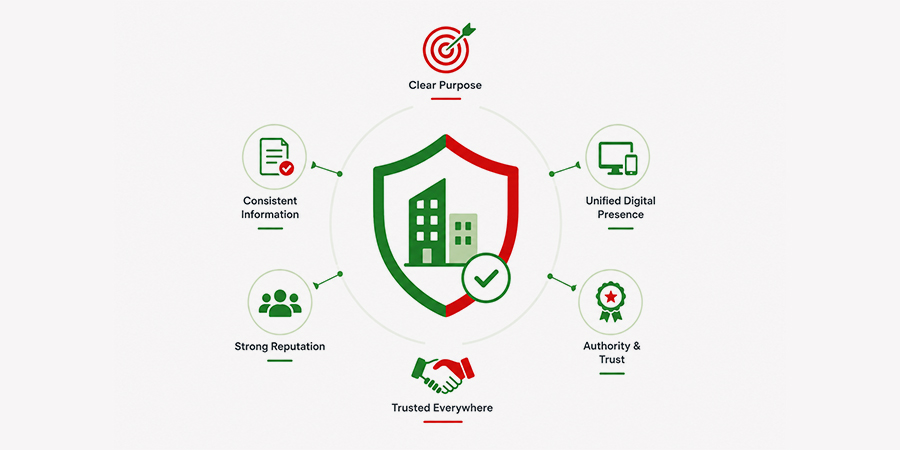
AI algorithms tend to look for consensus across the web. If your search result data is fragmented, thin, and contradictory, large language models are more likely to fill the gaps by using unreliable third-party forum threads or outdated blogs.
Building a strong brand identity across all the digital platforms is one of the most effective AI reputation management strategies.
3 Tips to Follow to Establish a Strong and Consistent Brand Identity
- You must ensure that your full name, company name, history, and core mission statement are accurately identical across all the major AI platforms.
- Always update your digital storefronts, such as your website, LinkedIn, and social media platforms, with consistent details, such as dates, achievements, and technical terms.
- As one of the most proactive AI reputation management strategies, we suggest that you must prioritise publishing a crystal-clear, authoritative, and factual narrative across your owned digital properties.
Strategy 4: Revamp Your Website
Your official website is the ultimate and most impactful digital storefront for your brand or your practice. A majority of AI search engines consider your website as the ultimate ‘source of truth’. AI crawlers treat your website domain as the primary blueprint for your individual expertise or your brand presence.

Thus, you must revamp your website with verified facts, data, and credentials.
- Provide Clear and Reliable Information
Your website data and content must be factual, unambiguous, and easy to understand for machine-learning algorithms. When you talk about your journey, achievements, and core offerings throughout your website, it leaves no room for algorithmic misinterpretation.
- Create Useful Pages Addressing Common Customer Questions
A majority of people use AI platforms because of their capability of directly answering questions. Thus, you must create dedicated pages to separately answer common customer queries through different pages. This will increase the likelihood of conversational engines extracting answers from your website.
What to Publish on Your Website?
You can consider creating and publishing this content on your website to allow AI crawlers to easily understand your content when implementing AI reputation management strategies.
| Types of Content to Publish | What to Write? |
| About Us Page | Detailed corporate history, mission statements, and verified founding dates |
| Service Page | In-depth breakdowns of your core capabilities and your brand’s industry experience |
| Product Information | Exact specifications, model numbers, and usage guides of your products. |
| FAQs | Direct question-and-answer formats that mirror conversational search prompts |
| Author Bios | Rich executive profiles to highlight the credentials, education, and achievements of your team leaders and prominent team members |
| Case Studies | Real-world examples of customer success that serve as proof points for your brand’s efficacy |
| Customer Resources | Helpful downloadable guides, glossaries, and troubleshooting manuals |
| Company News | Press releases, expansion announcements, and official corporate milestones |
Top 4 Tips to Follow –
Tip 1: You need to regularly refresh your website content, such as new leadership details, address updates, and structural corporate moves.
Tip 2: You can instruct your content marketing team to establish experience, expertise, authoritativeness, and trustworthiness (E-E-A-T) through your website content. They can showcase your certifications, awards, and industry badges to demonstrate your industry authority. Your AI reputation management strategies will be incomplete without high-authority content creation.
Tip 3: Always use clear internal linking throughout your website content and organise your site using a clean hierarchy and a direct linking structure. This will make it effortless for AI platforms to crawl and map out your content.
Tip 4: You should never publish thin, repetitive, and misleading content, as such low-quality, keyword-stuffed content can trigger algorithm flags and lower your domain credibility.
Strategy 5: Create High-Quality, Authoritative Content
Till now, we have been talking about how you can effectively structure your website so that AI platforms can easily extract details from it and showcase them in their summaries. They constantly read and analyse your content that is comprehensive, accurate, and original.
When you publish high-authority content across the web, it helps large language models as a trusted resource in the niche market. Creating and optimising high-authority content for AEO is one of the most effective AI reputation management strategies.

Always remember: AI platforms will definitely prefer your informative content more than online forum rumours or low-tier blogs.
| Types of Content to Prioritise | What to Publish? |
| Expert Guides | In-depth and comprehensive resources to explain complex industry topics |
| Industry Reports | Surveys and niche industry reports that other websites link to |
| Original Research | White papers and data-backed studies |
| Case Studies | Real-world breakdowns that outline a specific customer problem, your step-by-step resolution, and measurable data points |
| Interviews | Q&A sessions with internal executives or outside industry leaders |
| Frequently Asked Questions | Clear, structured question-and-answer pairs to match the exact conversational phrases and long-tail semantic queries users type into AI search engines |
| Through-leadership Articles | Opinion pieces, forward-looking trend analysis, and strategic insights to prove your unique experience within your market niche |
| Product Explainers | Crystal-clear descriptions, assembly workflows, and specific troubleshooting frameworks |
| Customer Education Resources | Downloadable glossaries, workflow checklists, and instructional materials |
Strategy 6: Earn Mentions From Trusted Third-Party Sources
Apart from your website, AI platforms strictly look for consensus across the web to build their summaries. Thus, you must earn high-authority backlinks from top websites. By implementing AI reputation management strategies, you can create a network of positive reference points that provide large language models with credible sources that those AI platforms may need to validate and cite your achievements.

8 Best Sources Where You Should Earn Mentions
- Industry Publications: Individuals need to secure features in their niche journals and trade magazines.
- Relevant News Websites: You can also try to build high-credibility citation links in press coverage on reputable news platforms.
- Professional Associations: You can try to get your name or your brand name listed on official trade boards, chamber of commerce sites, or guild rosters to establish yourself as a verified corporate network.
- Expert Interviews: You can participate in text-based professional Q&A sessions to allow AI models to map your name directly to industry solutions amd specialised keywords.
- Podcasts: You can partner with podcast hosts to appear on their podcast shows, especially those that publish detailed text summaries and episode transcripts online.
- Conferences: We suggest that individuals and businesses can secure lots on official event rosters, speaker listings, and panel agendas.
- Guest Contributions: You can ask your content writers to create authoritative op-eds or technical articles for external blogs to ethically build contextual links.
- Reputable Business Directories: You should also claim listings on major high-authority business platforms to confirm your basic corporate facts, operational metrics, and identity metrics for AI platforms, as it’s one of the most beneficial AI reputation management strategies.
What to Avoid?
- Spammy backlinks
- Paid fake reviews
- Low-quality publishing networks
Strategy 7: Manage Reviews and Customer Sentiment
Effectively managing online customer reviews is one of the most effective AI reputation management strategies. Because AI search engines actively crawl and scrape major customer feedback platforms to calculate your brand’s overall sentiment score.
So how does it work?
Imagine someone asks an LLM if a specific business or professional is reliable or not. When you have a glowing review profile with a bunch of genuine 5-star reviews, the AI model scans aggregate star ratings and text reviews to formulate its textual answers.
Here’s how you can effectively manage your customer reviews to build and manage a robust AI reputation.
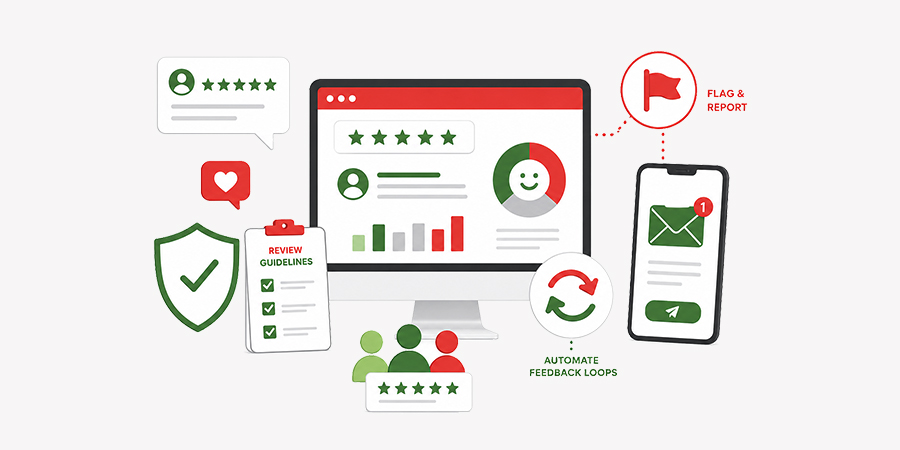
- Flag and Report Violations: You can systematically examine your review platforms like Google, Yelp, or Trustpilot to identify and report fake, defamatory, and competitor-manipulated customer feedback, especially those that have violated the platform guidelines.
- Automate Authentic Feedback Loops: We suggest that you implement automated post-purchase email or SMS funnels to capture major customer concerns. This automated follow-up process allows you to encourage your satisfied clients to share genuine 5-star feedback on your preferred review platforms.
- Respond to All Feedback Professionally: Just like review generation, responding to every type of review is quite crucial to build a robust reputation across the AI platforms. You need to write calm and solution-oriented responses to the reviews, no matter whether they’re positive or negative. Don’t forget to use clear semantic keywords in your response to make it rank for relevant AI search queries.
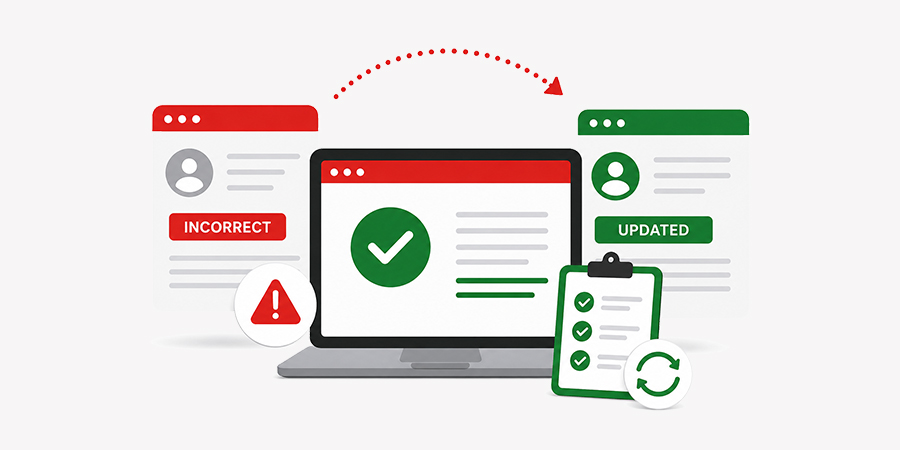
Strategy 8: Update Inaccurate or Harmful Information
Yes, there can be inaccurate or damaging information across AI platforms. If multiple AI platforms are confidently stating incorrect facts about your journey as a professional or highlighting old controversy, it means those AI systems are continuously scraping a high-authority root source or website that contains stale or malicious data.
- You can issue direct webmaster correction requests to contact blog owners, digital editors, and forum moderators that are hosting the inaccurate information.
- One of the most proactive AI reputation management strategies is using de-indexing techniques to send policy-backed negative content removal requests to completely take down harmful posts, fake profiles, and sensitive personal data leaks.
- You can directly edit or update your professional data on open-source directories, corporate listings, and Crunchbase profiles.
Strategy 9: Build a Continuous AI Reputation Monitoring System
As AI models are not static, they keep updating their training weights and refresh their live web-scraping indexes.
If you’re thinking that putting effort into AI reputation management strategies is a one-time investment, you’re making a big mistake. A positive AI narrative established today can be easily disrupted tomorrow by just an unaddressed negative news article or a few bad customer reviews.
Thus, it’s crucial to regularly monitor your AI reputation.
- Establish a Weekly/Monthly AI Monitoring Routine
You can set a recurring slot in your calendar to audit your digital footprint across both traditional search engines like Google and conversational search engines like ChatGPT and Google Gemini. You must regularly test to identify negative data shifts and prompt changes on a weekly and monthly basis.

You Must Track These Factors:
- Search Results: Changes on Google’s first page for your name, corporate brand name, and specific executive profiles
- AI-generated Brand Descriptions: Real-time summaries generated by major AI platforms like ChatGPT, Google Gemini, Claude, and Perplexity when someone asks about your professional background or reliability
- News Mentions: Blog, news articles, blogs, or industry columns mentioning your brand
- Reviews: Live aggregate scores and customer comment feeds on business-critical portals like G2, Glassdoor, Yelp, and Trustpilot
- Social Media Discussions: Trending conversations, public complaints, and viral threads across LinkedIn, Reddit, and X
- New Third-Party Profiles: Unauthorised biographies, competitor comparison, and scraper-site directories that are using your brand name
- Brand Sentiment: The overall emotional tone or sentiment of your professional identity or brand presence – positive, neutral, or negative
- Incorrect Information: Algorithmic errors, stale data, and misattributed quotes related to your brand location, leadership, and products/services
Strategy 10: Measure AI Search Results and Continuously Improve
Last but not least, measuring the success of your AI reputation management strategies is crucial to consistently improve your AI search results.
You need to track specific, quantifiable metrics to see exactly which online assets are successfully influencing the AI platforms to show the best possible results for user queries to you or your brand.
KPIs to Track:
- Accuracy of AI-generated Brand Information: The exact percentage of conversational search answers regarding your corporate history, executive details, and founding dates
- Positive vs. Negative Mentions: The overall ratio of favourable articles, reviews, and mentions
- Search Visibility: The frequency with which your official website or owned social properties are appearing across AI search result summaries
- Branded Search Results: Total control over search strings containing your brand variations
- Review Ratings and Sentiment: Changes in your aggregate star ratings and the specific technical keywords customers use when they’re leaving reviews about your service online
- Number and Quality of Authoritative Mentions: The volume of features and citation links you have secured from trusted and high-authority domains
- Website Engagement: Internal user data, click-through rates, and session durations on your core informational assets of your website
Top 5 AI Reputation Management Mistakes You Must Avoid
When you’re implementing AI reputation management strategies, you must avoid making certain mistakes, as they can ruin your AI reputation management efforts.
Here, we have talked about the 5 most common mistakes you must avoid while building and managing your personal or brand reputation on AI platforms. Identifying these mistakes can help you avoid them.
Mistake 1: Manipulating AI-generated Answers Directly
If you are engaging in malicious practices to manipulate AI-generated search result summaries, you’re making a huge mistake. You should never attempt to trick or hack conversational AI prompts via artificial injection patterns. Such attempts are more likely to fail because LLMs evaluate overall context. Additionally, the manipulative text can trigger automated filters and flag your personal or brand presence as unreliable across the AI landscape.
Mistake 2: Creating Fake Positive Reviews
Many times, individuals and brands try to generate fake positive reviews on third-party portals. They mostly aim to influence AI scrapers. However, this practice can backfire on you when advanced pattern-recognition algorithms of AI tools flag suspicious activity. In severe cases, it can cause permanent suspension of your account and devastate your public credibility.
A Pro Tip for You! If you’re struggling with online fake reviews when you’re not the one to generate them, you can consider hiring professional review removal services to take down those reviews from the web and protect your online reputation.
Mistake 3: Publishing Large Amounts of Poor AI-generated Content
If you consistently publish poor-quality AI-generated content on your website, social media profiles, and other platforms, it can destroy your digital trust. Because modern search engines and LLMs are capable of identifying low-value informational noise while preferring informational, highly creative, authoritative content to rank in their summaries.
Publishing poor-quality AI-generated content can ruin your opportunity to achieve the benefits of your AI reputation management strategies.
Mistake 4: Using Fake Profiles or Identities
Are you using fake profiles or showing fake identities across digital channels? If yes, you are making a big mistake! AI tools can easily detect these fake executive profiles or dummy corporate identities, which can lead to destroying your long-term authority. AI knowledge graphs can instantly double-check across open data sources (including Wikipedia) to flag unverified entities. Individuals and businesses can hire tailored social media account removal services if they’re struggling with profile extortions or impersonations.
Mistake 5: Creating Spammy Backlinks or Mentions
Individuals and brand owners often engage in practices like buying cheap automated backlink packages to instantly boost their digital assets. It can trigger harsh algorithmic search engine penalties and even permanently de-index your or your brand’s presence. In worst scenarios, creating spammy backlinks can completely wipe out your digital presence.
When you’re implementing AI reputation management strategies, even a single spammy backlink can ruin all your efforts.
Conclusion
In an era where AI search engines determine public perception about you or your brand, your digital survival depends on what artificial intelligence models say about you or your brand.
Instead of completely relying on traditional search engine results, you must consider optimising your digital presence to build a robust reputation across the AI platforms. It requires you to follow a strategic approach. We hope that our do-it-yourself guide will help you effectively build and manage a stellar AI reputation.
If you lack an expert in-house team, you can prioritise hiring an online reputation management agency to seek their expert guidance on AI reputation management strategies.

